


Updated CIPT Dumps PDF - CIPT Real Valid Brain Dumps With 216 Questions!
100% Free CIPT Exam Dumps Use Real Information Privacy Technologist Dumps
The CIPT certification is an excellent career opportunity for privacy and data protection professionals. It is a valuable credential that can help professionals advance their careers and increase their earning potential. Certified Information Privacy Technologist (CIPT) certification is recognized globally and is highly respected in the privacy and data protection industry. The CIPT certification is an excellent investment in the future for professionals who want to remain competitive in today's dynamic and rapidly evolving technology and privacy landscape.
NEW QUESTION # 24
Which is the most accurate type of biometrics?
- A. Voiceprint.
- B. DNA
- C. Facial recognition.
- D. Fingerprint.
Answer: A
NEW QUESTION # 25
An organization is launching a new smart speaker to the market. The device will have the capability to play music and provide news and weather updates. Which of the following would be a concern from a privacy perspective?
- A. Context aware computing.
- B. Appropriation.
- C. Browser Fingerprinting.
- D. Context of authority.
Answer: A
Explanation:
An organization launching a new smart speaker to the market that has the capability to play music and provide news and weather updates would have concerns about context aware computing rather than browser fingerprinting from a privacy perspective. Context aware computing involves using information about an individual's location or behavior to tailor their experience with technology. This can raise concerns about how personal data is collected and used without individuals' knowledge or consent.
NEW QUESTION # 26
Which Organization for Economic Co-operation and Development (OECD) privacy protection principle encourages an organization to obtain an individual s consent before transferring personal information?
- A. Accountability.
- B. Individual participation.
- C. Purpose specification.
- D. Collection limitation.
Answer: B
Explanation:
The individual participation principle encourages an organization to obtain an individual's consent before transferring personal information1. According to this principle, an individual should have the right to obtain from a data controller confirmation of whether or not the data controller has data relating to him; to have communicated to him such data within a reasonable time; to be given reasons if a request made under subparagraphs (a) and (b) is denied by the data controller; and to challenge such denial; and to challenge data relating to him and, if the challenge is successful, to have the data erased, rectified, completed or amended1. The other options are not principles that encourage an organization to obtain an individual's consent before transferring personal information.
http://www.oecdprivacy.org/
NEW QUESTION # 27
SCENARIO
You have just been hired by Ancillary.com, a seller of accessories for everything under the sun, including waterproof stickers for pool floats and decorative bands and cases for sunglasses. The company sells cell phone cases, e-cigarette cases, wine spouts, hanging air fresheners for homes and automobiles, book ends, kitchen implements, visors and shields for computer screens, passport holders, gardening tools and lawn ornaments, and catalogs full of health and beauty products. The list seems endless. As the CEO likes to say, Ancillary offers, without doubt, the widest assortment of low-price consumer products from a single company anywhere.
Ancillary's operations are similarly diverse. The company originated with a team of sales consultants selling home and beauty products at small parties in the homes of customers, and this base business is still thriving.
However, the company now sells online through retail sites designated for industries and demographics, sites such as "My Cool Ride" for automobile-related products or "Zoomer" for gear aimed toward young adults.
The company organization includes a plethora of divisions, units and outrigger operations, as Ancillary has been built along a decentered model rewarding individual initiative and flexibility, while also acquiring key assets. The retail sites seem to all function differently, and you wonder about their compliance with regulations and industry standards. Providing tech support to these sites is also a challenge, partly due to a variety of logins and authentication protocols.
You have been asked to lead three important new projects at Ancillary:
The first is the personal data management and security component of a multi-faceted initiative to unify the company's culture. For this project, you are considering using a series of third- party servers to provide company data and approved applications to employees.
The second project involves providing point of sales technology for the home sales force, allowing them to move beyond paper checks and manual credit card imprinting.
Finally, you are charged with developing privacy protections for a single web store housing all the company's product lines as well as products from affiliates. This new omnibus site will be known, aptly, as "Under the Sun." The Director of Marketing wants the site not only to sell Ancillary's products, but to link to additional products from other retailers through paid advertisements. You need to brief the executive team of security concerns posed by this approach.
What technology is under consideration in the first project in this scenario?
- A. MAC filtering
- B. Server driven controls.
- C. Data on demand
- D. Cloud computing
Answer: B
NEW QUESTION # 28
What is the best way to protect privacy on a geographic information system (GIS)?
- A. Limiting the data provided to the system.
- B. Scrambling location information.
- C. Using a wireless encryption protocol.
- D. Using a firewall.
Answer: A
NEW QUESTION # 29
What is the most effective first step to take to operationalize Privacy by Design principles in new product development and projects?
- A. Obtain leadership buy-in for a mandatory privacy review and approval process.
- B. Implementing a mandatory privacy review and legal approval process.
- C. Conduct annual Privacy by Design training and refreshers for all impacted personnel.
- D. Set up an online Privacy Impact Assessment tool to facilitate Privacy by Design compliance.
Answer: A
Explanation:
This is the most effective first step to operationalize Privacy by Design principles in new product development and projects. It is important to obtain leadership buy-in for a mandatory privacy review and approval process to ensure that privacy is a priority throughout the organization.
NEW QUESTION # 30
Which of the following most embodies the principle of Data Protection by Default?
- A. A website that has an opt-in form for marketing emails when registering to download a whitepaper.
- B. An electronic teddy bear with built-in voice recognition that only responds to its owner's voice.
- C. An internet forum for victims of domestic violence that allows anonymous posts without registration.
- D. A messaging app for high school students that uses HTTPS to communicate with the server.
Answer: A
Explanation:
Explanation
NEW QUESTION # 31
What can be used to determine the type of data in storage without exposing its contents?
- A. Collection records.
- B. Metadata.
- C. Data mapping.
- D. Server logs.
Answer: B
Explanation:
Explanation/Reference: https://cloud.google.com/storage/docs/gsutil/addlhelp/WorkingWithObjectMetadata
NEW QUESTION # 32
Which of the following CANNOT be effectively determined during a code audit?
- A. Whether the differential privacy implementation correctly anonymizes data.
- B. Whether consent is durably recorded in the case of a server crash.
- C. Whether access control logic is recommended in all cases.
- D. Whether data is being incorrectly shared with a third-party.
Answer: A
NEW QUESTION # 33
SCENARIO
It should be the most secure location housing data in all of Europe, if not the world. The Global Finance Data Collective (GFDC) stores financial information and other types of client data from large banks, insurance companies, multinational corporations and governmental agencies. After a long climb on a mountain road that leads only to the facility, you arrive at the security booth. Your credentials are checked and checked again by the guard to visually verify that you are the person pictured on your passport and national identification card. You are led down a long corridor with server rooms on each side, secured by combination locks built into the doors. You climb a flight of stairs and are led into an office that is lighted brilliantly by skylights where the GFDC Director of Security, Dr. Monique Batch, greets you. On the far wall you notice a bank of video screens showing different rooms in the facility. At the far end, several screens show different sections of the road up the mountain Dr. Batch explains once again your mission. As a data security auditor and consultant, it is a dream assignment: The GFDC does not want simply adequate controls, but the best and most effective security that current technologies allow.
"We were hacked twice last year," Dr. Batch says, "and although only a small number of records were stolen, the bad press impacted our business. Our clients count on us to provide security that is nothing short of impenetrable and to do so quietly. We hope to never make the news again." She notes that it is also essential that the facility is in compliance with all relevant security regulations and standards.
You have been asked to verify compliance as well as to evaluate all current security controls and security measures, including data encryption methods, authentication controls and the safest methods for transferring data into and out of the facility. As you prepare to begin your analysis, you find yourself considering an intriguing question: Can these people be sure that I am who I say I am?
You are shown to the office made available to you and are provided with system login information, including the name of the wireless network and a wireless key. Still pondering, you attempt to pull up the facility's wireless network, but no networks appear in the wireless list. When you search for the wireless network by name, however it is readily found.
Why would you recommend that GFC use record encryption rather than disk, file or table encryption?
- A. Record encryption is granular, limiting the damage of potential breaches.
- B. Record encryption involves tag masking, so its metadata cannot be decrypted
- C. Record encryption allows for encryption of personal data only.
- D. Record encryption is asymmetric, a stronger control measure.
Answer: A
NEW QUESTION # 34
SCENARIO
Please use the following to answer the next question:
Light Blue Health (LBH) is a healthcare technology company developing a new web and mobile application that collects personal health information from electronic patient health records. The application will use machine learning to recommend potential medical treatments and medications based on information collected from anonymized electronic health records. Patient users may also share health data collected from other mobile apps with the LBH app.
The application requires consent from the patient before importing electronic health records into the application and sharing it with their authorized physicians or healthcare provider. The patient can then review and share the recommended treatments with their physicians securely through the app. The patient user may also share location data and upload photos in the app. The patient user may also share location data and upload photos in the app for a healthcare provider to review along with the health record. The patient may also delegate access to the app.
LBH's privacy team meets with the Application development and Security teams, as well as key business stakeholders on a periodic basis. LBH also implements Privacy by Design (PbD) into the application development process.
The Privacy Team is conducting a Privacy Impact Assessment (PIA) to evaluate privacy risks during development of the application. The team must assess whether the application is collecting descriptive, demographic or any other user related data from the electronic health records that are not needed for the purposes of the application. The team is also reviewing whether the application may collect additional personal data for purposes for which the user did not provide consent.
Regarding the app, which action is an example of a decisional interference violation?
- A. The app asks income level to determine the treatment of care.
- B. The app sells aggregated data to an advertising company without prior consent.
- C. The app asks questions during account set-up to disclose family medical history that is not necessary for the treatment of the individual's symptoms.
- D. The app has a pop-up ad requesting sign-up for a pharmaceutical company newsletter.
Answer: A
Explanation:
Asking for income level to determine treatment of care could be considered decisional interference because it could influence or interfere with an individual's ability to make decisions about their own healthcare. This type of information may not be necessary for providing medical recommendations and could potentially lead to discrimination or unequal treatment.
NEW QUESTION # 35
When releasing aggregates, what must be performed to magnitude data to ensure privacy?
- A. Noise addition.
- B. Top coding.
- C. Basic rounding.
- D. Value swapping.
Answer: D
NEW QUESTION # 36
A healthcare provider would like to data mine information for research purposes however the Chief Privacy Officer is concerned medical data of individuals may be disclosed overcome the concern, which is the preferred technique for protecting such data while still allowing for analysis?
- A. Encryption
- B. Access Control
- C. Isolation
- D. Perturbation
Answer: D
Explanation:
perturbation would be a preferred technique for protecting medical data while still allowing for analysis. Perturbation involves adding noise or randomness to data in order to preserve privacy while still allowing for statistical analysis.
NEW QUESTION # 37
Which of the following would be the most appropriate solution for preventing privacy violations related to information exposure through an error message?
- A. Configuring the environment to use shorter error messages.
- B. Creating default error pages or error messages which do not include variable data.
- C. Handing exceptions internally and not displaying errors to the user.
- D. Logging the session name and necessary parameters once the error occurs to enable trouble shooting.
Answer: B
NEW QUESTION # 38
SCENARIO - Please use the following to answer the next question:
Clean-Q is a company that offers house-hold and office cleaning services. The company receives requests from consumers via their website and telephor, to book cleaning services. Based on the type and size of service, Clean-Q then contracts individuals that are registered on its resource database - currently managed in-house by Clean-Q IT Support. Because of Clean-Q:s business.
model, resources are contracted as needed instead of permanently employed.
The table below indicates some of the personal information Clean-Q requires as part of its business operations: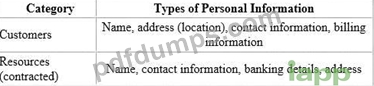
Clean-Q has an internal employee base of about 30 people. A recent privacy compliance exercise has been conducted to align employee data management and human resource functions with applicable data protection regulation.
Therefore, the Clean-Q permanent employee base is not included as part of this scenario.
With an increase in construction work and housing developments, Clean-Q has had an influx of requests for cleaning services. The demand has overwhelmed Clean-Q:s traditional supply and demand system that has caused some overlapping bookings.
In a business statrategy session held by senior management recently, Clearning invited vendors to present potential solutions to their current operational issues. These vendors includes included Application development and Cloud solution providers, presenting their proposed solution and platforms.
The Managing Direct opted to initiate the process to integrate Clean-Q's operations with a cloud solution (LeadOps) that will provide the following solution one single online platform. A web interface that Clean-Q accesses for the purposes of resource and customer management. This would entail uploading resource and customer information.
A customer facing web interface that enables customers to register, manage and submit cleaning service requests online.
A resource facing web interface that enables resources to apply and manage their assigned jobs.
An online payment facility for customer to pay for services.
What is a key consideration for assessing external service providers like LeadOps, which will conduct personal information processing operations on Clean-Q:s behalf?
- A. Recognizing the value of LeadOps website holding a verified security certificate.
- B. Establishing a relationship with the Managing Director of LeadOps.
- C. Understanding LeadOps costing model.
- D. Obtaining knowledge of LeadOps information handling practices and information security environment.
Answer: B
NEW QUESTION # 39
What was the first privacy framework to be developed?
- A. The Asia-Pacific Economic Cooperation (APEC) Privacy Framework.
- B. Code of Fair Information Practice Principles (FIPPs).
- C. Generally Accepted Privacy Principles.
- D. OECD Privacy Principles.
Answer: D
Explanation:
Explanation/Reference: http://oecdprivacy.org
NEW QUESTION # 40
SCENARIO
Please use the following to answer the next question:
Jordan just joined a fitness-tracker start-up based in California, USA, as its first Information Privacy and Security Officer. The company is quickly growing its business but does not sell any of the fitness trackers itself. Instead, it relies on a distribution network of third-party retailers in all major countries. Despite not having any stores, the company has a 78% market share in the EU. It has a website presenting the company and products, and a member section where customers can access their information. Only the email address and physical address need to be provided as part of the registration process in order to customize the site to the user's region and country. There is also a newsletter sent every month to all members featuring fitness tips, nutrition advice, product spotlights from partner companies based on user behavior and preferences.
Jordan says the General Data Protection Regulation (GDPR) does not apply to the company. He says the company is not established in the EU, nor does it have a processor in the region. Furthermore, it does not do any "offering goods or services" in the EU since it does not do any marketing there, nor sell to consumers directly. Jordan argues that it is the customers who chose to buy the products on their own initiative and there is no "offering" from the company.
The fitness trackers incorporate advanced features such as sleep tracking, GPS tracking, heart rate monitoring. wireless syncing, calorie-counting and step-tracking. The watch must be paired with either a smartphone or a computer in order to collect data on sleep levels, heart rates, etc. All information from the device must be sent to the company's servers in order to be processed, and then the results are sent to the smartphone or computer. Jordan argues that there is no personal information involved since the company does not collect banking or social security information.
Why is Jordan's claim that the company does not collect personal information as identified by the GDPR inaccurate?
- A. The fitness trackers capture sleep and heart rate data to monitor an individual's behavior.
- B. The potential customers must browse for products online.
- C. The website collects the customers' and users' region and country information.
- D. The customers must pair their fitness trackers to either smartphones or computers.
Answer: B
NEW QUESTION # 41
What is the potential advantage of homomorphic encryption?
- A. Encrypted information can be analyzed without decrypting it first.
- B. It makes data impenetrable to attacks.
- C. It allows greater security and faster processing times.
- D. Ciphertext size decreases as the security level increases.
Answer: B
NEW QUESTION # 42
SCENARIO
Please use the following to answer the next questions:
Your company is launching a new track and trace health app during the outbreak of a virus pandemic in the US. The developers claim the app is based on privacy by design because personal data collected was considered to ensure only necessary data is captured, users are presented with a privacy notice, and they are asked to give consent before data is shared. Users can update their consent after logging into an account, through a dedicated privacy and consent hub. This is accessible through the 'Settings' icon from any app page, then clicking 'My Preferences', and selecting 'Information Sharing and Consent' where the following choices are displayed:
* "I consent to receive notifications and infection alerts";
* "I consent to receive information on additional features or services, and new products";
* "I consent to sharing only my risk result and location information, for exposure and contact tracing purposes";
* "I consent to share my data for medical research purposes"; and
* "I consent to share my data with healthcare providers affiliated to the company".
For each choice, an ON* or OFF tab is available The default setting is ON for all Users purchase a virus screening service for USS29 99 for themselves or others using the app The virus screening service works as follows:
* Step 1 A photo of the user's face is taken.
* Step 2 The user measures their temperature and adds the reading in the app
* Step 3 The user is asked to read sentences so that a voice analysis can detect symptoms
* Step 4 The user is asked to answer questions on known symptoms
* Step 5 The user can input information on family members (name date of birth, citizenship, home address, phone number, email and relationship).) The results are displayed as one of the following risk status "Low. "Medium" or "High" if the user is deemed at "Medium " or "High" risk an alert may be sent to other users and the user is Invited to seek a medical consultation and diagnostic from a healthcare provider.
A user's risk status also feeds a world map for contact tracing purposes, where users are able to check if they have been or are in dose proximity of an infected person If a user has come in contact with another individual classified as "medium' or 'high' risk an instant notification also alerts the user of this. The app collects location trails of every user to monitor locations visited by an infected individual Location is collected using the phone's GPS functionary, whether the app is in use or not however, the exact location of the user is "blurred' for privacy reasons Users can only see on the map circles Which technology is best suited for the contact tracing feature of the app1?
- A. Near Field Communication (NFC)
- B. Deep learning
- C. Bluetooth
- D. Radio-Frequency Identification (RFID)
Answer: C
Explanation:
Bluetooth technology can enable devices to communicate with each other over short distances. This makes it well-suited for contact tracing applications where proximity between individuals needs to be detected. Deep learning (option B), Near Field Communication (NFC) (option C), and Radio-Frequency Identification (RFID) (option D) are technologies that could also have potential uses in a contact tracing app but may not be as well-suited as Bluetooth.
NEW QUESTION # 43
A key principle of an effective privacy policy is that it should be?
- A. Designed primarily by the organization s lawyers.
- B. Made general enough to maximize flexibility in its application.
- C. Presented with external parties as the intended audience.
- D. Written in enough detail to cover the majority of likely scenarios.
Answer: A
NEW QUESTION # 44
What is a main benefit of data aggregation?
- A. It is a good way to achieve de-identification and unlinkabilty.
- B. It allows one to draw valid conclusions from small data samples.
- C. It is a good way to perform analysis without needing a statistician.
- D. It applies two or more layers of protection to a single data record.
Answer: B
Explanation:
Explanation/Reference:
NEW QUESTION # 45
A user who owns a resource wants to give other individuals access to the resource. What control would apply?
- A. Context of authority controls.
- B. Discretionary access control.
- C. Mandatory access control.
- D. Role-based access controls.
Answer: D
Explanation:
Explanation/Reference: https://docs.microsoft.com/bs-latn-ba/azure/role-based-access-control/overview
NEW QUESTION # 46
What is true of providers of wireless technology?
- A. They are typically exempt from data security regulations.
- B. They routinely backup data that crosses their system.
- C. They can see all unencrypted data that crosses the system.
- D. They have the legal right in most countries to control and use any data on their systems.
Answer: C
NEW QUESTION # 47
Which of the following modes of interaction often target both people who personally know and are strangers to the attacker?
- A. Phishing.
- B. Consensually-shared sexual imagery.
- C. Unsolicited sexual imagery.
- D. Spam.
Answer: A
NEW QUESTION # 48
An organization is deciding between building a solution in-house versus purchasing a solution for a new customer facing application. When security threat are taken into consideration, a key advantage of purchasing a solution would be the availability of?
- A. Outsourcing.
- B. Patching and updates.
- C. Digital Rights Management.
- D. Persistent VPN.
Answer: B
Explanation:
when security threats are taken into consideration, a key advantage of purchasing a solution would be the availability of patching and updates.
NEW QUESTION # 49
......
Pass Your CIPT Exam Easily With 100% Exam Passing Guarantee: https://actualtorrent.pdfdumps.com/CIPT-valid-exam.html