


Get IAPP CIPT Dumps Questions Study Exam Guide Mar 20, 2026
CIPT Premium Exam Engine - Download Free PDF Questions
IAPP CIPT (Certified Information Privacy Technologist) certification exam is an essential qualification for professionals who are passionate about data privacy and protection. Certified Information Privacy Technologist (CIPT) certification is designed to assess the technical skills of individuals in the field of data privacy, including those who are responsible for implementing and managing data privacy programs within organizations. The CIPT certification exam is offered by the International Association of Privacy Professionals (IAPP), which is the largest and most respected global association for privacy professionals.
The CIPT certification exam is ideal for professionals who are responsible for ensuring the privacy and security of data within their organizations, including privacy officers, data protection officers, risk managers, IT professionals, and legal professionals. By obtaining the certification, candidates demonstrate their expertise in data privacy and their commitment to upholding the highest standards of privacy protection. The CIPT certification is an excellent opportunity for professionals to enhance their career prospects and increase their value to their organizations.
In today's digital age, privacy has become a significant concern for individuals and organizations alike. The IAPP CIPT Exam is an excellent opportunity for professionals to gain comprehensive knowledge and skills in privacy technology and become a certified expert in the field.
NEW QUESTION # 89
What has been found to undermine the public key infrastructure system?
- A. Man-in-the-middle attacks.
- B. Inability to track abandoned keys.
- C. Disreputable certificate authorities.
- D. Browsers missing a copy of the certificate authority's public key.
Answer: C
Explanation:
Public key infrastructure (PKI) relies heavily on the trustworthiness of certificate authorities (CAs). These CAs are responsible for issuing and verifying digital certificates. If a CA is compromised or disreputable, the entire PKI system's integrity can be undermined because the certificates it issues can no longer be trusted.
This can lead to a range of security issues, including the potential for man-in-the-middle attacks, as malicious actors could exploit compromised certificates to impersonate legitimate entities. Thus, maintaining reputable and secure CAs is critical to the PKI system's effectiveness.
Reference: IAPP CIPT Certification Textbook, Chapter on Cryptography and PKI, emphasizing the role and importance of CAs in PKI systems.
NEW QUESTION # 90
Which of the following became a foundation for privacy principles and practices of countries and organizations across the globe?
- A. The Code of Fair Information Practices.
- B. The Personal Data Ordinance.
- C. The EU Data Protection Directive.
- D. The Organization for Economic Co-operation and Development (OECD) Privacy Principles.
Answer: D
Explanation:
Explanation/Reference: https://privacyrights.org/resources/review-fair-information-principles-foundation-privacy-public- policy
NEW QUESTION # 91
An organization based in California, USA is implementing a new online helpdesk solution for recording customer call information. The organization considers the capture of personal data on the online helpdesk solution to be in the interest of the company in best servicing customer calls.
Before implementation, a privacy technologist should conduct which of the following?
- A. A privacy risk and impact assessment to evaluate potential risks from the proposed processing operations.
- B. A security assessment of the help desk solution and provider to assess if the technology was developed with a security by design approach.
- C. A Legitimate Interest Assessment (LIA) to ensure that the processing is proportionate and does not override the privacy, rights and freedoms of the customers.
- D. A Data Protection Impact Assessment (DPIA) and consultation with the appropriate regulator to ensure legal compliance.
Answer: C
Explanation:
In the context of an organization based in California, USA, considering the capture of personal data for best servicing customer calls, the most appropriate step before implementing the online helpdesk solution is to conduct a Legitimate Interest Assessment (LIA). This assessment ensures that the processing of personal data is necessary for the organization's legitimate interests and that it does not infringe upon the privacy, rights, and freedoms of individuals. An LIA helps to balance the company's interests with the privacy rights of the customers and includes an evaluation of necessity, proportionality, and safeguards. This aligns with privacy regulations and best practices as outlined in the IAPP's Information Privacy Technologist guidelines.
NEW QUESTION # 92
SCENARIO
Please use the following to answer the next question:
Chuck, a compliance auditor for a consulting firm focusing on healthcare clients, was required to travel to the client's office to perform an onsite review of the client's operations. He rented a car from Finley Motors upon arrival at the airport as so he could commute to and from the client's office. The car rental agreement was electronically signed by Chuck and included his name, address, driver's license, make/model of the car, billing rate, and additional details describing the rental transaction. On the second night, Chuck was caught by a red light camera not stopping at an intersection on his way to dinner. Chuck returned the car back to the car rental agency at the end week without mentioning the infraction and Finley Motors emailed a copy of the final receipt to the address on file.
Local law enforcement later reviewed the red light camera footage. As Finley Motors is the registered owner of the car, a notice was sent to them indicating the infraction and fine incurred. This notice included the license plate number, occurrence date and time, a photograph of the driver, and a web portal link to a video clip of the violation for further review. Finley Motors, however, was not responsible for the violation as they were not driving the car at the time and transferred the incident to AMP Payment Resources for further review. AMP Payment Resources identified Chuck as the driver based on the rental agreement he signed when picking up the car and then contacted Chuck directly through a written letter regarding the infraction to collect the fine.
After reviewing the incident through the AMP Payment Resources' web portal, Chuck paid the fine using his personal credit card. Two weeks later, Finley Motors sent Chuck an email promotion offering 10% off a future rental.
What is the most secure method Finley Motors should use to transmit Chuck's information to AMP Payment Resources?
- A. HyperText Transfer Protocol (HTTP).
- B. Transport Layer Security (TLS).
- C. Certificate Authority (CA).
- D. Cloud file transfer services.
Answer: B
Explanation:
Transport Layer Security (TLS) is the most secure method for transmitting data over a network. It encrypts data during transfer, ensuring that personal information remains confidential and protected from interception or tampering by unauthorized parties. In this scenario, using TLS to transmit Chuck's information to AMP Payment Resources would help secure the data against potential breaches. The IAPP emphasizes the importance of using strong encryption protocols like TLS to safeguard personal data during transmission.
NEW QUESTION # 93
SCENARIO
Clean-Q is a company that offers house-hold and office cleaning services. The company receives requests from consumers via their website and telephone, to book cleaning services. Based on the type and size of service, Clean-Q then contracts individuals that are registered on its resource database - currently managed in-house by Clean-Q IT Support. Because of Clean-Q's business model, resources are contracted as needed instead of permanently employed.
The table below indicates some of the personal information Clean-Q requires as part of its business operations: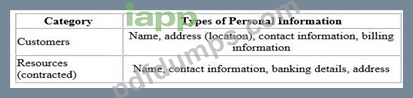
Clean-Q has an internal employee base of about 30 people. A recent privacy compliance exercise has been conducted to align employee data management and human resource functions with applicable data protection regulation. Therefore, the Clean-Q permanent employee base is not included as part of this scenario.
With an increase in construction work and housing developments, Clean-Q has had an influx of requests for cleaning services. The demand has overwhelmed Clean-Q's traditional supply and demand system that has caused some overlapping bookings.
Ina business strategy session held by senior management recently, Clear-Q invited vendors to present potential solutions to their current operational issues. These vendors included Application developers and Cloud-Q's solution providers, presenting their proposed solutions and platforms.
The Managing Director opted to initiate the process to integrate Clean-Q's operations with a cloud solution (LeadOps) that will provide the following solution one single online platform: A web interface that Clean-Q accesses for the purposes of resource and customer management. This would entail uploading resource and customer information.
A customer facing web interface that enables customers to register, manage and submit cleaning service requests online.
A resource facing web interface that enables resources to apply and manage their assigned jobs.
An online payment facility for customers to pay for services.
What is a key consideration for assessing external service providers like LeadOps, which will conduct personal information processing operations on Clean-Q's behalf?
- A. Understanding LeadOps' costing model.
- B. Establishing a relationship with the Managing Director of LeadOps.
- C. Recognizing the value of LeadOps' website holding a verified security certificate.
- D. Obtaining knowledge of LeadOps' information handling practices and information security environment.
Answer: D
NEW QUESTION # 94
A privacy engineer reviews a newly developed on-line registration page on a company's website. The purpose of the page is to enable corporate customers to submit a returns / refund request for physical goods. The page displays the following data capture fields: company name, account reference, company address, contact name, email address, contact phone number, product name, quantity, issue description and company bank account details.
After her review, the privacy engineer recommends setting certain capture fields as "non-mandatory". Setting which of the following fields as "non-mandatory" would be the best example of the principle of data minimization?
- A. The contact name and email address.
- B. The company address and name.
- C. The company bank account detail field.
- D. The contact phone number field.
Answer: C
Explanation:
The principle of data minimization dictates that only the minimum necessary personal data should be collected for a given purpose. In the context of an online registration page for returns or refunds, setting the company bank account detail field as non-mandatory best exemplifies data minimization. This is because, typically, bank account details are highly sensitive and not immediately necessary for processing a return or refund request. Instead, these details could be collected later in the process when the refund is being processed. Collecting only essential information up front reduces the risk of data exposure and aligns with privacy best practices, as outlined in frameworks such as GDPR and supported by IAPP guidance on data minimization.
NEW QUESTION # 95
Which of the following statements describes an acceptable disclosure practice?
- A. When an organization discloses data to a vendor, the terms of the vendor' privacy notice prevail over the organization' privacy notice.
- B. Intermediaries processing sensitive data on behalf of an organization require stricter disclosure oversight than vendors.
- C. With regard to limitation of use, internal disclosure policies override contractual agreements with third parties.
- D. An organization's privacy policy discloses how data will be used among groups within the organization itself.
Answer: D
NEW QUESTION # 96
When releasing aggregates, what must be performed to magnitude data to ensure privacy?
- A. Top coding.
- B. Noise addition.
- C. Basic rounding.
- D. Value swapping.
Answer: B
Explanation:
To ensure privacy when releasing aggregated data, adding noise to the data is a common and effective technique. Noise addition involves introducing random data to the dataset, which helps to obscure individual entries and prevent re-identification. This method maintains the utility of the dataset while protecting the privacy of individuals whose data is included.
Reference:
IAPP Certification Textbooks: "De-identification Techniques" discuss the application of noise addition (also known as differential privacy) as a method to protect individual privacy in aggregated data.
NEW QUESTION # 97
Which of the following would best improve an organization' s system of limiting data use?
- A. Instituting a system of user authentication for company personnel.
- B. Applying audit trails to resources to monitor company personnel.
- C. Confirming implied consent for any secondary use of data.
- D. Implementing digital rights management technology.
Answer: D
Explanation:
Implementing digital rights management (DRM) technology would best improve an organization's system of limiting data use. DRM technology helps control how data is used, shared, and accessed within and outside the organization by enforcing policies and permissions. This ensures that data is only used in ways that comply with organizational policies and legal requirements, thereby limiting unauthorized or inappropriate use of data.
Reference:
IAPP CIPT Study Guide: The role of DRM in controlling data use.
GDPR, Article 25: Data protection by design and by default, which includes using technologies like DRM to enforce data usage policies.
NEW QUESTION # 98
Which of the following is the least effective privacy preserving practice in the Systems Development Life Cycle (SDLC)?
- A. Developing data flow modeling to identify sources and destinations of sensitive data.
- B. Following secure and privacy coding standards in the development.
- C. Reviewing the code against Open Web Application Security Project (OWASP) Top 10 Security Risks.
- D. Conducting privacy threat modeling for the use-case.
Answer: A
NEW QUESTION # 99
Not updating software for a system that processes human resources data with the latest security patches may create what?
- A. Privacy vulnerabilities.
- B. Reportable privacy violations.
- C. Privacy threat vectors.
- D. Authentication issues.
Answer: A
Explanation:
Not updating software with the latest security patches can expose systems to various vulnerabilities, including those that can compromise privacy. When systems processing sensitive data, such as human resources data, are not updated, they become susceptible to security exploits that can lead to unauthorized access or data breaches. This negligence creates privacy vulnerabilities because it increases the risk that personal data could be accessed, stolen, or altered by malicious actors. Privacy vulnerabilities are essentially weaknesses in a system that could be exploited to compromise the privacy of data subjects. This concept is emphasized in the IAPP's training materials, which highlight the importance of maintaining up-to-date software as part of a robust data protection strategy.
NEW QUESTION # 100
SCENARIO
Carol was a U.S.-based glassmaker who sold her work at art festivals. She kept things simple by only accepting cash and personal checks.
As business grew, Carol couldn't keep up with demand, and traveling to festivals became burdensome. Carol opened a small boutique and hired Sam to run it while she worked in the studio. Sam was a natural salesperson, and business doubled. Carol told Sam, "I don't know what you are doing, but keep doing it!" But months later, the gift shop was in chaos. Carol realized that Sam needed help so she hired Jane, who had business expertise and could handle the back-office tasks. Sam would continue to focus on sales. Carol gave Jane a few weeks to get acquainted with the artisan craft business, and then scheduled a meeting for the three of them to discuss Jane's first impressions.
At the meeting, Carol could not wait to hear Jane's thoughts, but she was unprepared for what Jane had to say.
"Carol, I know that he doesn't realize it, but some of Sam's efforts to increase sales have put you in a vulnerable position. You are not protecting customers' personal information like you should." Sam said, "I am protecting our information. I keep it in the safe with our bank deposit. It's only a list of customers' names, addresses and phone numbers that I get from their checks before I deposit them. I contact them when you finish a piece that I think they would like. That's the only information I have! The only other thing I do is post photos and information about your work on the photo sharing site that I use with family and friends. I provide my email address and people send me their information if they want to see more of your work. Posting online really helps sales, Carol. In fact, the only complaint I hear is about having to come into the shop to make a purchase." Carol replied, "Jane, that doesn't sound so bad. Could you just fix things and help us to post even more online?"
'I can," said Jane. "But it's not quite that simple. I need to set up a new program to make sure that we follow the best practices in data management. And I am concerned for our customers. They should be able to manage how we use their personal information. We also should develop a social media strategy." Sam and Jane worked hard during the following year. One of the decisions they made was to contract with an outside vendor to manage online sales. At the end of the year, Carol shared some exciting news. "Sam and Jane, you have done such a great job that one of the biggest names in the glass business wants to buy us out!
And Jane, they want to talk to you about merging all of our customer and vendor information with theirs beforehand." What type of principles would be the best guide for Jane's ideas regarding a new data management program?
- A. Fair Information Practice Principles
- B. Incident preparedness principles.
- C. Collection limitation principles.
- D. Vendor management principles.
Answer: A
NEW QUESTION # 101
SCENARIO
Please use the following to answer the next question:
Chuck, a compliance auditor for a consulting firm focusing on healthcare clients, was required to travel to the client's office to perform an onsite review of the client's operations. He rented a car from Finley Motors upon arrival at the airport as so he could commute to and from the client's office. The car rental agreement was electronically signed by Chuck and included his name, address, driver's license, make/model of the car, billing rate, and additional details describing the rental transaction. On the second night, Chuck was caught by a red light camera not stopping at an intersection on his way to dinner. Chuck returned the car back to the car rental agency at the end week without mentioning the infraction and Finley Motors emailed a copy of the final receipt to the address on file.
Local law enforcement later reviewed the red light camera footage. As Finley Motors is the registered owner of the car, a notice was sent to them indicating the infraction and fine incurred. This notice included the license plate number, occurrence date and time, a photograph of the driver, and a web portal link to a video clip of the violation for further review. Finley Motors, however, was not responsible for the violation as they were not driving the car at the time and transferred the incident to AMP Payment Resources for further review. AMP Payment Resources identified Chuck as the driver based on the rental agreement he signed when picking up the car and then contacted Chuck directly through a written letter regarding the infraction to collect the fine.
After reviewing the incident through the AMP Payment Resources' web portal, Chuck paid the fine using his personal credit card. Two weeks later, Finley Motors sent Chuck an email promotion offering 10% off a future rental.
What should Finley Motors have done to incorporate the transparency principle of Privacy by Design (PbD)?
- A. Documented that Finley Motors has a legitimate interest to share Chuck's information.
- B. Signed a data sharing agreement with AMP Payment Resources.
- C. Obtained verbal consent from Chuck and recorded it within internal systems.
- D. Provided notice of data sharing practices within the electronically signed rental agreement.
Answer: D
Explanation:
Privacy by Design (PbD) principles emphasize transparency, meaning that organizations should inform individuals about their data processing practices. In this scenario, Finley Motors should have provided notice within the rental agreement about their data sharing practices with third parties like AMP Payment Resources.
This transparency would ensure that Chuck was aware that his personal information could be shared for purposes such as managing infractions. According to the IAPP, incorporating such notices in agreements is a best practice for maintaining transparency and upholding data protection principles.
NEW QUESTION # 102
Which of the following is a stage in the data life cycle?
- A. Data inventory.
- B. Data retention.
- C. Data classification.
- D. Data masking.
Answer: B
Explanation:
* Option A: Data classification is a process used to categorize data based on sensitivity and other criteria, but it is not a stage in the data lifecycle.
* Option B: Data inventory involves cataloging data assets, which is part of data management practices rather than a lifecycle stage.
* Option C: Data masking is a technique used to protect data but is not a lifecycle stage.
* Option D: Data retention is a stage in the data lifecycle that involves keeping data for a specified period according to legal, regulatory, and business requirements.
References:
* IAPP CIPT Study Guide
* Data lifecycle management frameworks and best practices
NEW QUESTION # 103
What is an Access Control List?
- A. A list of individuals who have had their access privileges to a resource revoked.
- B. A list showing the resources that an individual has permission to access.
- C. A list of steps necessary for an individual to access a resource.
- D. A list that indicates the type of permission granted to each individual.
Answer: B
Explanation:
* Option A: Decentralization of data typically increases the complexity of access controls as data is spread across various locations and systems.
* Option B: Regular data inventories help understand what data exists and where it is stored, but they do not directly reduce the need for different types of access controls.
* Option C: Standardization of technology simplifies the IT environment, making it easier to implement and manage consistent access controls across the organization.
* Option D: An increased number of remote employees generally requires more robust and varied access controls to manage the different ways remote access is secured.
:
IAPP CIPT Study Guide
Best practices for access control management in IT systems
NEW QUESTION # 104
SCENARIO
Please use the following to answer next question:
EnsureClaim is developing a mobile app platform for managing data used for assessing car accident insurance claims. Individuals use the app to take pictures at the crash site, eliminating the need for a built-in vehicle camer a. EnsureClaim uses a third-party hosting provider to store data collected by the app. EnsureClaim customer service employees also receive and review app data before sharing with insurance claim adjusters.
The app collects the following information:
First and last name
Date of birth (DOB)
Mailing address
Email address
Car VIN number
Car model
License plate
Insurance card number
Photo
Vehicle diagnostics
Geolocation
What would be the best way to supervise the third-party systems the EnsureClaim App will share data with?
- A. Review the privacy notices for each third-party that the app will share personal data with to determine adequate privacy and data protection controls are in place.
- B. Conduct a security and privacy review before onboarding new vendors that collect personal data from the app.
- C. Anonymize all personal data collected by the app before sharing any data with third-parties.
- D. Develop policies and procedures that outline how data is shared with third-party apps.
Answer: C
NEW QUESTION # 105
SCENARIO
Please use the following to answer next question:
EnsureClaim is developing a mobile app platform for managing data used for assessing car accident insurance claims. Individuals use the app to take pictures at the crash site, eliminating the need for a built-in vehicle camera. EnsureClaim uses a third-party hosting provider to store data collected by the app. EnsureClaim customer service employees also receive and review app data before sharing with insurance claim adjusters.
The app collects the following information:
First and last name
Date of birth (DOB)
Mailing address
Email address
Car VIN number
Car model
License plate
Insurance card number
Photo
Vehicle diagnostics
Geolocation
What IT architecture would be most appropriate for this mobile platform?
- A. Client-server architecture.
- B. Plug-in-based architecture.
- C. Peer-to-peer architecture.
- D. Service-oriented architecture.
Answer: A
Explanation:
A client-server architecture is most appropriate for a mobile platform like EnsureClaim's app. This architecture allows for a centralized server to store and manage data, while clients (the mobile app users) can access and interact with the data as needed. This setup supports efficient data management, security, and scalability, making it suitable for handling the data collected by the app and providing the necessary functionality for both users and customer service employees.
NEW QUESTION # 106
What is the main function of the Amnesic Incognito Live System or TAILS device?
- A. It encrypts data stored on any computer on a network.
- B. It causes a system to suspend its security protocols.
- C. It accesses systems with a credential that leaves no discernable tracks.
- D. It allows the user to run a self-contained computer from a USB device.
Answer: D
Explanation:
Explanation/Reference: https://www.wired.co.uk/article/tails-operating-software
NEW QUESTION # 107
What is the main function of a breach response center?
- A. Providing training to internal constituencies.
- B. Interfacing with privacy regulators and governmental bodies.
- C. Addressing privacy incidents.
- D. Detecting internal security attacks.
Answer: C
Explanation:
The main function of a breach response center is to address privacy incidents1. A breach response center is a team of experts that conducts a comprehensive breach response when a data breach occurs1. The breach response center may include forensics, legal, information security, information technology, operations, human resources, communications, investor relations, and management1. The other options are not the main function of a breach response center, but rather possible tasks or roles that may be involved in a breach response.
NEW QUESTION # 108
......
Free CIPT Exam Braindumps IAPP Pratice Exam: https://actualtorrent.pdfdumps.com/CIPT-valid-exam.html