


Pass Apple Apple-Device-Support exam questions - convert Test Engine to PDF
Pass Your Apple-Device-Support Exam Easily - Real Apple-Device-Support Practice Dump Updated Dec 05, 2025
NEW QUESTION # 21
Which two Continuity features work when a user is signed in with different Apple Accounts on two devices?
(Select two.)
- A. Handoff
- B. Sidecar
- C. AirDrop
- D. AirPlay to Mac
- E. Auto Unlock
Answer: C,D
Explanation:
* B:AirDrop works between different accounts if enabled.
* C:AirPlay to Mac functions without account matching.
* Option A: Handoff requires same account.
* Option D: Sidecar needs same account.
* Option E: Auto Unlock requires same account.References: Apple Support - "Continuity requirements" (support.apple.com/HT204681).
NEW QUESTION # 22
A user finds several Recovered Files folders in the Trash. What should you advise the user to do?
- A. Do nothing. Malware was detected.
- B. Delete all the folders immediately.
- C. Retrieve useful files, then empty the Trash.
- D. Change preference files.
Answer: C
Explanation:
Recovered Files folders appear in Trash after a crash or improper shutdown, containing temporary files. Users should check for useful data (e.g., unsaved work) and then empty Trash to free space.
* Option A: Not malware-related.
* Option C: Preference files aren't involved.
* Option D: Immediate deletion risks data loss.
* Option B: Correct-safe and practical.References: Apple Support - "If files appear in Trash" (support.
apple.com/HT202121).
NEW QUESTION # 23
A user created an encrypted backup of their iPhone on a Mac. Because they forgot the backup password, they can't restore the encrypted backup. What must the user do to create a new encrypted backup with a new password?
- A. Create a new encrypted backup on a different Mac.
- B. Use the Reset All Settings option in Settings.
- C. Use the Reset Network Settings option in Settings.
- D. Restart their iPhone and reconnect it to the Mac.
Answer: B
Explanation:
Forgotten encrypted backup passwords can't be recovered.Reset All Settings(Settings > General > Transfer or Reset iPhone) clears the old backup password link, allowing a new encrypted backup with a new password on the same Mac.
* Option B: Different Mac isn't necessary.
* Option C: Network reset doesn't affect backups.
* Option D: Restarting doesn't clear the password.
* Option A: Correct-resets backup access.References: Apple Support - "If you forget your encrypted backup password" (support.apple.com/HT205220).
NEW QUESTION # 24
Which wireless authentication method allows a Mac to use digital certificates to authenticate to secure wireless networks?
- A. WPA Personal
- B. WPA3 Transitional
- C. WPA3 Enterprise
- D. WPA3 Personal
Answer: C
Explanation:
WPA3 Enterprisesupports digital certificates for authentication, ideal for secure organizational networks, unlike personal modes.
* Option B: WPA Personal uses passwords.
* Option C: WPA3 Personal uses passwords, not certificates.
* Option D: Transitional is a hybrid, not certificate-based.
* Option A: Correct-enterprise-grade security.References: Apple Support - "Connect to Wi-Fi" (support.
apple.com/HT202831).
NEW QUESTION # 25
Select three responses.
Which three scenarios cause Apple File System (APFS) volumes to generate encryption keys?
- A. During the first user's password creation
- B. During the first macOS boot sequence
- C. After erase content and setting
- D. At first user login on the Mac
- E. During user creation
Answer: A,C,E
Explanation:
APFS is a file system that supports encryption at the volume level. Each volume has its own encryption key, called the Volume Encryption Key (VEK), which is stored in the APFS container metadata and protected by another key, called the Key Encryption Key (KEK). The KEK is derived from the user's password and wrapped by a secure token, which is a feature that ensures only authorized users can access the encrypted data. According to the Apple Device Support Reference Materials12, the following scenarios cause APFS volumes to generate encryption keys:
* During user creation. When a new user is created on an APFS volume, a secure token is generated for that user and a KEK is derived from the user's password. The KEK is used to encrypt the VEK and store it in the metadata.
* During the first user's password creation. When the first user on an APFS volume sets their password, a secure token is granted to that user and a KEK is derived from the password. The KEK is used to encrypt the VEK and store it in the metadata.
* After erase content and setting. When a user erases all content and settings on an APFS volume, the VEK and the KEK are deleted and new ones are generated. The new VEK is encrypted with the new KEK and stored in the metadata.
References:
* Use secure token, bootstrap token, and volume ownership in deployments.
* Data Protection in Apple devices.
NEW QUESTION # 26
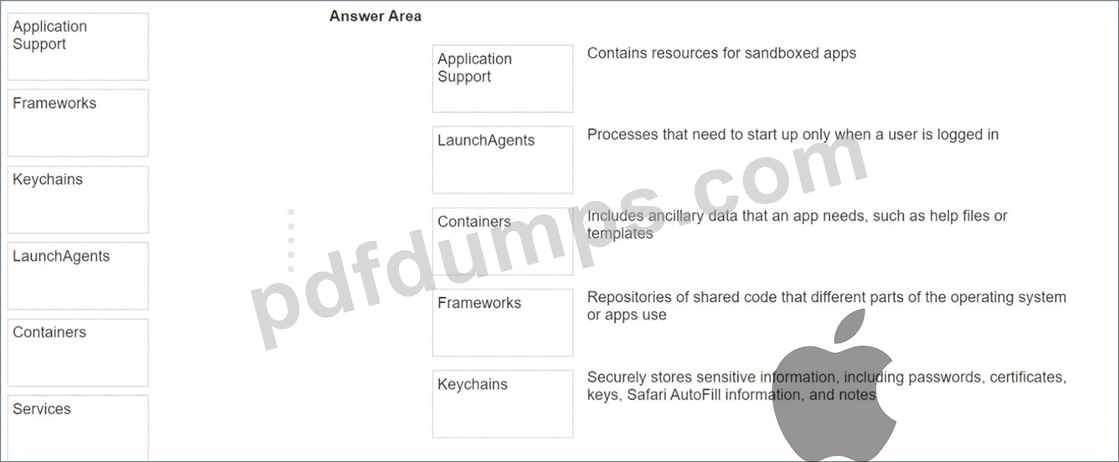
Match the macOS library resources listed on the left to the descriptions on the right by dragging responses to the correct target areas. Responses may be used once, more than once, or not at all.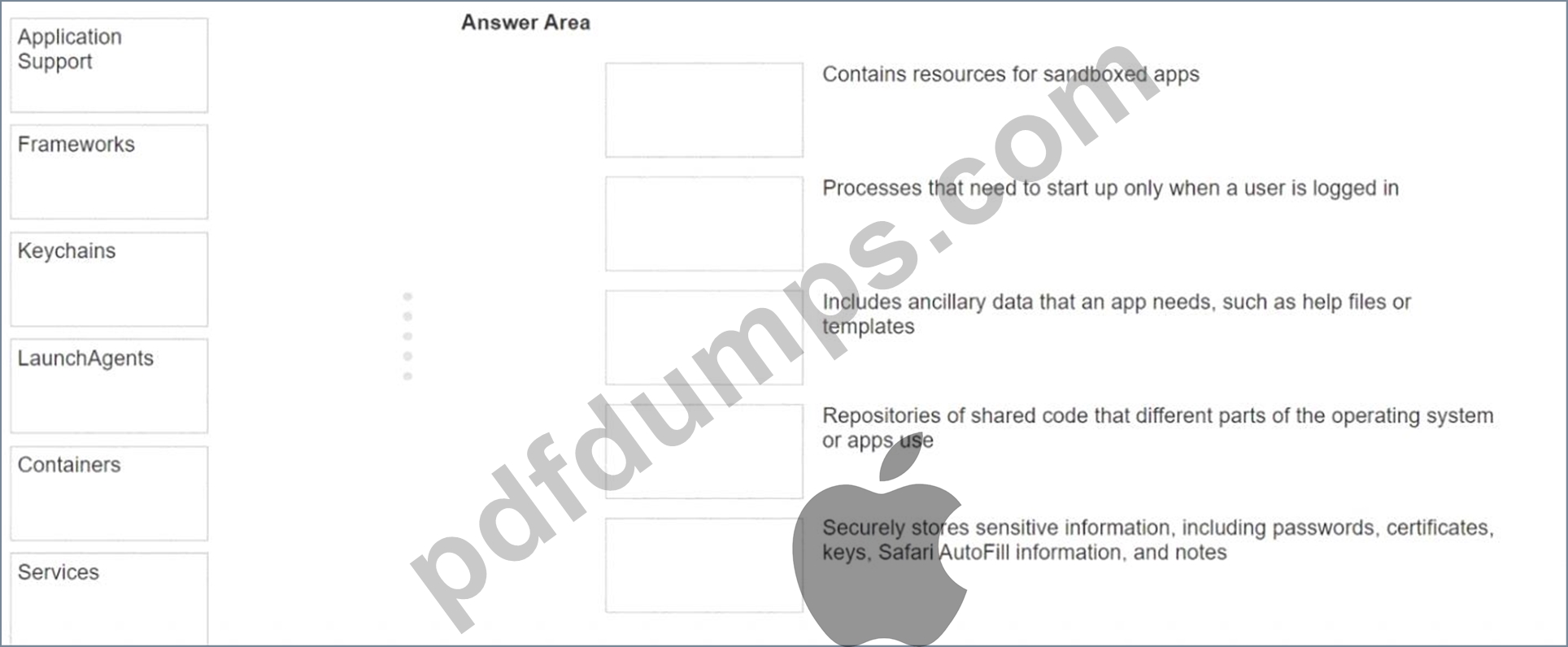
Answer:
Explanation: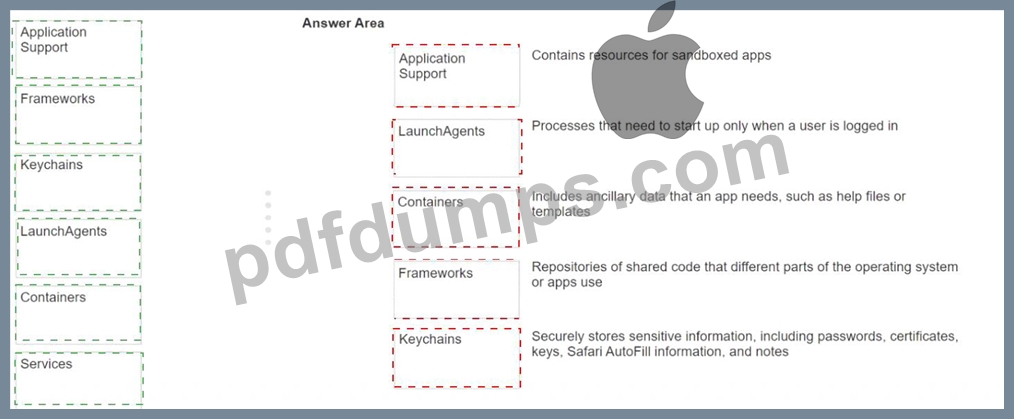
NEW QUESTION # 27
How do you start up in safe mode on a Mac with Apple silicon?
- A. 1. Connect to power, then shut down your Mac. B. 2. Press and hold the power button for three seconds, then remove power for at least 10 seconds.
3. Wait for the Continue in Safe Mode button to appear.
4. Log in to your Mac. - B. 1. Shut down your Mac, then press and hold the power button for three seconds.
2. When the startup options window appears, select your startup disk.
3. Click the Continue in Safe Mode button.
4. Log in to your Mac. - C. 1. Shut down your Mac. then quickly press the power button three times. O C. 2. Wait until the startup options window appears.
3. Select your startup disk, then press and hold the Shift key until the Continue in Safe Mode button appears
4. Continue to press and hold the Shift key until the Login window appears or you're asked to log in again. - D. 1. Shut down your Mac, Turn on your Mac and continue to press and hold the power button. O A. 2.
When the startup options window appears, release the power button.
3. Select your startup disk, press and hold the Shift key, click Continue in Safe Mode, then release the Shift key.
4. Log in to your Mac.
Answer: B
NEW QUESTION # 28
What could be a reason you can't update your compatible iPad to the latest iPadOS?
- A. The Apple Account used to update to the latest iPadOS doesn't have iPadOS in Purchase History.
- B. Your iPad battery level is lower than 50 percent.
- C. Your iPad doesn't have enough available storage space.
- D. Your iPad is connected to cellular only.
Answer: C
Explanation:
Insufficient storage (e.g., <5GB free) prevents iPadOS updates, as they require space for download and installation (check inSettings > General > iPad Storage).
* Option A: Cellular can work if "Use Cellular Data" is on.
* Option B: <50% battery prompts charging, not blocks visibility.
* Option D: Purchase History isn't tied to updates.
* Option C: Correct-common issue.References: Apple Support - "Update your iPad" (support.apple.com
/HT204204).
NEW QUESTION # 29
Which option can you access to view the current activity of Apple Configurator for Mac?
- A. From the Apple Configurator menu bar, choose Window > Activity.
- B. From the Apple Configurator menu, choose View Activity.
- C. Double-click the device and select Activity.
Answer: A
NEW QUESTION # 30
Scenario
Melody's Mac has multiple printers configured.
Where in System Settings should you go to determine if her printers were configured manually or by an MDM solution?
- A. General > Sharing > Printer Sharing
- B. Printers & Scanners > Advanced
- C. Printers > Advanced
- D. Privacy & Security > Profiles
Answer: D
Explanation:
To determine if Melody's printers were configured manually or by an MDM solution, you should go to Privacy & Security > Profiles in System Settings. This is where you can see the profiles that are installed on the Mac, which may include printer settings. If there are any profiles that contain the Printing or AirPrint payload, then the printers were configured by an MDM solution. Otherwise, the printers were configured manually by the user or an administrator. References: Printing MDM payload settings for Apple devices - Apple Support, AirPrint MDM payload settings for Apple devices - Apple Support, Intro to mobile device management profiles - Apple Support
NEW QUESTION # 31
Which setting should you check to find out if ACME manages her iPhone?
- A. Privacy & Security > Device Management
- B. General > Software Update
- C. General > VPN & Device Management
- D. General > Profile & Device Management
- E. Control Center > Device Profile
Answer: D
Explanation:
This is the correct setting to check if an iPhone is managed by an organization, such as ACME. A profile is a file that contains settings and policies that can be installed on an iPhone to control its features and behavior. A profile can be installed by an organization to manage the device remotely, or by the user to customize the device. A profile can also indicate that the device is supervised, which means that the organization has more control over the device and can apply extra restrictions. To see if an iPhone has a profile installed, go to Settings > General > Profile & Device Management. If there is no profile, this section will not appear. If there is a profile, tap on it to see what type of changes are made. To learn more about the features changed for your specific organization, ask your administrator whether these settings are enforced. References: Delete unknown configuration profiles from your iPhone or iPad, Get started with a supervised iPhone or iPad, See who has access to your iPhone or iPad, How to check if an iPhone is locked or unlocked
NEW QUESTION # 32
Select two responses.
Which two ways can you use to reset a FileVault password on a Mac?
- A. Authenticator app
- B. Using a trusted device
- C. SMS verification code
- D. iCIoud account and password
- E. Recovery key
Answer: D,E
Explanation:
FileVault is a feature that encrypts the data on your Mac's startup disk, making it more secure. To unlock your Mac, you need to enter your account password or a recovery key. A recovery key is a 28-character code that is generated when you turn on FileVault. You can choose to store it in iCloud or write it down and keep it in a safe place. An iCloud account and password can also be used to reset your FileVault password, if you enabled this option when you turned on FileVault. The other options, authenticator app, using a trusted device, and SMS verification code, are not valid ways to reset a FileVault password on a Mac. References: 1 Use FileVault to encrypt the startup disk on your Mac - Apple Support 2 Reset a macOS User Password - Kandji 3 How to unlock your Mac with its Recovery Key and FileVault active - Macworld
NEW QUESTION # 33
You want to protect your Mac from unwanted contacts from other computers.
Which action should you take to protect your Mac while it's connected to the internet?
- A. Go to System Settings > Privacy & Security > Lockdown Mode, then click Turn On.
- B. Go to System Settings > Network > Firewall, then turn on Firewall.
- C. Go to Safari Settings > Privacy, then enable Prevent cross-site tracking.
- D. Go to Safari Settings > Privacy, then enable Hide IP address from trackers.
Answer: B
Explanation:
This is the correct answer because turning on the firewall is the best way to protect your Mac from unwanted contacts from other computers when you are connected to the internet or a network. A firewall is a software or hardware system that blocks unauthorized access to your Mac by filtering the incoming and outgoing network traffic. The firewall can prevent hackers, malware, or other threats from accessing your Mac or stealing your data. You can also customize the firewall settings to allow or block specific apps and services from communicating through the firewall. To turn on the firewall on your Mac, you need to go to System Settings > Network > Firewall, and click the Turn On Firewall button. You can also click the Firewall Options button to see more settings and options. References: Block connections to your Mac with a firewall - Apple Support, A Practical Guide to Securing Your Mac | Reviews by Wirecutter
NEW QUESTION # 34
If you need to sync data from iCIoud to your Windows PC, what must you do?
- A. Download iCIoud for Windows from the Microsoft Store.
- B. Download iCIoud on your PC and manually start the transfer.
- C. Download the files and send them to your PC manually.
- D. Airdrop the files to your PC.
Answer: A
Explanation:
To sync data from iCloud to your Windows PC, you need to download and install iCloud for Windows from the Microsoft Store. This is a free app that allows you to access your iCloud photos, documents, bookmarks, passwords, and other data on your PC. You can also use iCloud for Windows to sync your iCloud Mail, Contacts, and Calendar with Outlook. To use iCloud for Windows, you need to sign in with your Apple ID and choose the features and content that you want to keep up to date across your devices. You also need to have iCloud set up on your iPhone, iPad, iPod touch, or Mac with the same Apple ID. References: Set up and use iCloud for Windows - Apple Support, Set up iCloud for Windows on your PC - Apple Support, Use iCloud for Windows to synchronize calendar and contacts with Outlook - Microsoft Support
NEW QUESTION # 35
What command gives you the ability to set, change, and reset privacy permissions for a single app or all apps?
- A. Sysadminctl
- B. ifconfig
- C. tccutil
- D. dscl
Answer: C
Explanation:
Thetccutilcommand in Terminal manages the Transparency, Consent, and Control (TCC) database, controlling app privacy permissions (e.g., camera, microphone). Example: tccutil reset All resets all permissions.
* Option B: dscl manages directory services, not privacy.
* Option C: ifconfig configures network interfaces.
* Option D: Sysadminctl manages system accounts, not TCC.
* Option A: Correct for macOS privacy management.References: Apple Developer - "TCC Command Line" (developer.apple.com/documentation).
NEW QUESTION # 36
You use Apple Watch 6 to track your physical activity and health metrics, but you have some trouble seeing the screen and using the watch controls.
Which iPhone feature can you use to help you see and operate Apple Watch more easily?
- A. Audio Descriptions
- B. Ask Siri
- C. Apple Watch Mirroring
- D. Voice Over
Answer: C
Explanation:
Reference Mode is a display mode for professional content creation workflows, like color grading, editing, and content review, where accurate colors and consistent image quality are critical. Reference Mode enables the
12.9-inch iPad Pro with Liquid Retina XDR display to deliver reference color for popular color standards and video formats, such as BT.709, sRGB, HDR10, Dolby Vision, and more. It also disables all dynamic display adjustments for ambient surround, such as True Tone, Auto-Brightness, and Night Shift. Guillermo can use Reference Mode to match the color requirements of his workflow and ensure that his marketing materials and color grading are accurate and consistent. He can also use Reference Mode with Sidecar to use his iPad Pro as a secondary reference display for his Mac. References: Use Reference Mode on your iPad Pro, iPadOS 16:
These are the new features exclusive to M1 iPads
NEW QUESTION # 37
Files App, what storage format does it support?
- A. MS-DOS (FAT)
- B. EX-FAT
- C. NTFS
- D. Mac OS Extended
- E. APFS
Answer: A,B,D,E
Explanation:
The Files app is an app that lets you browse, organize, and manage files stored on your device, iCloud Drive, and external storage devices. The Files app supports different storage formats for external storage devices, such as USB drives and SD cards. According to Apple, the supported formats are EX-FAT, MS-DOS (FAT), Mac OS Extended (HFS+), and APFS1. These formats allow the Files app to read and write files on the external storage devices. The Files app does not support NTFS, which is a format used by Windows. NTFS is not compatible with the Files app, and the Files app can only read files from NTFS-formatted devices, but not write or modify them2. To use an NTFS-formatted device with the Files app, you need to reformat it to one of the supported formats using a Mac or PC. References: Connect external storage devices to iPhone - Apple Support, The Complete Guide to Using External Storage on iOS and iPadOS - Gizmodo
NEW QUESTION # 38
Select the setting in the sidebar that you should you use to copy the password of a known Wi-Fi network.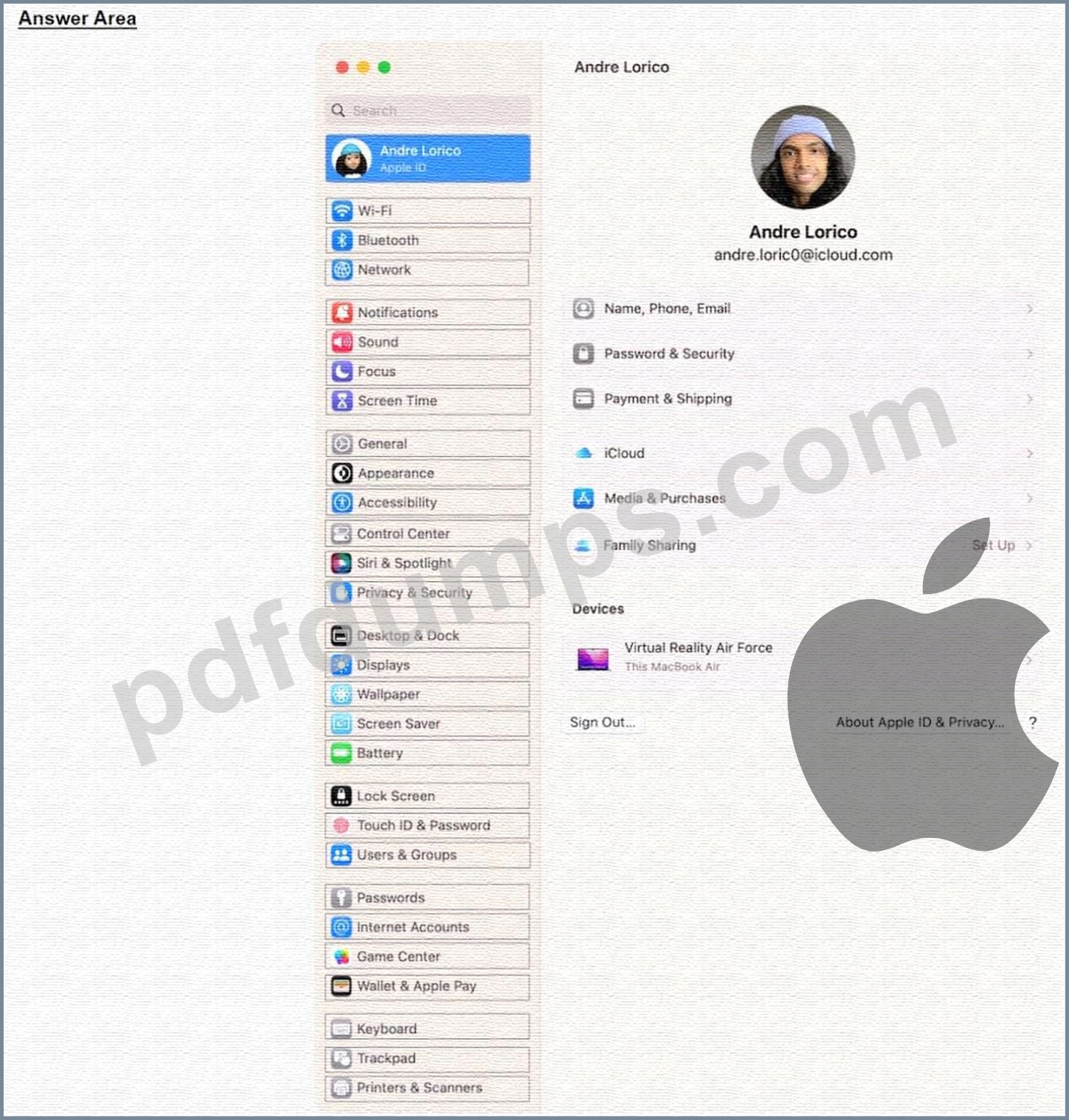
Answer:
Explanation: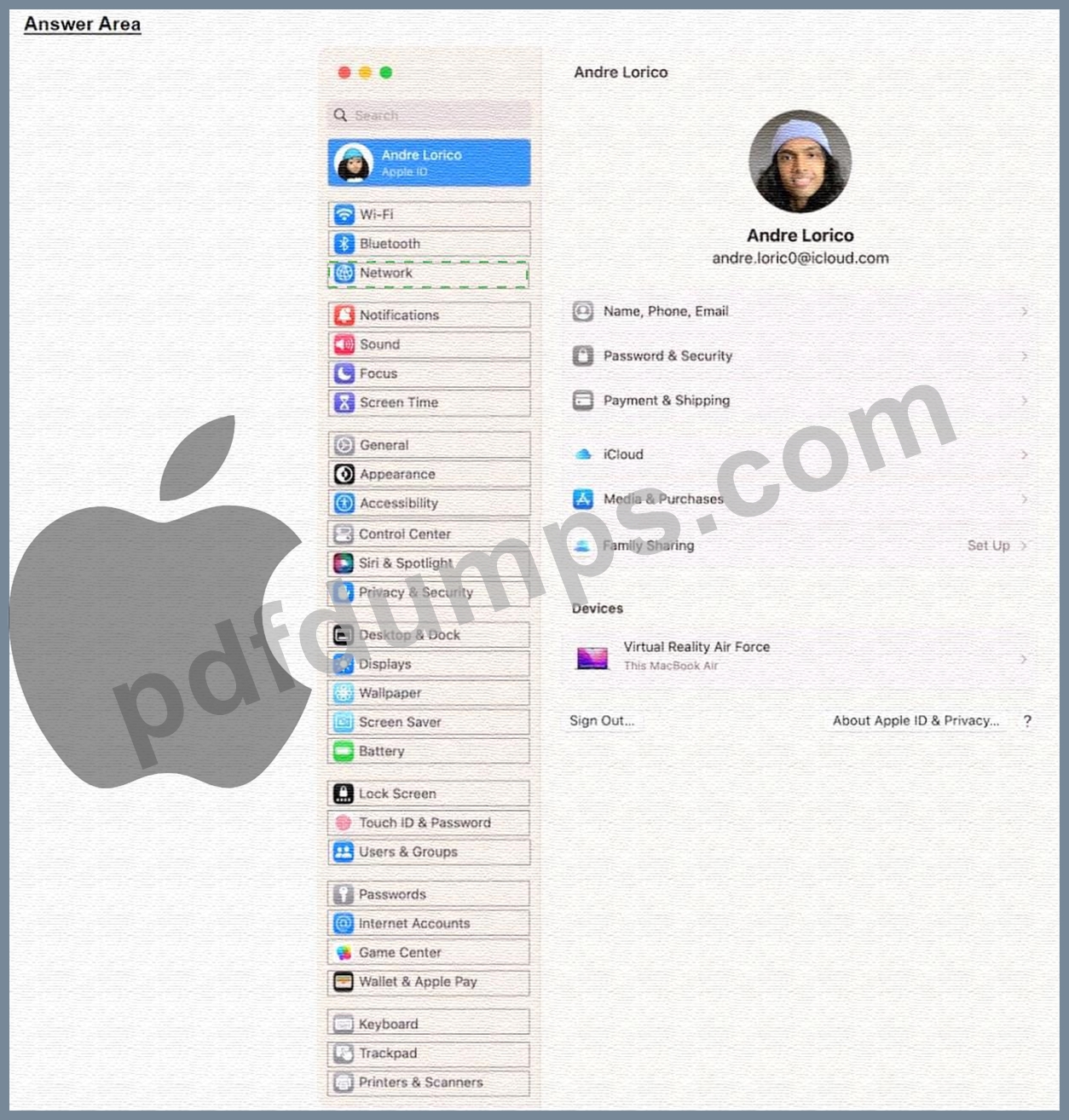
Explanation
Click Network in the sidebar, then click Wi-Fi on the right. Scroll down and click Advanced to open the list of known networks. Click the More button. next to the network name, then choose Copy Password.
NEW QUESTION # 39
After Krista installed some new apps, her Mac became slow and unresponsive. She asks if you can help resolve the issue. Which resource should you use to examine processes running on Krista's Mac and check how they're affecting its performance?
- A. Console
- B. Activity Monitor
- C. Diagnostic Reporting
- D. System Information
Answer: B
Explanation:
Activity Monitor is an app that shows information about the processes running on your Mac, including how much CPU, memory, disk, network, and energy they use. You can use Activity Monitor to identify and quit processes that are slowing down your Mac or causing other issues. You can also view graphs and statistics of your Mac's performance and activity. To open Activity Monitor, go to Applications > Utilities, or use Spotlight to search for it. You can then select a process and click the Info button to see more details, or click the X button to quit the process. You can also sort the processes by different columns, such as CPU, Memory, or Energy, to see which ones are using the most resources. You can also choose different tabs to see different types of processes, such as CPU, Memory, Disk, Network, or Cache. Activity Monitor is a useful tool for troubleshooting performance issues on your Mac and optimizing its efficiency. References: Use Activity Monitor on your Mac, How to see all the running programs on your Mac, How to See Which Program Is Using All Your CPU on Mac, How to track and kill processes on your Mac
NEW QUESTION # 40
Which app should you configure to get live image descriptions of your surroundings on iPhone?
- A. Scanner
- B. Settings
- C. Camera
- D. Photos
- E. Magnifier
Answer: E
Explanation:
Magnifier is an app that lets you use your iPhone as a magnifying glass to zoom in on objects and text. You can also use Magnifier to scan your surroundings and receive live image descriptions of the scenes and people detected in the camera view. You can customize the settings for image descriptions to receive text or speech feedback. To use Magnifier, you need to enable it in Settings > Accessibility > Magnifier1. References: Receive image descriptions of your surroundings in Magnifier on iPhone, Apple Support.
NEW QUESTION # 41
How many days do you have to recover deleted files from iCIoud Drive?
- A. 0
- B. 1
- C. 2
- D. 3
Answer: B
NEW QUESTION # 42
......
Apple Apple-Device-Support Exam Syllabus Topics:
| Topic | Details |
|---|---|
| Topic 1 |
|
| Topic 2 |
|
| Topic 3 |
|
| Topic 4 |
|
| Topic 5 |
|
| Topic 6 |
|
| Topic 7 |
|
| Topic 8 |
|
| Topic 9 |
|
| Topic 10 |
|
| Topic 11 |
|
Apple-Device-Support Real Exam Questions and Answers FREE: https://actualtorrent.pdfdumps.com/Apple-Device-Support-valid-exam.html