


The Best ISQI CTFL_Syll2018 Study Guides and Dumps of 2024
Top ISQI CTFL_Syll2018 Exam Audio Study Guide! Practice Questions Edition
The CTFL_Syll2018 certification exam is recognized globally and is highly valued by employers in the software development industry. ISTQB Certified Tester Foundation Level (Syllabus 2018) certification demonstrates that an individual has a solid understanding of software testing concepts and is capable of applying this knowledge in practical situations. ISTQB Certified Tester Foundation Level (Syllabus 2018) certification also provides individuals with an opportunity to advance their careers in software testing and gain recognition for their expertise in this field.
ISQI CTFL_Syll2018 certification exam is an excellent opportunity for individuals who want to build a career in software testing. CTFL_Syll2018 exam covers all the essential concepts and is recognized globally. ISTQB Certified Tester Foundation Level (Syllabus 2018) certification is suitable for both new and experienced professionals, and there are no prerequisites for taking the exam.
NEW QUESTION # 209
You have been asked to improve the way test automation tools are being used in your company.
Which one of the following is the BEST approach?
- A. Keeping expected results separate from the automation tool to allow the testers to check the results
- B. Selecting and automating scripts that test new functionality to find the most defects
- C. Ensuring that all data, inputs and actions are stored in the tool's script for ease of maintenance
- D. Using a keyword-driven testing approach to separate the actions and data from the tool's script
Answer: B
NEW QUESTION # 210
You need to test the login page of a web site The page contains fields for user name and password Which test design techniques are most appropriate for this case?
- A. Equivalence partitioning, Boundary value analysis.
- B. Decision coverage, fault attack.
- C. Decision table testing, state transition testing.
- D. Exploratory testing, statement coverage.
Answer: C
Explanation:
Provides developers with information to isolate the failure is the incident report objective that this excerpt satisfies, because it gives details about how to recreate the failure using a specific test file and location . An incident report is a document that records any event that deviates from the expected or desired behaviour of the software under test . One of its objectives is to provide developers with information to isolate the failure, which means to identify and locate the cause of the failure in the software . The other options are not incident report objectives that this excerpt satisfies. Option B is wrong, because this excerpt does not belong to an incident report, but rather to a test report. A test report is a document that summarizes the results and outcomes of testing activities . Option C is wrong, because this excerpt does not provide project managers with information on the project risks, which means to identify and assess the potential threats or uncertainties that may affect the project objectives or outcomes . Option D is wrong, because this excerpt does not provide test managers with information to report test progress, which means to measure and communicate how much of the planned testing activities have been completed or remain to be done .
NEW QUESTION # 211
Which of the following tools is most likely to detect defects in functions or methods in source code?
- A. unit test framework tool
- B. configuration management tool
- C. monitoring tool
- D. test design tool
Answer: A
NEW QUESTION # 212
Typically, exit criteria may consist of:
- A. Defining the amount, level of detail structure, and templates for the test documentation.
- B. Estimates of defect density or reliability measures.
- C. Adequacy of the test approaches taken.
- D. Discussions on disaster recovery.
Answer: B
Explanation:
Explanation
These are examples of exit criteria, which are the conditions that must be met before testing can be completed.
Exit criteria may also include test coverage measures, residual risk assessment, or stakeholder approval. The other options are not exit criteria, but rather test planning activities.
NEW QUESTION # 213
What is Test Design?
- A. The overall process of testing a system to verify that it meets specified requirements.
- B. An approach to testing to reduce the level of product risks by focusing on high-risk areas in the product
- C. The process of selecting test techniques to exercise the functions implemented by the tested system
- D. The process of transforming general testing objectives into tangible test conditions and test cases
Answer: D
Explanation:
Explanation
Test design is the process of transforming general testing objectives into tangible test conditions and test cases that can be executed and verified against expected results. Test design involves identifying test techniques, coverage criteria, input data, expected outcomes and other test parameters.
Reference: A Study Guide to the ISTQB Foundation Level 2018 Syllabus1, Chapter 3, Section 3.2.1, page
53.
NEW QUESTION # 214
Which statement best describes the key difference between a mindset for test activities and a mindset for development activities?
- A. A tester possesses professional pessimism while a developer is concerned with validating the product
- B. A tester Is Interested in building solutions while a developer is concerned with verifying the product
- C. A tester is concerned with verifying the product while a developer possesses professional pessimism
- D. A tester is concerned with finding defects while a developer is interested in designing solutions
Answer: D
Explanation:
Explanation
According to the syllabus, a mindset is a set of attitudes, beliefs, and assumptions that influence how a person thinks, feels, and behaves. A mindset for test activities and a mindset for development activities are different and complementary, as they reflect different goals and perspectives of testing and development. A tester is concerned with finding defects while a developer is interested in designing solutions. This statement best describes the key difference between a mindset for test activities and a mindset for development activities. A tester's mindset is focused on identifying and reporting problems in the software product or system, such as errors, failures, or deviations from requirements or expectations. A tester's mindset is also characterized by professional skepticism, curiosity, creativity, and critical thinking. A developer's mindset is focused on creating and implementing solutions for the software product or system, such as features, functions, or enhancements. A developer's mindset is also characterized by professional optimism, confidence, logic, and analytical thinking. The other answers are incorrect because they either confuse the roles of testers and developers or use incorrect terms.
References: [Certified Tester Foundation Level Syllabus], Section 1.5.1, page 19-20.
NEW QUESTION # 215
Functional and structural tests are alternative test types that may be used separately or together at which test
level? [K1]
- A. At all levels from integration testing to acceptance testing
- B. At all test levels
- C. At integration testing and system testing levels only
- D. At the component test level only
Answer: B
NEW QUESTION # 216
Which type of software development product can undergo static testing?
- A. should be performed on the installation and user guide documents as these documents are used by the end user
- B. Static testing is done only on the code as part of the "code review" sessions Other documents are reviewed, but not by static testing Static tests
- C. Any software development product can undergo static testing, including requirements specifications, design specifications and code
- D. Static testing is done only on the requirements. You need to execute the software in order to find defects in the code
Answer: C
Explanation:
Any software development product can undergo static testing, including requirements specifications, design specifications, code, test cases, test plans, user manuals, etc. Static testing is a type of testing that does not involve executing the software or system under test, but rather analyzing it using various techniques, such as reviews, inspections, walkthroughs, checklists, static analysis tools, etc. Static testing can help find defects and improve the quality of any software development product at any stage of the software development lifecycle.
References: Certified Tester Foundation Level Syllabus, Section 3.1 and 3.2
NEW QUESTION # 217
Which of the following is an approach that can be used for exploratory testing?
- A. Time-boxed test sessions are created, during which a tester uses a test charter containing test objectives
to guide the testing. - B. Tests are designed based on the guidance of stakeholders and experts outside the test team.
- C. A tester methodically executes tests from a list of possible failures, based on experience, defect and
failure data. - D. A tester analyses, designs and implements tests based on external rules and standards.
Answer: B
NEW QUESTION # 218
Which of the following Is an example of tasks most associated with the test design activity?
- A. Test data, derived from production data, is developed for use during testing
- B. The Identification of test execution and test automation tools
- C. The project manager updates the project schedule as key test tasks are completed
- D. Every day, the tester notes the status of his/her test cases in preparation for daily reports
Answer: A
Explanation:
According to the syllabus, test design is the activity of deriving and specifying test cases from test conditions to test software. Test design involves processes such as identifying test data, designing test scenarios, creating test procedures, and defining expected results. The answer A is correct because it is an example of a task most associated with the test design activity. Test data, derived from production data, is developed for use during testing. The other answers are incorrect because they are examples of tasks associated with other test activities, such as test planning (B), test implementation, and test monitoring and control (D).
References: Certified Tester Foundation Level Syllabus, Section 1.4.2, page 16-17.
NEW QUESTION # 219
Given the following examples of entry and exit criteria:
1. A defined level of code coverage has been achieved
2. The test automation tool has been installed and properly configured
3. The number of unresolved defects is within the predefined limit
4. The performance test environment has been set-up and is available
5. The user stones hove proper acceptance criteria defined
6. The testing budget has been spent and the project sponsor bears the risk of not testing any further Which of the following BEST categorizes them as entry and exit criteria:
- A. Entry criteria - 1, 3. 4; Exit criteria - 2. 5. 6
- B. Entry criteria - 2. 4: Exit criteria - 1. 3. 5. 6
- C. Entry criteria - 2. 4. 5; Exit criteria - 1. 3, 6
- D. Entry criteria - 2, 4. 5, 6; Exit criteria -1.3
Answer: C
Explanation:
The correct answer is B, as it categorizes them as entry and exit criteria correctly. Entry criteria are conditions that must be met before testing can begin or continue with a specific activity or phase3. Exit criteria are conditions that must be met before testing can conclude or stop for a specific activity or phase3. The following table shows how each example can be categorized: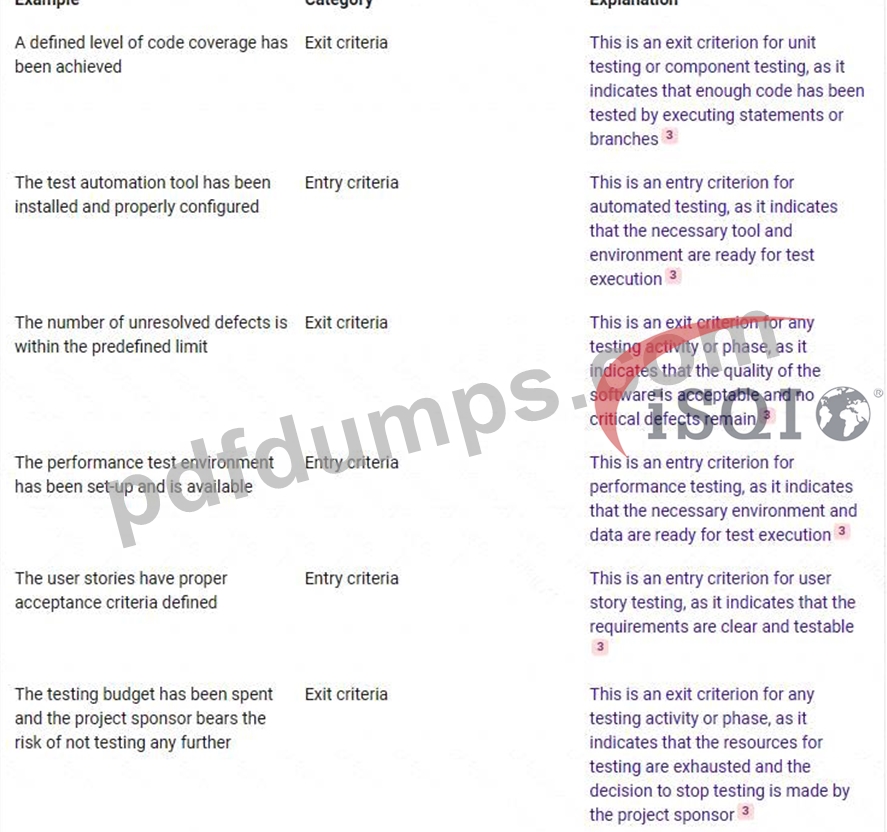
Therefore, option B is the correct answer. Options A, C, and D are incorrect, as they do not categorize them as entry and exit criteria correctly. References: 3, Section 2.4
NEW QUESTION # 220
An issue has been found in a production system, where a code component fails to release memory after it has finished using it. Which of the following tools would have been the MOST effective at detecting this defect during Performance testing?
- A. Dynamic analysis tool.
- B. Test Execution tool.
- C. Coverage measurement tool.
- D. Configuration management tool.
Answer: A
Explanation:
Explanation
According to the syllabus, dynamic analysis tools are tools that perform testing or analysis by executing the software or a part of it. Dynamic analysis tools can help detect defects or problems that only appear during runtime, such as memory leaks, performance issues, concurrency errors, etc. The answer A is correct because it suggests using a dynamic analysis tool for detecting a memory leak during performance testing. A memory leak is a situation where a code component fails to release memory after it has finished using it, causing memory exhaustion and degradation of performance. A dynamic analysis tool can monitor the memory usage of the code component and identify any memory leaks. The other answers are incorrect because they suggest using tools that are not suitable for detecting memory leaks during performance testing. A test execution tool is a tool that executes test cases automatically or semi-automatically. A configuration management tool is a tool that controls and tracks changes to the software components and documentation. A coverage measurement tool is a tool that measures how much of the code or functionality has been exercised by a test suite.
References: Certified Tester Foundation Level Syllabus, Section 4.6.1, page 53-54.
NEW QUESTION # 221
The following diagram lists various types of operating systems, databases and application servers supported by the application under test. For complete coverage of all combinations, how many combinations of the above are to be tested?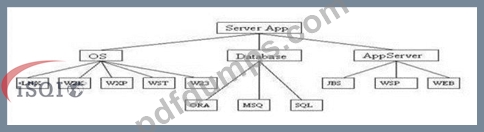
- A. 0
- B. 1
- C. 2
- D. 3
Answer: C
NEW QUESTION # 222
From the following list, which of the following apply to experience-based techniques? [K2]
a. Test cases are derived from a model of the problem to be solved or the software
b. Test cases are derived from the knowledge of the testers
c. The knowledge of testers, developers and users is used to drive testing
d. The internal structure of the code is used to derive test cases
- A. b and c.
- B. a and d.
- C. a and b.
- D. c and d.
Answer: A
NEW QUESTION # 223
Which of the following is an example of Static testing?
- A. Usability testing
- B. Requirements review
- C. Calculating path coverage using tools
- D. Performance testing
Answer: B
Explanation:
Explanation
Static testing is testing of a component or system at a specification or implementation level without execution of that software. Requirements review is an example of static testing, because it involves checking the quality and completeness of the requirements specification document without executing the software.
Reference: A Study Guide to the ISTQB Foundation Level 2018 Syllabus1, Chapter 2, Section 2.3.
NEW QUESTION # 224
An iPhone application identifies and counts all purchases of a particular product from a shopping website. The application incorrectly counts purchase attempts by including both failed attempts, and also those where the purchase was terminated by the user before completion. Testing has identified that the problem was located in the 'purchase identification' module, where the first stage in the purchasing process was counted, rather than a successful confirmed purchase.
Which of the following statements correctly identifies what has happened? [K2]
- A. An error by the programmer led to a mistake in the purchase identification module and this caused a defect in the application
- B. The application failed because of a defect in the purchase identification module caused by a programmer mistake or an error in the specification.
- C. A bug in the purchase identification module caused a fault in the application
- D. A defect in the purchase identification module caused by a mistake in the module specification led to a defect in the overall application
Answer: B
Explanation:
Explanation
The application failed because of a defect in the purchase identification module caused by a programmer mistake or an error in the specification. A defect is a flaw or imperfection in a software product that causes it to fail to meet its requirements or expectations. A failure is an event or behavior of a software product that deviates from its requirements or expectations. An error is a human action or decision that produces a defect.
A mistake is an incorrect action or decision that leads to an error. In this case, the application failed because it incorrectly counted purchase attempts, which was a defect in the purchase identification module. The defect was caused by either a programmer mistake (such as writing wrong code) or an error in the specification (such as defining wrong requirements). A detailed explanation of defects, failures, errors, and mistakes can be found in [A Study Guide to the ISTQB Foundation Level 2018 Syllabus], pages 5-6.
NEW QUESTION # 225
......
Valid CTFL_Syll2018 Exam Updates - 2024 Study Guide: https://actualtorrent.pdfdumps.com/CTFL_Syll2018-valid-exam.html