


PDF Download Free of Workday-Pro-Time-Tracking Valid Practice Test Questions
Workday-Pro-Time-Tracking Test Engine files, Workday-Pro-Time-Tracking Dumps PDF
NEW QUESTION # 19
You have configured a Time Entry Code and assigned a default calculation tag of Callback Guaranteed Time.
What happens when a worker reports time using this Time Entry Code?
- A. The hours are tagged with the Time Calculation Tag applied in the worker's Work Schedule Calendar.
- B. The hours are tagged to the default Time Entry Code identified in the Time Entry Template.
- C. The hours are paid at time and a half the worker's hourly rate.
- D. The hours are tagged with the Callback Guaranteed Time Calculation Tag.
Answer: D
Explanation:
The correct answer is D. The hours are tagged with the Callback Guaranteed Time Calculation Tag .
In Workday Time Tracking, when a default calculation tag is assigned to a Time Entry Code , that tag is automatically applied to time reported with that code unless other calculation logic changes the outcome. This means the time entry itself carries the designated calculation tag into the time calculation process. In this case, if the Time Entry Code has a default calculation tag of Callback Guaranteed Time , then any hours entered using that code will be tagged with Callback Guaranteed Time .
This setup is commonly used to ensure specific kinds of time are consistently identified for later calculation logic, such as guaranteed callback minimums, premiums, or special pay treatment. The tag itself does not automatically determine the pay rate; instead, it marks the hours so the relevant time calculations can recognize and process them correctly.
Option A is incorrect because the worker's Work Schedule Calendar does not control the default calculation tag placed on a Time Entry Code. Option B is incorrect because the Time Entry Template does not retag the reported time to another default code in this way. Option C is incorrect because assigning a calculation tag alone does not directly guarantee payment at time and a half; pay outcomes depend on downstream calculation and payroll configuration.
NEW QUESTION # 20
Refer to the following scenario to answer the question below.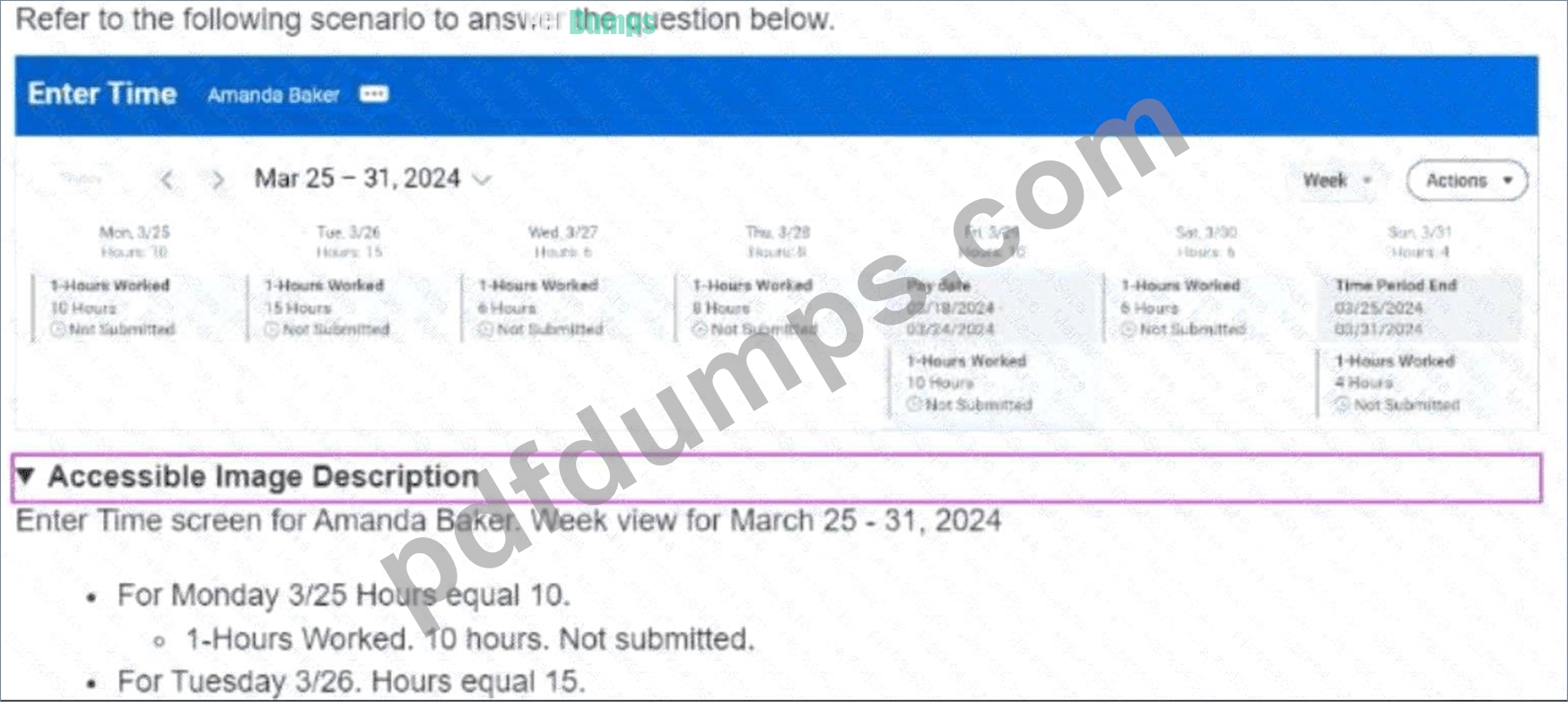
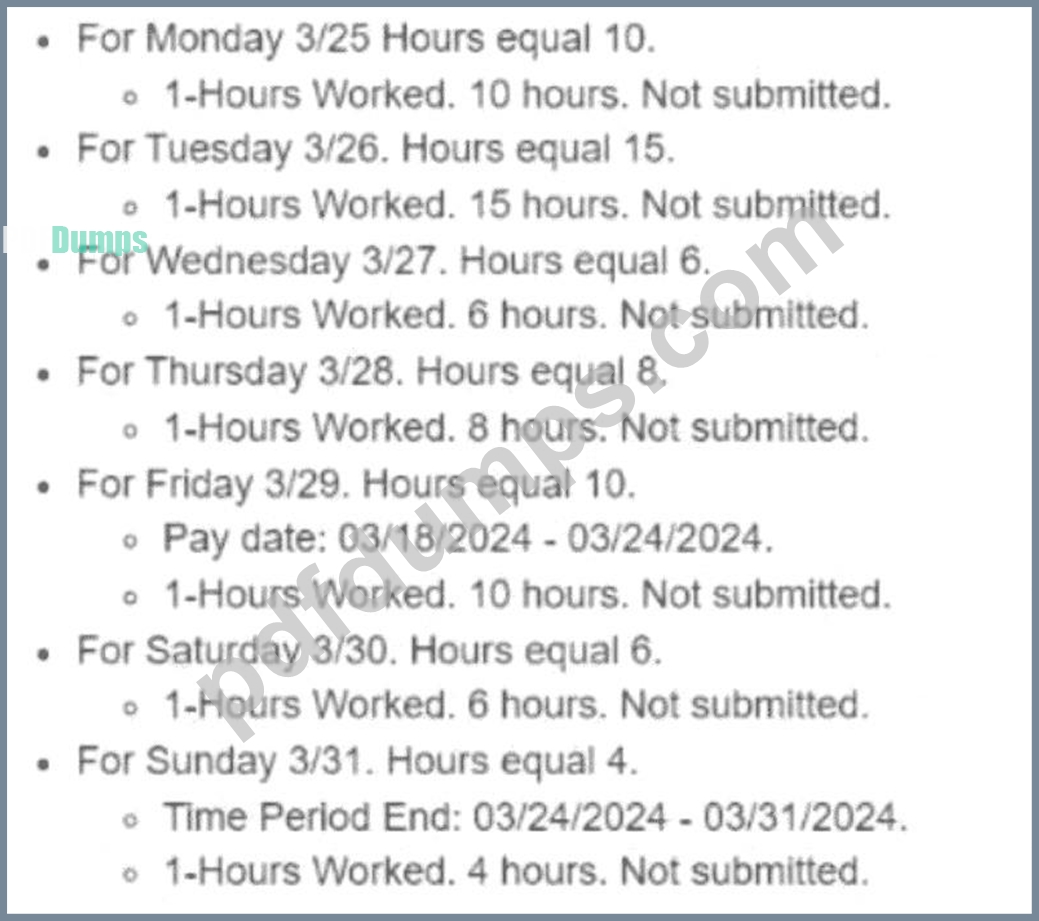
Amanda Baker is eligible for the following calculations: Daily OT > 8 regular hours in a day, Daily double time > 12 regular hours in a day, Weekly OT > 40 regular hours in a week.
How many time calculation tags are assigned on the calculated tab for Tuesday?
- A. 0
- B. 1
- C. 2
- D. 3
Answer: A
Explanation:
The correct answer is C. 3 . On Tuesday , Amanda Baker reported 15 hours . Based on the rules provided, Workday Time Tracking would evaluate those 15 hours against the applicable daily and weekly thresholds.
The first 8 hours remain regular hours . Since she worked more than 8 hours in the day, the next block of hours qualifies for daily overtime . Because she also exceeded 12 hours in the same day , the hours above
12 qualify for daily double time .
That means Tuesday's calculated results would typically be split into three calculation tag categories: Regular
, Daily Overtime , and Daily Double Time . This produces a total of 3 time calculation tags on the calculated tab for that day.
The weekly overtime rule does not add a fourth tag for Tuesday. Weekly overtime applies only after total regular hours for the week exceed 40 . By the end of Tuesday, Amanda has worked 10 hours on Monday +
15 hours on Tuesday = 25 total hours , which is still below the weekly 40-hour threshold. Therefore, weekly overtime has not yet been triggered on Tuesday.
So the correct count of calculation tags assigned for Tuesday is 3 .
NEW QUESTION # 21
Refer to the following scenario to answer the question below.
You are reviewing time for a worker. The worker has reported hours for the seventh consecutive day and the hours are calculating as configured. This week, the worker reported 11 hours on the seventh consecutive day worked. This worker is eligible for double-time on all hours worked over 8 hours on the seventh consecutive day; however, all 11 hours are tagged as seventh consecutive day hours.
To solve this issue, you determine that the worker should be made eligible for a specific time tracking component.
What time tracking component should this worker be eligible for?
- A. Time Entry Template
- B. Time Calculation Group
- C. Time Calculation Tag
- D. Time Code Group
Answer: B
Explanation:
The correct answer is C. Time Calculation Group .
In Workday Time Tracking, a Time Calculation Group is the component that bundles together the time calculations that apply to a specific worker population. If a worker should receive special overtime or double- time logic-such as double time for hours over 8 on the seventh consecutive day -the worker must be eligible for the appropriate Time Calculation Group that contains those rules.
In this scenario, the worker's time is being tagged as seventh consecutive day hours, but the expected split into double time after 8 hours is not occurring. That strongly suggests the worker is not currently eligible for the calculation group that includes the seventh consecutive day double-time calculation . Making the worker eligible for the correct calculation group ensures Workday runs the additional rule needed to reclassify hours over the threshold.
The other options are not correct for this purpose. A Time Entry Template controls how time is entered, not how overtime logic is calculated. A Time Calculation Tag is a result or identifier used by calculations, not an eligibility-based worker component. A Time Code Group organizes time entry codes, but it does not determine whether complex overtime calculations are applied.
Therefore, the worker should be made eligible for the appropriate Time Calculation Group
NEW QUESTION # 22
You want to ensure all historical reported and calculated time data is permanently locked from editing by any user.
What function do you use?
- A. Unlock for Adjustments
- B. Open Time Entry
- C. Lock Time Entry
- D. Close Time Entry
Answer: C
Explanation:
The correct answer is B. Lock Time Entry .
In Workday Time Tracking, Lock Time Entry is the function used when an organization wants historical reported time and calculated time results to be locked from further editing by any user. This is typically used after time has been finalized and organizations want to preserve data integrity for payroll, audit, compliance, and historical recordkeeping. Once time is locked, Workday prevents normal editing activity against that time data, which makes it the strongest control for protecting finalized history.
This is different from Close Time Entry . Closing time entry generally controls whether a time entry period is open for entry and processing, but it is not the same as applying a hard lock to historical data. Unlock for Adjustments is the opposite action, used when previously locked time must be reopened in a controlled way for corrections. Open Time Entry is used to allow time entry activity, not to secure finalized data.
The wording in the question is important: it asks for a function that ensures historical reported and calculated time data is permanently locked from editing by any user . In Workday Time Tracking, that requirement aligns most directly with Lock Time Entry , because it is specifically intended to secure finalized time data from further modification.
NEW QUESTION # 23
What is the recommended sequence that time calculations should be processed?
- A. Calculations using Worktags should be prioritized after all overtime calculations.
- B. Double-time calculations should be prioritized before overtime calculations.
- C. Weekly overtime calculations should be processed before daily overtime calculations.
- D. Monthly overtime calculations should be prioritized first.
Answer: B
Explanation:
The correct answer is A. Double-time calculations should be prioritized before overtime calculations .
In Workday Time Tracking, the sequence of time calculation processing is critical because one calculation may change the tags or hours that another calculation evaluates. When both double time and overtime rules apply, the recommended approach is to process the more specific and higher-premium rule first . That is why double-time calculations should be prioritized before overtime calculations .
This sequencing prevents hours that should qualify as double time from first being absorbed into a broader overtime rule. For example, if overtime runs before double time, Workday may tag or remove hours in a way that interferes with the later double-time calculation. By allowing double time to run first, the system correctly identifies the highest-threshold hours and preserves proper pay treatment before more general overtime logic is applied to the remaining eligible time.
Option B is incorrect because there is no general Workday recommendation that monthly overtime should always run first. Option C is incorrect because worktag-based calculations are not universally sequenced after all overtime calculations; their order depends on business design. Option D is incorrect because weekly overtime is typically not processed before daily overtime when both rules interact; daily and other premium thresholds usually need to be identified first.
Therefore, the recommended processing sequence is to prioritize double-time calculations before overtime calculations .
NEW QUESTION # 24
When creating a work schedule calendar, what does the Work Week Start Day field default to?
- A. Saturday
- B. Monday
- C. Friday
- D. Sunday
Answer: B
Explanation:
The correct answer is D. Monday .
In Workday Time Tracking, when you create a Work Schedule Calendar , the Work Week Start Day field defaults to Monday . This default is important because the work week start day influences how Workday organizes weekly scheduling, displays calendar weeks, and applies certain weekly time calculations. Since many organizations structure operational or reporting weeks from Monday through Sunday, Workday uses Monday as the standard default starting point unless configuration is intentionally changed.
This field matters because it helps define how a worker's schedule is grouped across the week for planning and tracking purposes. It can affect how managers and administrators interpret weekly patterns, shift rotations, and time-based reporting. Although organizations may later adjust the work week start day based on business requirements, regional practices, or union rules, the initial default value during setup remains Monday .
The other answer choices are incorrect because they are not the standard default delivered in the initial calendar setup. While a company could choose Friday , Saturday , or Sunday for a custom business need, those are configured exceptions rather than the default system behavior.
So, for a newly created Work Schedule Calendar in Workday Time Tracking, the Work Week Start Day defaults to Monday .
NEW QUESTION # 25
What app provides a central location for cards that display frequently used tasks and reports for Time Tracking?
- A. Time Administrator Home
- B. All Time Entry Templates
- C. View Worker's Time Eligibility
- D. View Worker's Time Eligibility by Organization
Answer: A
Explanation:
The correct answer is D. Time Administrator Home .
In Workday Time Tracking, Time Administrator Home is the app designed to provide administrators with a centralized workspace for managing time tracking activities. It displays cards that surface commonly used tasks, reports, alerts, and administrative actions, making it easier for time administrators to access the most relevant tools from one place. This home page is intended to improve efficiency by organizing frequent Time Tracking functions into a single operational hub.
The other options are not apps that provide a card-based administrative home experience. All Time Entry Templates is a report or task used to review configured templates, not a central home app. View Worker's Time Eligibility is a worker-specific report used to review which time tracking components apply to a worker. View Worker's Time Eligibility by Organization is also a reporting function, focused on reviewing eligibility across organizations rather than serving as a dashboard.
Because the question specifically asks for an app that offers a central location for cards showing frequently used Time Tracking tasks and reports, Time Administrator Home is the only option that fits that description.
It is the main administrative landing area for ongoing monitoring and action in Workday Time Tracking.
Therefore, the correct answer is D. Time Administrator Home .
NEW QUESTION # 26
How are Time Tracking Calculations assigned to workers?
- A. They are added to Time Calculation Groups where eligibility is assigned.
- B. They are added to the Time Entry Template.
- C. They are added directly to the worker upon hire or job change.
- D. They are added to the worker's Supervisory Organization.
Answer: A
Explanation:
The correct answer is C. They are added to Time Calculation Groups where eligibility is assigned .
In Workday Time Tracking, individual time calculations are not assigned directly to workers one by one .
Instead, calculations are bundled into a Time Calculation Group , and that group is then associated with workers through eligibility rules . This design allows organizations to manage calculations efficiently for groups of workers who share the same overtime, premium, shift, or regulatory rules.
For example, one worker population may need standard weekly overtime calculations, while another may require California daily overtime, double time, and seventh consecutive day rules. Rather than assigning each calculation directly to each worker, Workday places those calculations into the appropriate Time Calculation Group and uses worker eligibility criteria to determine who receives that group.
Option A is incorrect because a Time Entry Template controls how workers enter time, not which calculations process the time. Option B is incorrect because calculations are not typically assigned directly to the worker record during hire or job change. Option D is incorrect because a Supervisory Organization may help drive eligibility logic, but calculations are not assigned there as the delivery mechanism.
Therefore, in Workday, Time Tracking Calculations are assigned through Time Calculation Groups with eligibility rules , making C the correct answer.
NEW QUESTION # 27
On what Time Tracking component can you configure a worktag as required?
- A. Time Entry template
- B. Time Calculation tag
- C. Time entry code
- D. Worktag
Answer: A
Explanation:
The correct answer is D. Time Entry template .
In Workday Time Tracking, the Time Entry template controls the structure of the time entry experience for a group of workers. This includes what fields appear during time entry, how time is entered, and whether certain information must be provided before a worker can submit time. When a business wants to make a worktag required , that requirement is configured through the Time Entry template , because the template governs the entry rules and data capture requirements presented to the worker.
This is the correct design point because worktags such as cost center, project, grant, or other organizational tracking values are often needed at the point of entry for labor costing, reporting, or downstream payroll and financial processing. By making the worktag required in the template, Workday enforces that workers supply that value whenever they enter qualifying time.
The other options are not the primary place for this setup. A Worktag is the classification object itself, not the entry-rule configuration component. A Time entry code identifies the type of time being reported, such as regular or training time, but it does not generally control whether a worktag is universally required in the entry interface. A Time Calculation tag is used for calculation logic, not for entry field requirements.
So the correct answer is D. Time Entry template .
NEW QUESTION # 28
What report do you run to ensure that a period schedule is assigned to a worker?
- A. Audit - Workers with Multiple Time Period Schedules
- B. View Worker's Time Eligibility
- C. Time Entry Period Schedule Review
- D. View Period Schedule
Answer: B
Explanation:
The correct answer is D. View Worker's Time Eligibility .
In Workday Time Tracking, when you want to confirm whether a specific worker has been assigned a period schedule , the most direct report is View Worker's Time Eligibility . This report is used to review which Time Tracking components a worker is currently eligible for and receiving, including items such as time entry templates, approval templates, and period schedules . Since the question is focused on verifying assignment to a worker , this worker-level eligibility view is the most appropriate choice.
The other options do not fit the requirement as well. Audit - Workers with Multiple Time Period Schedules is an exception report used to identify workers who have more than one schedule, not to simply confirm that a worker has one assigned. View Period Schedule lets you inspect the schedule definition itself, but it is not the best worker-specific confirmation tool. Time Entry Period Schedule Review may sound related, but it is not the standard report used to validate a worker's eligibility-based assignment in the same direct way.
So, if your goal is to ensure that a particular worker is assigned the correct period schedule, the correct report is View Worker's Time Eligibility .
NEW QUESTION # 29
What calculated field type will you use to calculate the number of holidays a worker has in a time week?
- A. Count Related Instances
- B. Lookup Related Value
- C. Date Difference
- D. Arithmetic
Answer: A
Explanation:
The correct answer is B. Count Related Instances .
In Workday Time Tracking, when the requirement is to determine how many holidays occur for a worker within a time week , the calculation is about counting occurrences of related records that meet certain criteria. That is exactly what Count Related Instances is designed to do. It counts the number of related objects or records associated with the parent business object, typically after applying a filter such as days marked as holidays.
In this scenario, the parent context is the time week , and the system needs to count how many related day- level instances in that week qualify as holidays. Because the requirement is a numeric count of instances , not a sum of hours or a mathematical formula, Count Related Instances is the most appropriate calculated field type.
The other options do not match the business need. Arithmetic is used when combining numeric values through math operations, but first you would still need the holiday count itself. Lookup Related Value retrieves a value from a related object, not the number of occurrences. Date Difference calculates the difference between two dates and is not intended for counting holiday days in a week.
Therefore, for calculating the number of holidays in a time week, the correct calculated field type is Count Related Instances .
NEW QUESTION # 30
You need to track regular hours and callback time. How will you configure the Callback time entry code so it is only used for time calculations referencing Callback tags?
- A. Callback should not be configured as a time entry code.
- B. Callback must be configured as a separate time entry code with the default Calculation Tag field blank.
- C. Callback must be configured on the Advanced tab on the time entry code.
- D. Callback must be configured as a temporary Time Calculation tag.
Answer: C
Explanation:
The correct answer is D. Callback must be configured on the Advanced tab on the time entry code . In Workday Time Tracking, when a specific type of entered time such as callback time needs to be recognized only by certain time calculations, that behavior is typically controlled through calculation tags associated with the time entry code . These settings are maintained on the Advanced configuration area of the time entry code, where Workday allows the code to be tied to the appropriate calculation logic.
This setup is important because callback hours are usually different from regular worked hours and often need separate treatment for premiums, overtime rules, or special pay outcomes. By configuring the Callback- related calculation behavior directly on the time entry code, Workday ensures that only time calculations referencing the Callback tag evaluate that entry in the intended way.
Option A is incorrect because leaving the default calculation tag blank would not specifically direct callback entries into callback-based calculations. Option B is incorrect because a "temporary Time Calculation tag" is not the correct setup approach for a permanent time entry type like callback. Option C is incorrect because callback absolutely can and often should be configured as a distinct time entry code for accurate tracking and payroll-related calculation logic.
NEW QUESTION # 31
What Time Type do you use to enter elapsed time?
- A. Time Off Time Type
- B. In/Out Time Type
- C. Hours Only Time Type
- D. Absence Table Time Type
Answer: C
Explanation:
The correct answer is B. Hours Only Time Type .
In Workday Time Tracking, elapsed time means entering the total amount of time worked as a number of hours rather than recording specific start and end punch times . That is exactly the purpose of the Hours Only Time Type . It is used when workers report time by duration, such as 8 hours of regular work, 4 hours of training, or 2.5 hours on a project, without providing in and out timestamps.
This differs from the In/Out Time Type , which is used when workers must record actual clock-style entries such as start time, meal breaks, and end time. That method is appropriate for punch-based populations, but it is not considered elapsed-time entry in the way this question is asking. Absence Table Time Type and Time Off Time Type are related to absence and leave reporting, not standard worked time entered as elapsed hours.
The distinction is important in Workday setup because a worker's time entry experience depends heavily on the Time Type assigned through the relevant templates and eligibility rules. If the business wants workers to simply enter the amount of time worked rather than exact punches, the appropriate configuration is Hours Only Time Type .
NEW QUESTION # 32
You need to create a validation that warns a worker if they have multiple time blocks with overtime in a time period.
What is the top-level business object?
- A. Worker
- B. Time Block
- C. Time Day
- D. Time Week
Answer: D
Explanation:
The correct answer is A. Time Week .
In Workday Time Tracking, the top-level business object should match the level at which the validation needs to evaluate data. This question asks for a warning if a worker has multiple time blocks with overtime in a time period . Because the requirement is not limited to a single block or a single day, Workday must evaluate time across a broader period and determine whether multiple qualifying overtime blocks exist within that span. For this kind of period-based validation, Time Week is the correct top-level business object.
Using Time Week allows the validation to review all related time blocks within the weekly time context and count or evaluate how many overtime-related blocks exist. This is appropriate when the validation logic depends on a grouped time period rather than on an individual transaction.
The other options are less suitable. Time Block is too granular because it only represents one specific entry and cannot serve as the best top-level object for evaluating multiple blocks across a period. Time Day would only evaluate one day at a time, not the broader time period. Worker is too general and does not provide the specific time-period structure needed for this validation design.
Therefore, for a validation checking multiple overtime time blocks within a time period, the correct top-level business object is Time Week .
NEW QUESTION # 33
Refer to the following scenario to answer the question below.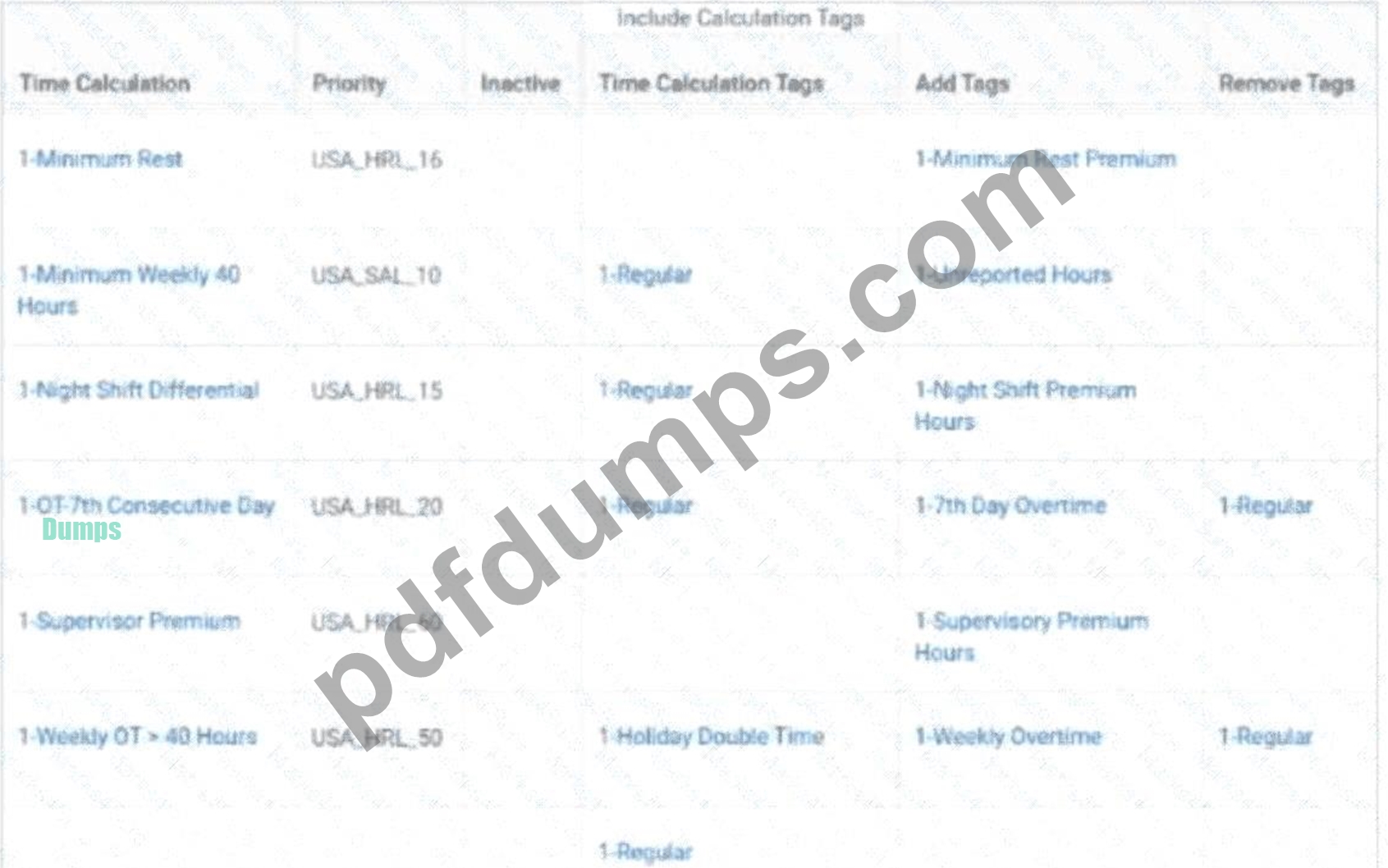
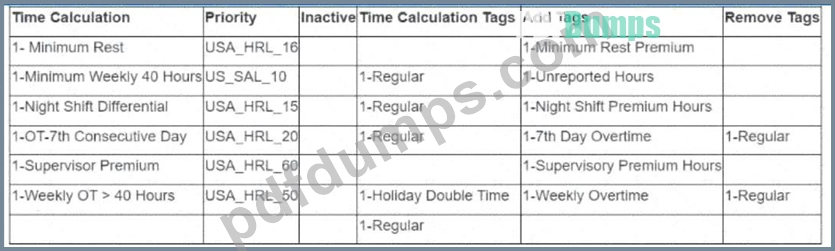
In the report, what calculation has the highest priority?
- A. 1-Night Shift Differential
- B. 1-Minimum Rest
- C. 1-Minimum Weekly 40 Hours
- D. 1-Weekly Overtime
Answer: C
Explanation:
The correct answer is D. 1-Minimum Weekly 40 Hours . In the scenario shown, the Priority column lists the calculation priorities as values such as USA_HRL_16 , USA_SAL_10 , USA_HRL_15 , USA_HRL_20 , and USA_HRL_50 . Among the answer choices, 1-Minimum Weekly 40 Hours has the priority USA_SAL_10 , which represents the highest priority in the report because it carries the lowest priority number shown among the listed options.
In Workday Time Tracking, priorities are important because they determine the sequence in which time calculations are applied. This matters when more than one time calculation can affect the same reported time.
Higher-priority calculations are evaluated first, and their output may influence later calculations such as overtime, premiums, shift differential, or exception handling. That sequencing is essential to avoid overlap, double counting, or incorrect premium generation.
The other options have lower priority values in the report: 1-Night Shift Differential is USA_HRL_15 , 1- Minimum Rest is USA_HRL_16 , and 1-Weekly Overtime is not the highest priority item shown.
Therefore, based on the priority values displayed in the report, the correct choice is 1-Minimum Weekly 40 Hours .
NEW QUESTION # 34
The tenant includes a daily overtime calculation (regular hours > 8) with the priority of USA0045. You need to configure a daily double time calculation (regular hours > 12).
What priority should you assign to the Daily Double Time calculation so it calculates before the Daily Overtime?
- A. USA0040
- B. USA0045
- C. USA0055
- D. USA0050
Answer: A
Explanation:
The correct answer is A. USA0040 .
In Workday Time Tracking, time calculation priority determines the order in which calculations are processed. A calculation with a lower priority value runs before a calculation with a higher value. Since the existing Daily Overtime calculation has a priority of USA0045 , any new calculation that must run earlier needs a priority number lower than 0045.
Because the organization wants the Daily Double Time rule for hours greater than 12 to calculate before Daily Overtime, the proper priority is USA0040 . This ensures that the double time logic evaluates first and can correctly identify the hours that should receive double time treatment before the broader overtime calculation processes the remaining qualifying hours.
The other options are incorrect for the following reasons. USA0045 would place the new calculation at the same priority as Daily Overtime, which does not ensure the correct processing sequence. USA0050 and USA0055 are higher values, so they would run after the overtime calculation, which could lead to incorrect tagging or pay treatment of hours above 12.
In Workday, correct priority sequencing is critical whenever multiple calculations interact, especially for overtime and premium scenarios. Therefore, the correct priority is USA0040 .
NEW QUESTION # 35
A group of In/Out workers need automatically-created time blocks for their meal breaks. While configuring this, you notice the option is unavailable.
What prerequisite setting do you need to enable first?
- A. Ensure Break is an allowed out reason in the Allowable Types for Out Time.
- B. Ensure Meal is an allowed out reason in the Allowable Types for Out Time.
- C. Ensure the Default In/Out Pattern is set to In/Break, In/Meal, In/Break, In/Out.
- D. Ensure the Default In/Out Pattern is set to In/Meal, In/Out.
Answer: B
Explanation:
The correct answer is D. Ensure Meal is an allowed out reason in the Allowable Types for Out Time .
In Workday Time Tracking, automatically created meal-break time blocks depend on Workday being able to recognize Meal as a valid Out Time reason for the worker's in/out configuration. If Meal is not included in the Allowable Types for Out Time , the related setup option for automatic meal-break block creation will not be available because the system has no valid meal event type to generate against.
This is a prerequisite relationship in setup: first, the time entry framework must allow Meal as a valid out- time type; only then can Workday support automated handling tied specifically to meal breaks. Without that allowed type, the system cannot distinguish meal-related out times from other kinds of breaks or punches.
Option C is incorrect because Break and Meal are different out reasons in Workday, and the question specifically asks about meal breaks . Options A and B focus on the default in/out pattern, which can influence entry behavior, but they do not represent the key prerequisite that unlocks the automatic meal-break configuration. The system must first recognize Meal as an approved out reason.
NEW QUESTION # 36
The time tracking administrator asks you to confirm that workers are reporting their scheduled hours each day.
What type of time calculation will you use?
- A. Minimum Daily
- B. Standard Overtime
- C. Shift Differential
- D. Time Block Conditional
Answer: A
Explanation:
The correct answer is B. Minimum Daily .
In Workday Time Tracking, a Minimum Daily time calculation is used when the business needs to compare the amount of time a worker reported in a day against an expected minimum threshold. When the requirement is to confirm that workers are reporting their scheduled hours each day , this is essentially a daily minimum- hours validation and calculation scenario. Workday uses Minimum Daily logic to evaluate whether reported time meets the expected number of hours for that day and to identify shortfalls when the worker reports less than the required amount.
This calculation type is commonly used in situations where organizations need to ensure daily schedule compliance, guaranteed minimums, or identify underreported time based on work expectations. Since the question is about confirming scheduled daily hours, Minimum Daily is the best fit because it focuses directly on the comparison of daily reported hours against the expected daily amount.
The other options are not correct for this purpose. Shift Differential is used for premium treatment based on shift timing, such as evening or night work. Time Block Conditional evaluates conditions on individual time blocks, but it is not the standard calculation type for checking whether daily scheduled hours were fully reported. Standard Overtime applies to hours exceeding thresholds, not to verifying whether minimum scheduled hours were entered.
So the correct calculation type is Minimum Dai ly.
NEW QUESTION # 37
What restrictions apply to the Adjust Calculated Time task?
- A. Adjusted time will continue to be calculated by Workday just like normal time.
- B. Adjustments are submitted only during unlocked periods.
- C. A worker cannot adjust their own calculated time.
- D. Time off is eligible to be adjusted.
Answer: C
Explanation:
The correct answer is C. A worker cannot adjust their own calculated time .
In Workday Time Tracking, the Adjust Calculated Time task is an administrative function used to correct or override calculated time results, such as overtime or premium outcomes, when the automatically generated result needs manual intervention. Because this task can directly change calculation outcomes that affect pay, compliance, and reporting, Workday restricts it from being performed by the worker on their own time.
Instead, it is intended for authorized administrative roles, such as a time tracking administrator or another appropriately secured user.
Option A is incorrect because time off is not generally the focus of the Adjust Calculated Time task; this task is used for calculated worked-time results, not for adjusting absence or time-off entries in the same way.
Option B is not the best restriction stated here because period locking rules relate to broader time-entry administration and do not define the core restriction of who can perform the task. Option D is incorrect because once calculated time is manually adjusted, it is no longer simply treated the same as fully system- calculated normal time; the adjustment reflects an administrative override.
Therefore, the key restriction that applies is that a worker cannot adjust their own calculated time , making C the correct answer.
NEW QUESTION # 38
What EIB is used for loading legacy time entry data for configuration testing?
- A. Import Reported Time Blocks
- B. Put Holiday Calendar
- C. Put Period Schedule
- D. Payroll Input
Answer: A
Explanation:
The correct answer is B. Import Reported Time Blocks .
In Workday Time Tracking, when an organization needs to load legacy time entry data into the tenant for configuration testing , the appropriate Enterprise Interface Builder (EIB) is Import Reported Time Blocks .
This EIB is specifically designed to bring in historical or external reported time entries so that organizations can validate how Workday processes time calculations, overtime rules, validations, approvals, and downstream integrations using realistic data.
This is especially useful during implementation or testing cycles when the team wants to confirm that configured time entry templates, time calculations, and administrative processes behave correctly with actual time data patterns from the legacy system. By importing reported time blocks, Workday can apply the configured rules and allow testers to compare expected and actual outcomes.
The other options are not intended for loading time entry history. Payroll Input is used for payroll-related input data, not for time entry blocks. Put Period Schedule is used to maintain or load period schedule information. Put Holiday Calendar is for holiday setup, not worker time records. None of those options load the detailed reported worked-time entries needed for time tracking configuration testing.
Therefore, the correct EIB for loading legacy time entry data into Workday Time Tracking is Import Reported Time Blocks .
NEW QUESTION # 39
You are creating a time block conditional calculation.
What business object can you use to check for adjusted, calculated time?
- A. Time Shift
- B. Time Block
- C. Time Day
- D. Time Week
Answer: B
Explanation:
The correct answer is A. Time Block .
In Workday Time Tracking, a Time Block Conditional calculation evaluates conditions at the individual time entry level . When the requirement is to check for adjusted, calculated time , the relevant information is associated with the actual time block record, because that is where Workday stores the entered time and the calculation outcomes tied to that specific entry. A Time Block is the most granular time-related business object and is the correct object to use when testing whether a block has been adjusted or contains calculated results.
This is important because Time Block Conditional logic is intended to inspect and act on specific time blocks rather than broader summarized periods. If you need to determine whether a worker's time block reflects adjusted calculated time, the evaluation must happen on the Time Block object itself.
The other options are not correct for this use case. Time Shift relates more to shift structure or scheduling context, not the direct record used for conditional evaluation of calculated time. Time Day summarizes time at the day level and is used for daily comparisons or accumulations. Time Week is used for weekly totals and thresholds. Neither Time Day nor Time Week is the right object for checking an individual adjusted, calculated time block.
Therefore, the correct business object is Time Block .
NEW QUESTION # 40
A manager uses the Assign Work Schedule task to assign a work schedule to a worker.
What overrides the schedule assignment?
- A. Ad hoc schedule changes
- B. Flextime bands
- C. Work schedule eligible rules
- D. Schedule deviation calculation
Answer: A
Explanation:
The correct answer is D. Ad hoc schedule changes .
In Workday Time Tracking, when a manager assigns a work schedule to a worker using the Assign Work Schedule task, that schedule becomes the worker's standard planned schedule. However, Workday also supports temporary or date-specific exceptions through ad hoc schedule changes . These changes are designed to override the normal assigned schedule for a particular day or period without replacing the worker' s overall schedule assignment. This is useful when a worker has a temporary shift change, a one-time different start and end time, or a short-term adjustment due to business needs.
This is why ad hoc schedule changes are considered the override mechanism. They sit on top of the normal schedule assignment and take precedence for the affected dates.
The other options do not override the assigned work schedule itself. Flextime bands provide flexibility around expected start and end times, but they do not replace the assigned schedule. Schedule deviation calculation is used to compare reported time against schedule expectations and identify variances; it analyzes schedule differences rather than overriding the schedule. Work schedule eligible rules determine which workers can receive certain schedules, but they do not act as overrides after assignment.
So, the component that overrides an assigned work schedule is Ad hoc schedule changes .
NEW QUESTION # 41
Refer to the following scenario to answer the question below.
You are reviewing time for a worker in California. The worker has reported hours for the seventh consecutive day and the hours are calculating as configured. This week the worker reported 11 hours on the seventh consecutive day worked. This worker is eligible for double-time on all hours worked over 8 on the seventh consecutive day; however, all 11 hours are tagged as seventh consecutive day hours.
You have created and assigned the Seventh Consecutive Day Double Time time calculation to a time calculation group.
Where on the Seventh Consecutive Day Double Time calculation do you find the hours that count toward seventh consecutive day double time?
- A. Include Calculation Tags grid
- B. Add Tags field
- C. Remove Tags field
- D. Time Calculation Group grid
Answer: A
Explanation:
The correct answer is A. Include Calculation Tags grid .
In Workday Time Tracking, the Include Calculation Tags section determines which hours are evaluated by a specific time calculation. For a rule such as Seventh Consecutive Day Double Time , Workday looks at the hours that already carry certain calculation tags and uses those tagged hours to determine whether the threshold for double time has been reached. In other words, the hours that count toward the seventh consecutive day double-time rule are identified in the Include Calculation Tags grid .
This is different from the Add Tags field, which defines the result of the calculation by specifying the tag that will be added after the criteria are met. The Remove Tags field controls which tags should be removed once the calculation applies. The Time Calculation Group grid is not where the hours are identified; it simply groups related calculations for worker eligibility and execution.
In this scenario, if all 11 hours remain tagged as seventh consecutive day hours instead of splitting after 8 hours, reviewing the Include Calculation Tags grid is essential because it shows exactly which tagged hours Workday is counting toward the threshold. That is the configuration area that determines the hours considered for the seventh consecutive day double-time calculation.
Therefore, the correct answer is A .
NEW QUESTION # 42
......
Pass Your Workday Certification Workday-Pro-Time-Tracking Exam on Aug 28, 2026 with 57 Questions: https://actualtorrent.pdfdumps.com/Workday-Pro-Time-Tracking-valid-exam.html