


Pass DP-203 Exam Latest Practice Questions Updated on Mar 16, 2026
Microsoft DP-203 Study Guide Archives
The DP-203 certification exam is an excellent way for data professionals to enhance their skills and demonstrate their expertise to potential employers. Data Engineering on Microsoft Azure certification is recognized globally and is a valuable asset for individuals looking to advance their careers in data engineering. Furthermore, Microsoft Azure is becoming increasingly popular, and the demand for data engineering professionals who can design and implement data solutions on Microsoft Azure is growing. Therefore, passing the DP-203 certification exam is a great way to stay ahead of the competition and demonstrate your expertise in data engineering on Microsoft Azure.
Microsoft DP-203 certification exam is an excellent credential for data professionals who want to demonstrate their expertise in data engineering on Azure. Data Engineering on Microsoft Azure certification can help candidates enhance their career prospects and open up new job opportunities. With the right preparation and study, candidates can pass the Microsoft DP-203 certification exam and become certified data engineers on Azure.
NEW QUESTION # 186
You are designing a sales transactions table in an Azure Synapse Analytics dedicated SQL pool. The table will contains approximately 60 million rows per month and will be partitioned by month. The table will use a clustered column store index and round-robin distribution.
Approximately how many rows will there be for each combination of distribution and partition?
- A. 60 million
- B. 5 million
- C. 20 million
- D. 1 million
Answer: A
Explanation:
Explanation
https://docs.microsoft.com/en-us/azure/synapse-analytics/sql-data-warehouse/sql-data-warehouse-tables-partition
NEW QUESTION # 187
You are designing an application that will store petabytes of medical imaging data When the data is first created, the data will be accessed frequently during the first week. After one month, the data must be accessible within 30 seconds, but files will be accessed infrequently. After one year, the data will be accessed infrequently but must be accessible within five minutes.
You need to select a storage strategy for the dat
a. The solution must minimize costs.
Which storage tier should you use for each time frame? To answer, select the appropriate options in the answer area.
NOTE: Each correct selection is worth one point.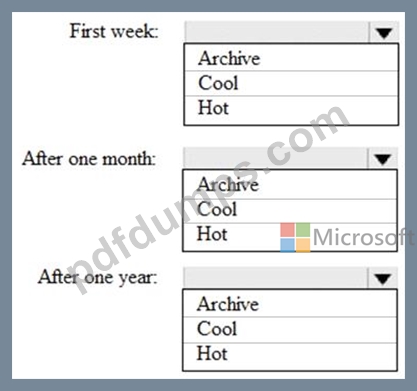
Answer:
Explanation: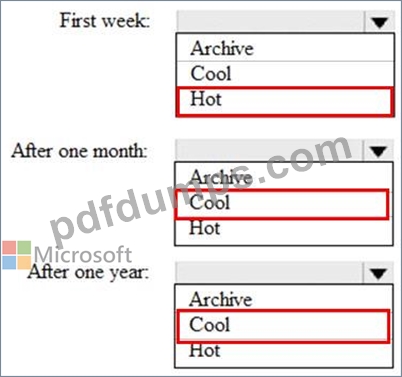
Reference:
https://docs.microsoft.com/en-us/azure/storage/blobs/storage-blob-storage-tiers
NEW QUESTION # 188
You need to collect application metrics, streaming query events, and application log messages for an Azure Databrick cluster.
Which type of library and workspace should you implement? To answer, select the appropriate options in the answer area.
NOTE: Each correct selection is worth one point.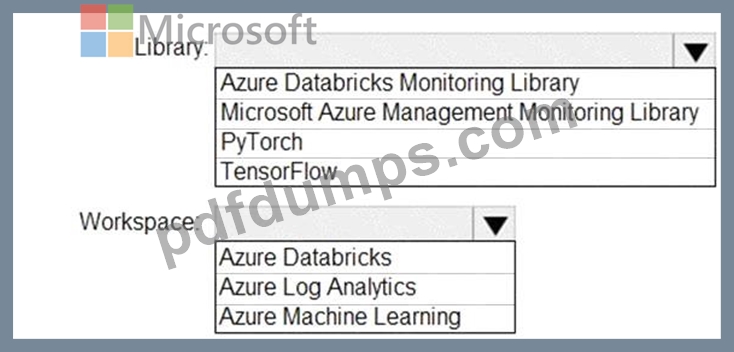
Answer:
Explanation: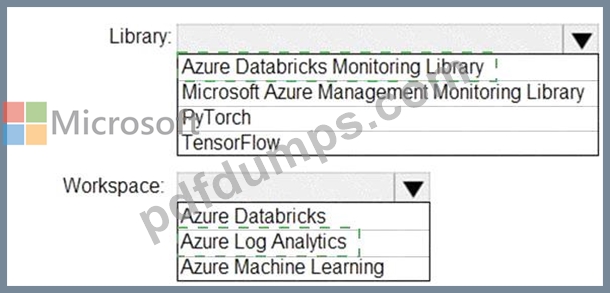
Explanation: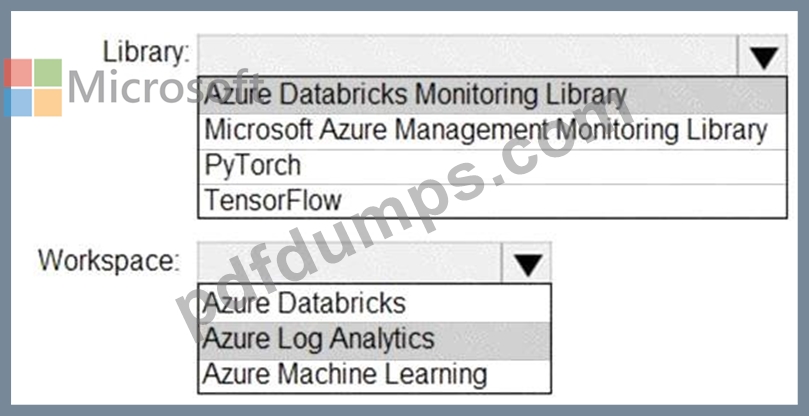
You can send application logs and metrics from Azure Databricks to a Log Analytics workspace. It uses the Azure Databricks Monitoring Library, which is available on GitHub.
References:
https://docs.microsoft.com/en-us/azure/architecture/databricks-monitoring/application-logs
NEW QUESTION # 189
You plan to create a real-time monitoring app that alerts users when a device travels more than 200 meters away from a designated location.
You need to design an Azure Stream Analytics job to process the data for the planned app. The solution must minimize the amount of code developed and the number of technologies used.
What should you include in the Stream Analytics job? To answer, select the appropriate options in the answer area.
NOTE: Each correct selection is worth one point.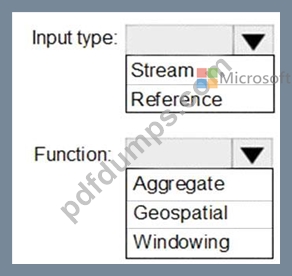
Answer:
Explanation: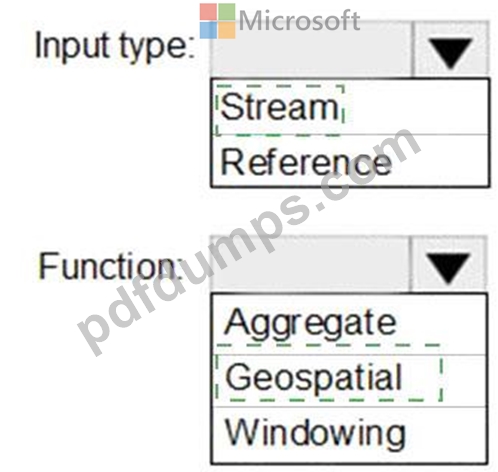
Explanation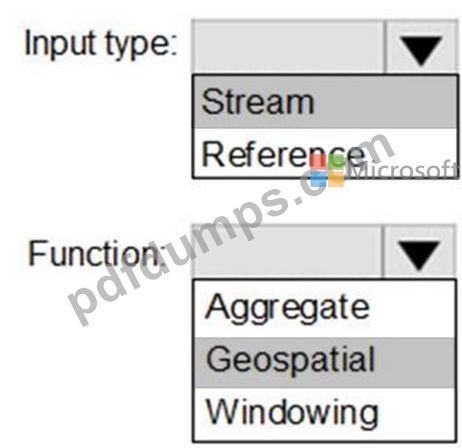
Diagram, table Description automatically generated
Input type: Stream
You can process real-time IoT data streams with Azure Stream Analytics.
Function: Geospatial
With built-in geospatial functions, you can use Azure Stream Analytics to build applications for scenarios such as fleet management, ride sharing, connected cars, and asset tracking.
Note: In a real-world scenario, you could have hundreds of these sensors generating events as a stream.
Ideally, a gateway device would run code to push these events to Azure Event Hubs or Azure IoT Hubs.
Reference:
https://docs.microsoft.com/en-us/azure/stream-analytics/stream-analytics-get-started-with-azure-stream-analytics
https://docs.microsoft.com/en-us/azure/stream-analytics/geospatial-scenarios
NEW QUESTION # 190
You have an Azure subscription.
You need to deploy an Azure Data Lake Storage Gen2 Premium account. The solution must meet the following requirements:
* Blobs that are older than 365 days must be deleted.
* Administrator efforts must be minimized.
* Costs must be minimized
What should you use? To answer, select the appropriate options in the answer area. NOTE Each correct selection is worth one point.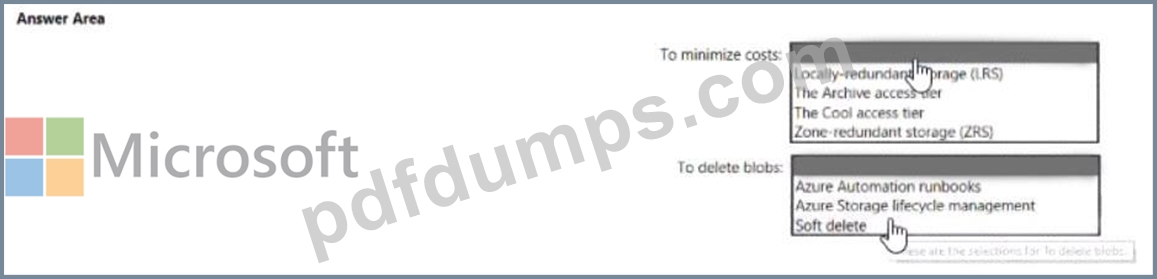
Answer:
Explanation: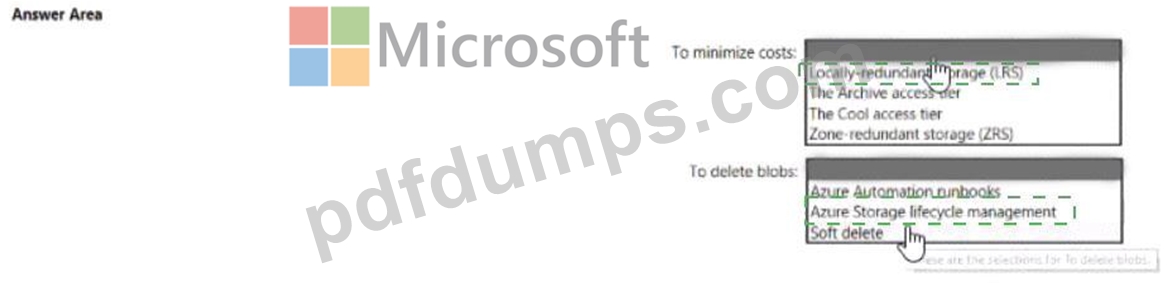
Explanation
NEW QUESTION # 191
You have an Azure subscription that contains an Azure Synapse Analytics dedicated SQL pool named Pool1 and an Azure Data Lake Storage account named storage1. Storage1 requires secure transfers.
You need to create an external data source in Pool1 that will be used to read .orc files in storage1.
How should you complete the code? To answer, select the appropriate options in the answer area.
NOTE: Each correct selection is worth one point.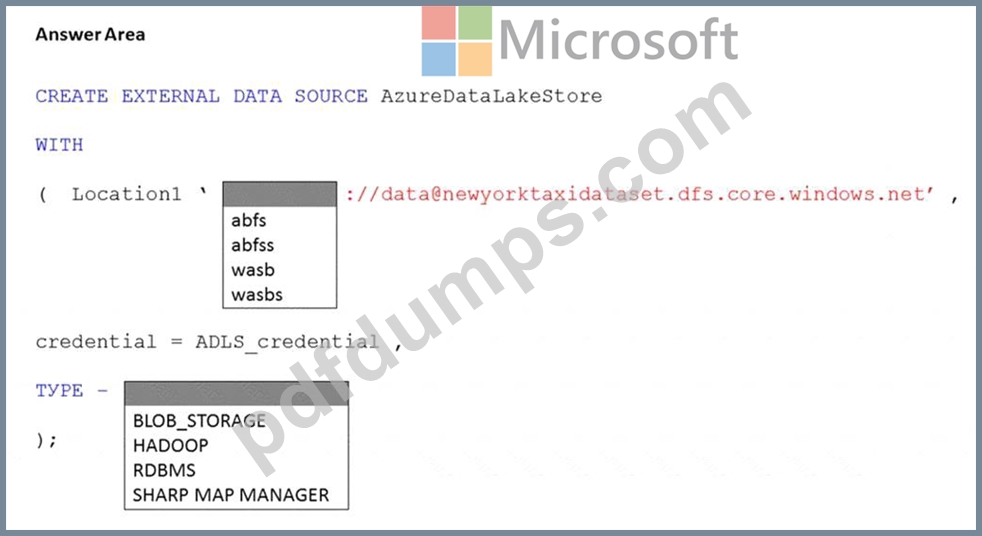
Answer:
Explanation: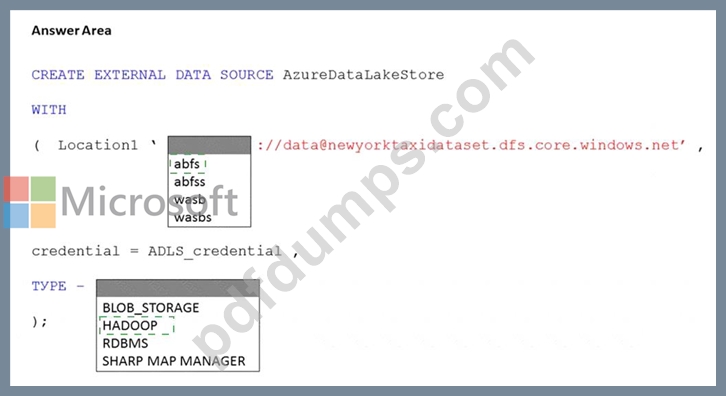
Explanation
Graphical user interface, text, application, email Description automatically generated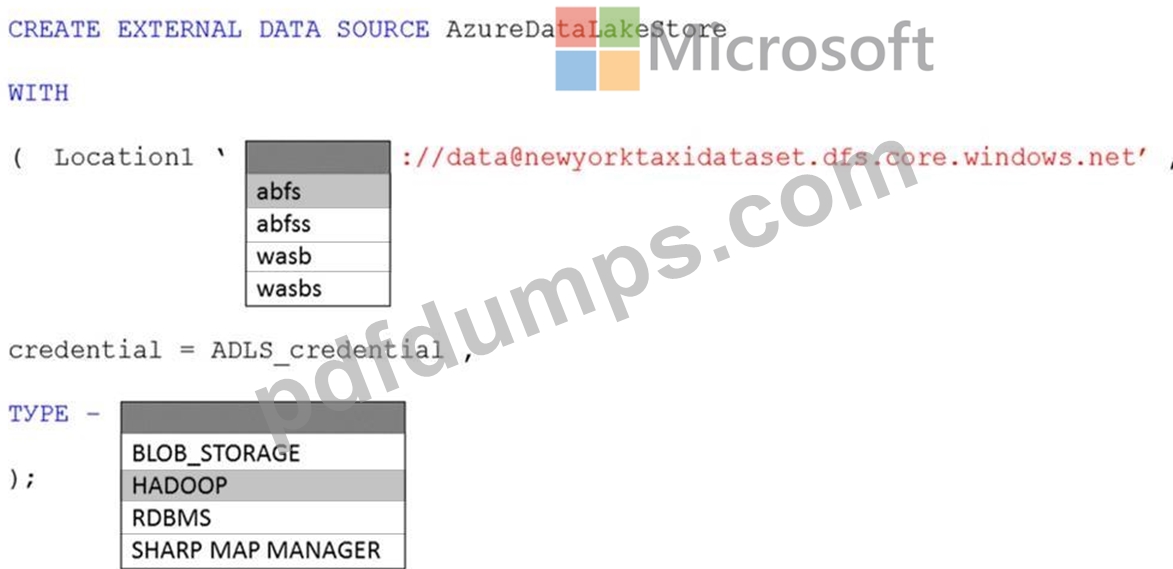
Reference:
https://docs.microsoft.com/en-us/sql/t-sql/statements/create-external-data-source-transact-sql?view=azure-sqldw
NEW QUESTION # 192
You need to create an Azure Data Factory pipeline to process data for the following three departments at your company: Ecommerce, retail, and wholesale. The solution must ensure that data can also be processed for the entire company.
How should you complete the Data Factory data flow script? To answer, drag the appropriate values to the correct targets. Each value may be used once, more than once, or not at all. You may need to drag the split bar between panes or scroll to view content.
NOTE: Each correct selection is worth one point.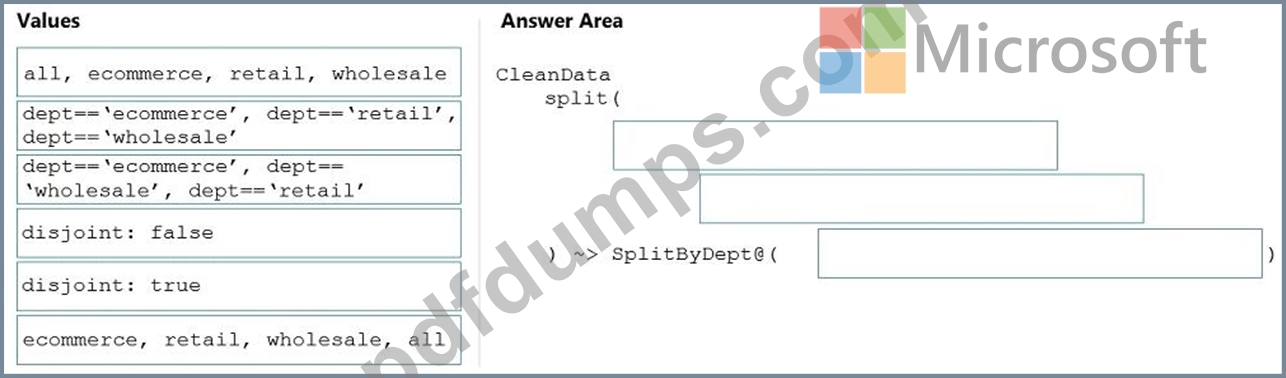
Answer:
Explanation: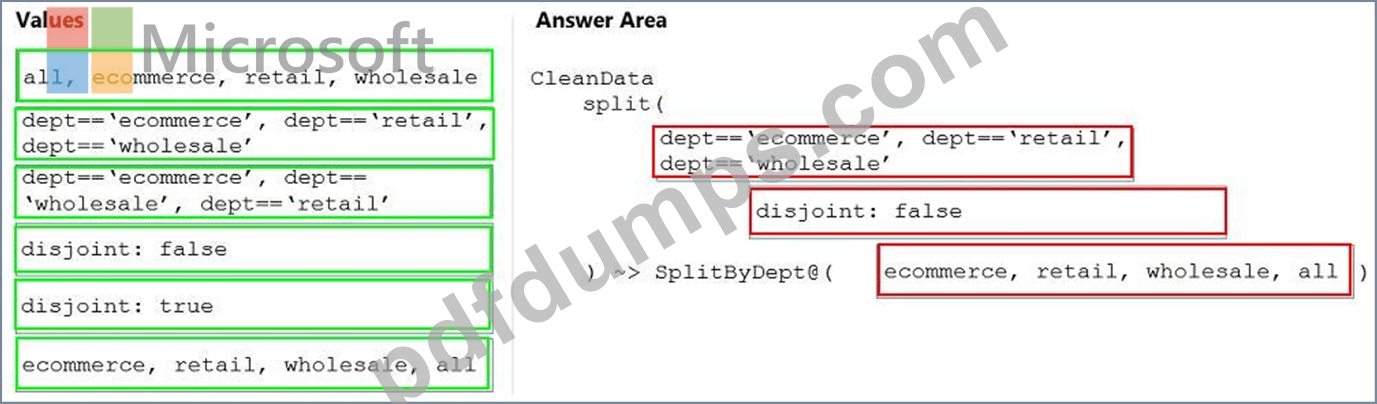
Reference:
https://docs.microsoft.com/en-us/azure/data-factory/data-flow-conditional-split
NEW QUESTION # 193
you have a project in Azure DevOps that contains a repository named Repo1. Repo1 contains a branch named main.
You create a new Azure Synapse workspace named Workspace1.
You need to create data processing pipelines in Workspace1. The solution must meet the following requirements:
* Pipeline artifacts must be stored in Repo1.
* Source control must be provided for pipeline artifacts.
* All development must be performed in a feature branch.
which four actions should you perform in sequence in Synapse Studio? To answer, move the appropriate actions from the list of actions to the answer area and arrange them in the correct order.
Answer:
Explanation:
Explanation:
NEW QUESTION # 194
You have an Azure Synapse Analytics dedicated SQL pool that contains the users shown in the following table.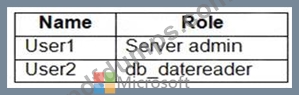
User1 executes a query on the database, and the query returns the results shown in the following exhibit.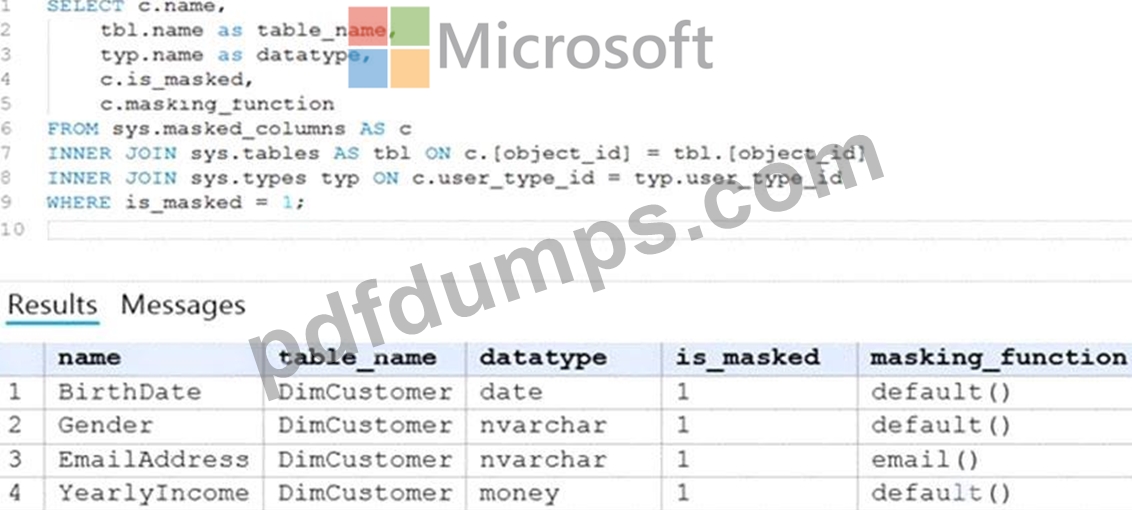
User1 is the only user who has access to the unmasked data.
Use the drop-down menus to select the answer choice that completes each statement based on the information presented in the graphic.
NOTE: Each correct selection is worth one point.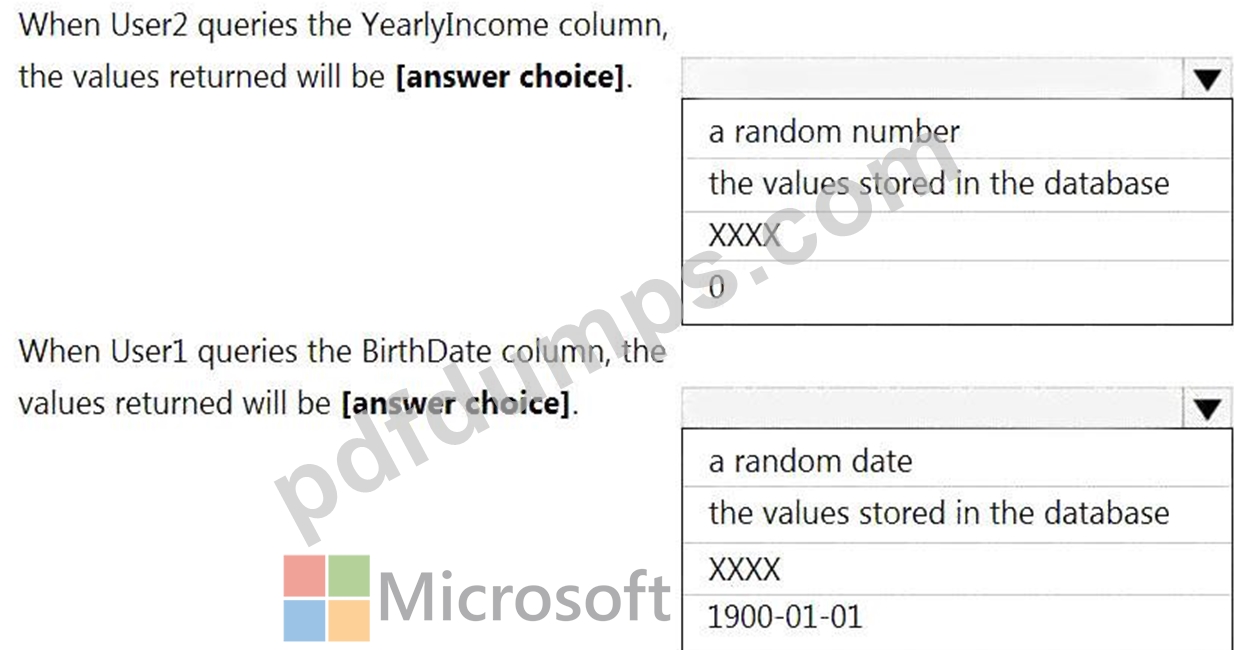
Answer:
Explanation: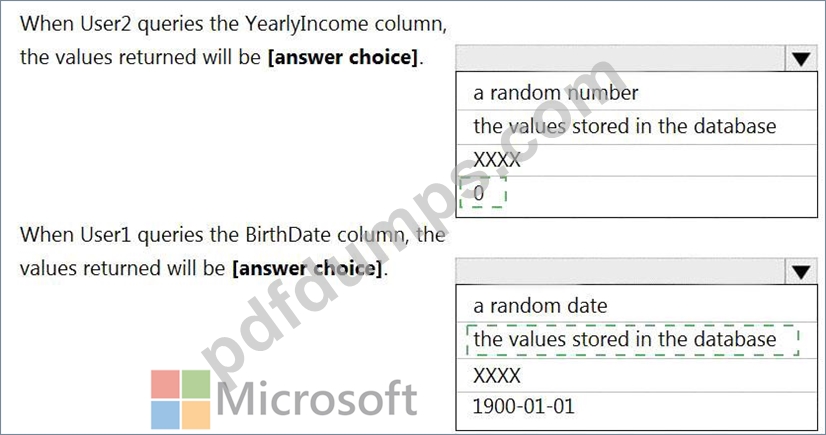
Explanation
Graphical user interface, text, application, email Description automatically generated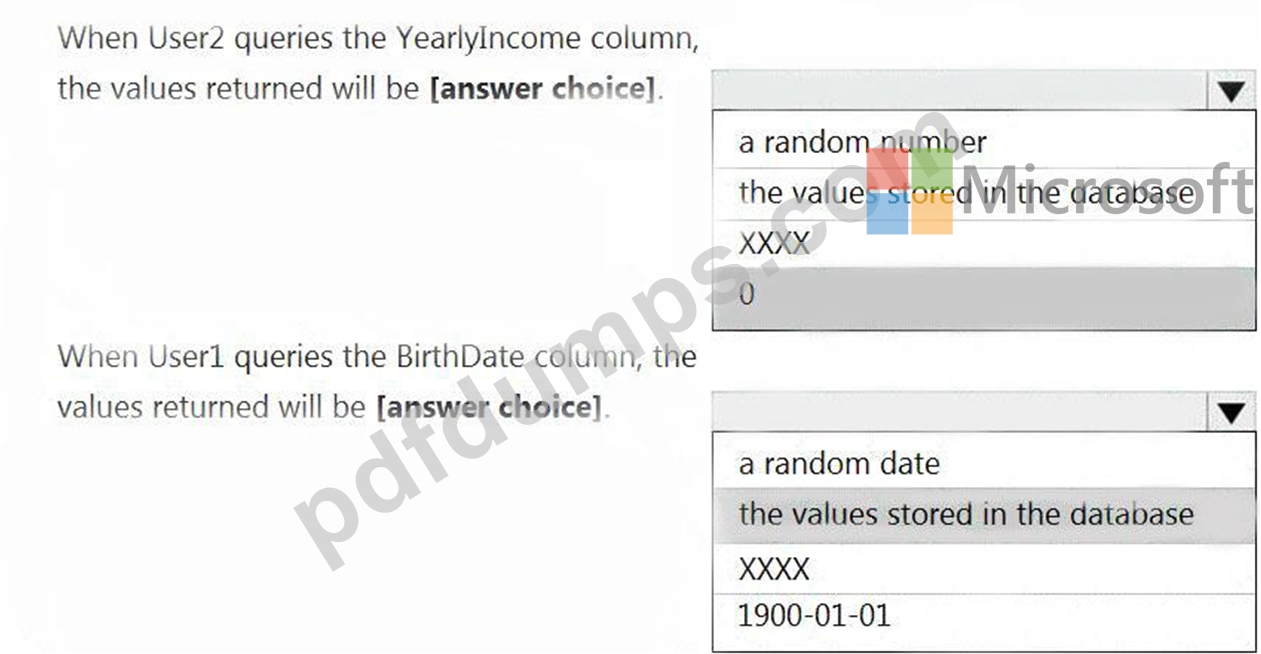
Box 1: 0
The YearlyIncome column is of the money data type.
The Default masking function: Full masking according to the data types of the designated fields
* Use a zero value for numeric data types (bigint, bit, decimal, int, money, numeric, smallint, smallmoney, tinyint, float, real).
Box 2: the values stored in the database
Users with administrator privileges are always excluded from masking, and see the original data without any mask.
Reference:
https://docs.microsoft.com/en-us/azure/azure-sql/database/dynamic-data-masking-overview
NEW QUESTION # 195
You have an Azure subscription that contains an Azure Synapse Analytics dedicated SQL pool named Pool1 and an Azure Data Lake Storage account named storage1. Storage1 requires secure transfers.
You need to create an external data source in Pool1 that will be used to read .orc files in storage1.
How should you complete the code? To answer, select the appropriate options in the answer area.
NOTE: Each correct selection is worth one point.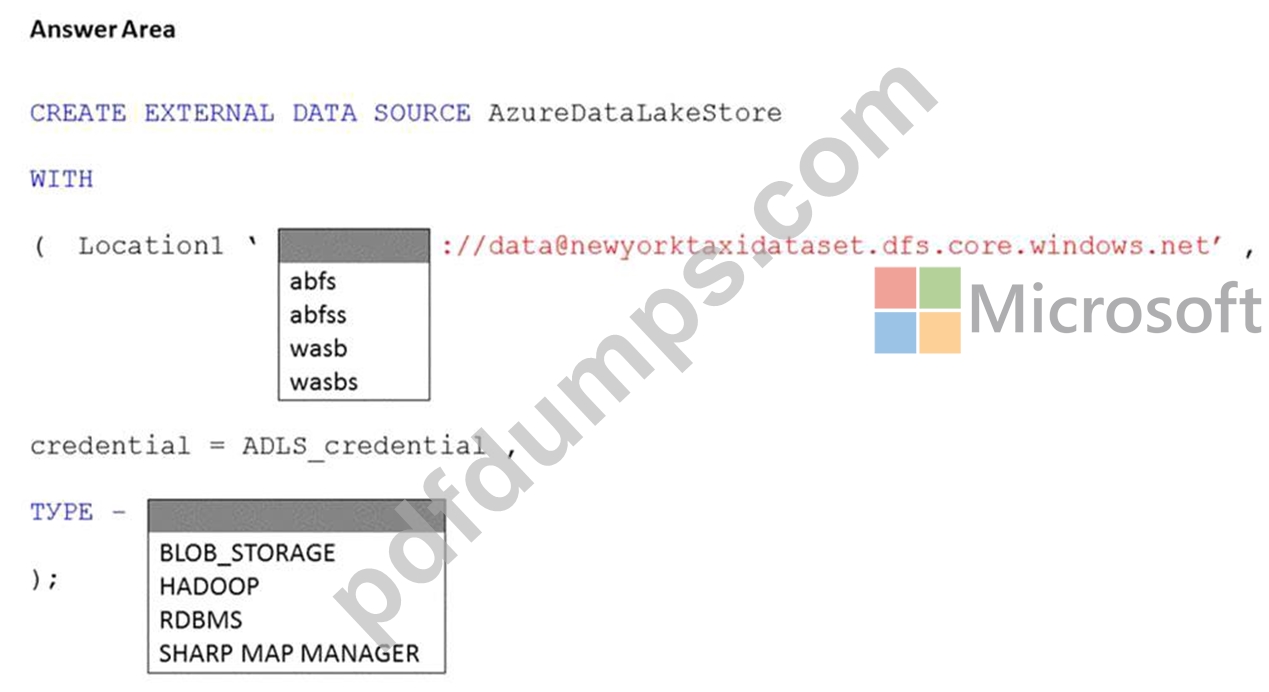
Answer:
Explanation: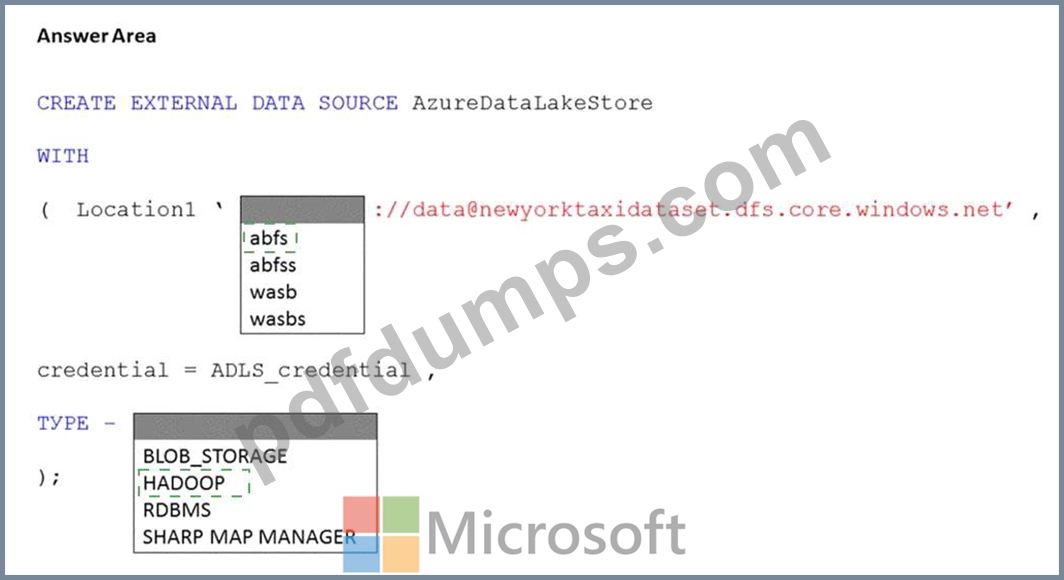
Explanation
Graphical user interface, text, application, email Description automatically generated
Reference:
https://docs.microsoft.com/en-us/sql/t-sql/statements/create-external-data-source-transact-sql?view=azure-sqldw
NEW QUESTION # 196
You have an Azure data factory.
You need to ensure that pipeline-run data is retained for 120 days. The solution must ensure that you can query the data by using the Kusto query language.
Which four actions should you perform in sequence? To answer, move the appropriate actions from the list of actions to the answer area and arrange them in the correct order.
NOTE: More than one order of answer choices is correct. You will receive credit for any of the correct orders you select.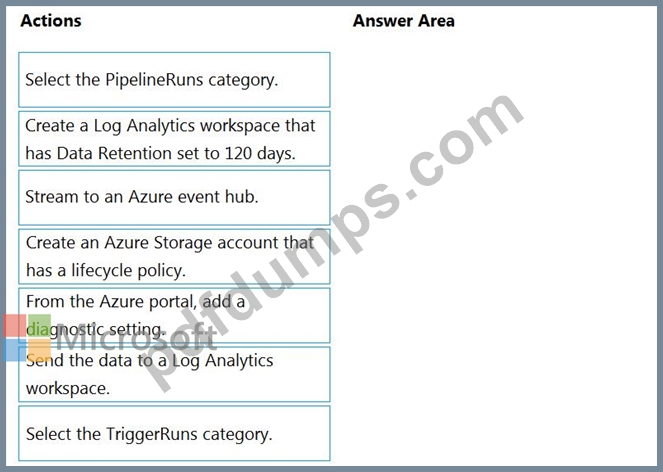
Answer:
Explanation: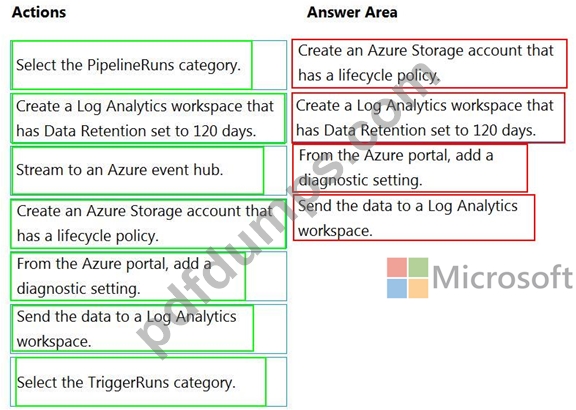
Reference:
https://docs.microsoft.com/en-us/azure/data-factory/monitor-using-azure-monitor
NEW QUESTION # 197
You have an Azure Data Lake Storage Gen2 account that contains a container named container1. You have an Azure Synapse Analytics serverless SQL pool that contains a native external table named dbo.Table1. The source data for dbo.Table1 is stored in container1. The folder structure of container1 is shown in the following exhibit.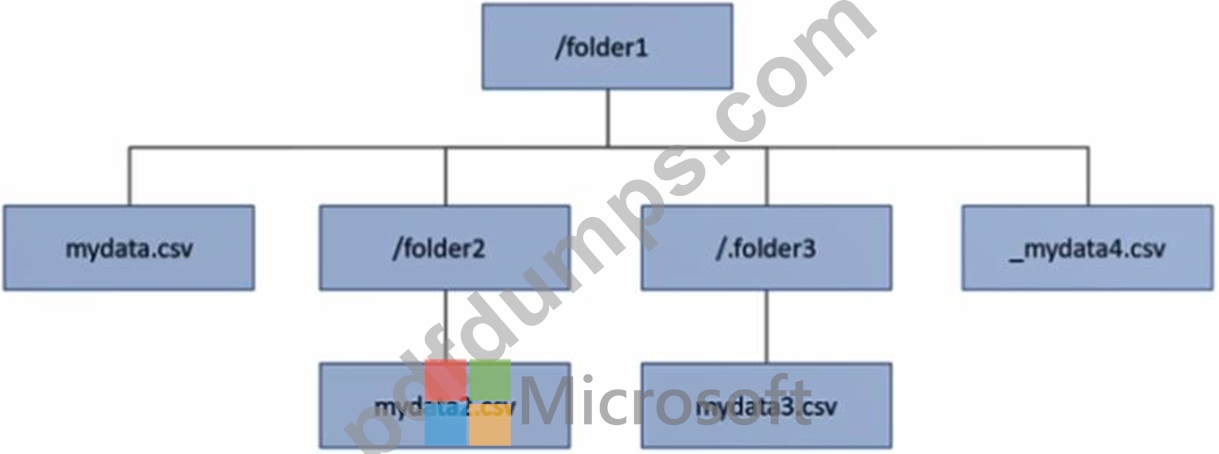
The external data source is defined by using the following statement.
For each of the following statements, select Yes if the statement is true. Otherwise, select No.
NOTE: Each correct selection is worth one point.
Answer:
Explanation:
NEW QUESTION # 198
Note: This question is part of a series of questions that present the same scenario. Each question in the series contains a unique solution that might meet the stated goals. Some question sets might have more than one correct solution, while others might not have a correct solution.
After you answer a question in this section, you will NOT be able to return to it. As a result, these questions will not appear in the review screen.
You have an Azure Storage account that contains 100 GB of files. The files contain rows of text and numerical values. 75% of the rows contain description data that has an average length of 1.1 MB.
You plan to copy the data from the storage account to an enterprise data warehouse in Azure Synapse Analytics.
You need to prepare the files to ensure that the data copies quickly.
Solution: You copy the files to a table that has a columnstore index.
Does this meet the goal?
- A. No
- B. Yes
Answer: A
Explanation:
Explanation
Instead convert the files to compressed delimited text files.
Reference:
https://docs.microsoft.com/en-us/azure/sql-data-warehouse/guidance-for-loading-data
NEW QUESTION # 199
You have data stored in thousands of CSV files in Azure Data Lake Storage Gen2. Each file has a header row followed by a properly formatted carriage return (/r) and line feed (/n).
You are implementing a pattern that batch loads the files daily into an enterprise data warehouse in Azure Synapse Analytics by using PolyBase.
You need to skip the header row when you import the files into the data warehouse. Before building the loading pattern, you need to prepare the required database objects in Azure Synapse Analytics.
Which three actions should you perform in sequence? To answer, move the appropriate actions from the list of actions to the answer area and arrange them in the correct order.
NOTE: Each correct selection is worth one point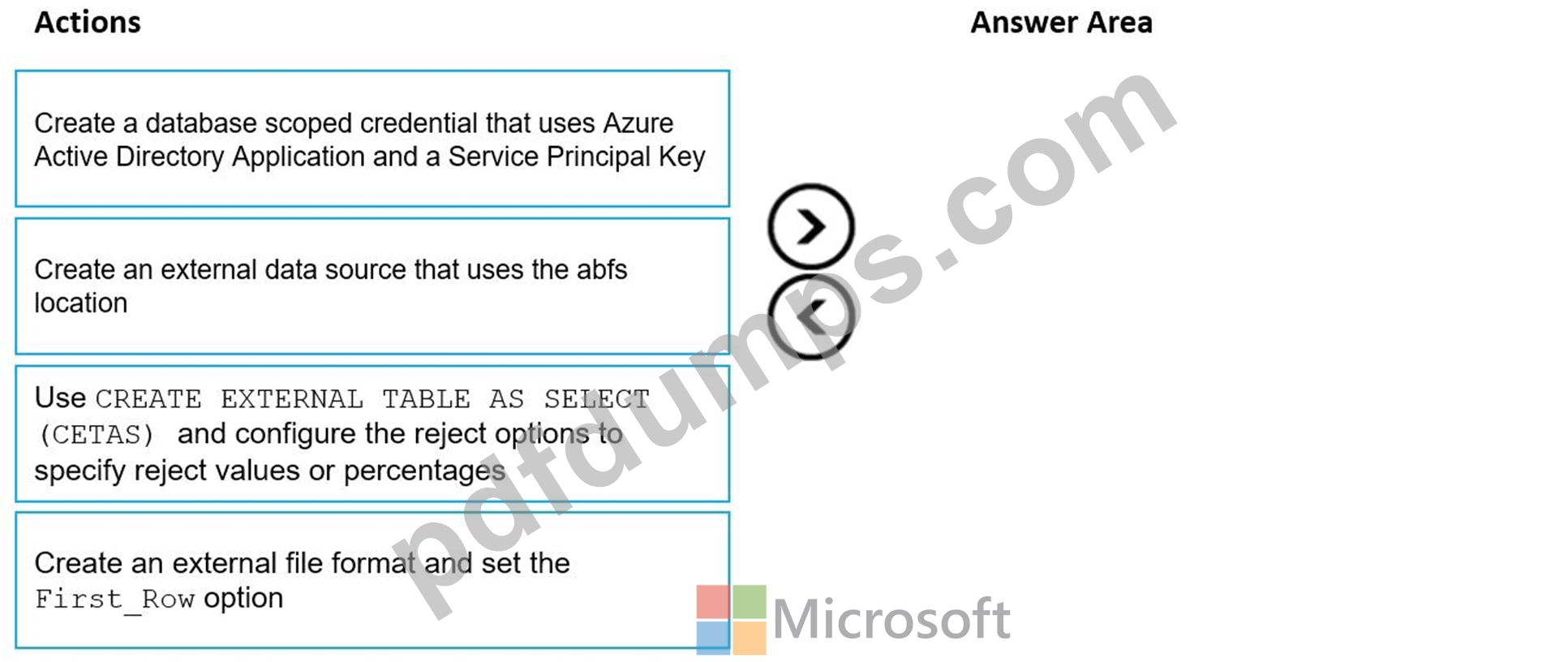
Answer:
Explanation: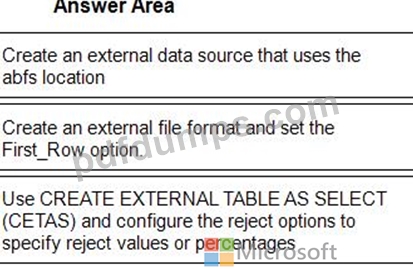
1 - Create an external data source that uses the abfs location
2 - Create an external file format and set the First_Row option.
3 - Use CREATE EXTERNAL TABLE AS SELECT (CETAS) and configure the reject options to specify reject values or percentages Reference:
https://docs.microsoft.com/en-us/sql/relational-databases/polybase/polybase-t-sql-objects
https://docs.microsoft.com/en-us/sql/t-sql/statements/create-external-table-as-select-transact-sql
Topic 2, Contoso
Transactional Date
Contoso has three years of customer, transactional, operation, sourcing, and supplier data comprised of 10 billion records stored across multiple on-premises Microsoft SQL Server servers. The SQL server instances contain data from various operational systems. The data is loaded into the instances by using SQL server integration Services (SSIS) packages.
You estimate that combining all product sales transactions into a company-wide sales transactions dataset will result in a single table that contains 5 billion rows, with one row per transaction.
Most queries targeting the sales transactions data will be used to identify which products were sold in retail stores and which products were sold online during different time period. Sales transaction data that is older than three years will be removed monthly.
You plan to create a retail store table that will contain the address of each retail store. The table will be approximately 2 MB. Queries for retail store sales will include the retail store addresses.
You plan to create a promotional table that will contain a promotion ID. The promotion ID will be associated to a specific product. The product will be identified by a product ID. The table will be approximately 5 GB.
Streaming Twitter Data
The ecommerce department at Contoso develops and Azure logic app that captures trending Twitter feeds referencing the company's products and pushes the products to Azure Event Hubs.
Planned Changes
Contoso plans to implement the following changes:
* Load the sales transaction dataset to Azure Synapse Analytics.
* Integrate on-premises data stores with Azure Synapse Analytics by using SSIS packages.
* Use Azure Synapse Analytics to analyze Twitter feeds to assess customer sentiments about products.
Sales Transaction Dataset Requirements
Contoso identifies the following requirements for the sales transaction dataset:
* Partition data that contains sales transaction records. Partitions must be designed to provide efficient loads by month. Boundary values must belong: to the partition on the right.
* Ensure that queries joining and filtering sales transaction records based on product ID complete as quickly as possible.
* Implement a surrogate key to account for changes to the retail store addresses.
* Ensure that data storage costs and performance are predictable.
* Minimize how long it takes to remove old records.
Customer Sentiment Analytics Requirement
Contoso identifies the following requirements for customer sentiment analytics:
* Allow Contoso users to use PolyBase in an A/ure Synapse Analytics dedicated SQL pool to query the content of the data records that host the Twitter feeds. Data must be protected by using row-level security (RLS). The users must be authenticated by using their own A/ureAD credentials.
* Maximize the throughput of ingesting Twitter feeds from Event Hubs to Azure Storage without purchasing additional throughput or capacity units.
* Store Twitter feeds in Azure Storage by using Event Hubs Capture. The feeds will be converted into Parquet files.
* Ensure that the data store supports Azure AD-based access control down to the object level.
* Minimize administrative effort to maintain the Twitter feed data records.
* Purge Twitter feed data records;itftaitJ are older than two years.
Data Integration Requirements
Contoso identifies the following requirements for data integration:
Use an Azure service that leverages the existing SSIS packages to ingest on-premises data into datasets stored in a dedicated SQL pool of Azure Synaps Analytics and transform the data.
Identify a process to ensure that changes to the ingestion and transformation activities can be version controlled and developed independently by multiple data engineers.
NEW QUESTION # 200
You have an Azure Synapse serverless SQL pool.
You need to read JSON documents from a file by using the OPENROWSET function.
How should you complete the query? To answer, select the appropriate options in the answer area.
NOTE: Each correct selection is worth one point.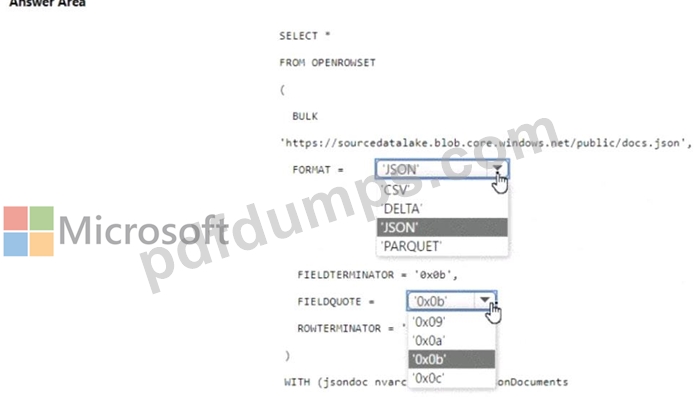
Answer:
Explanation: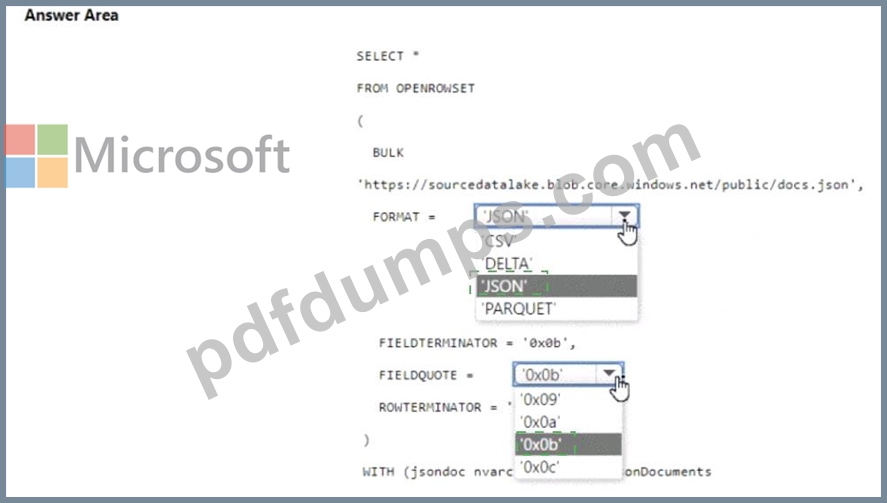
Explanation: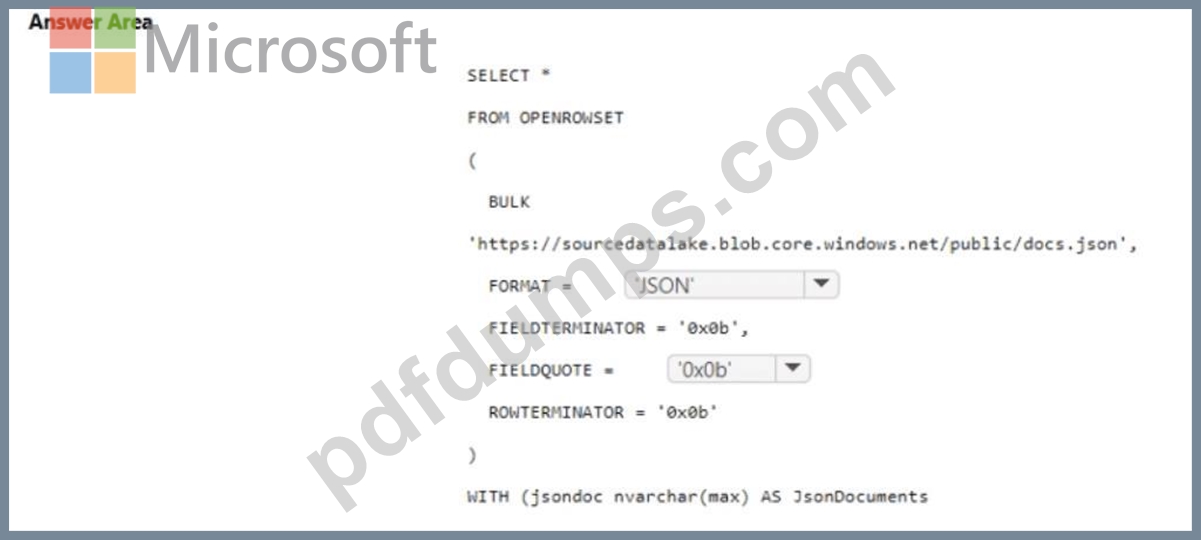
NEW QUESTION # 201
You need to implement an Azure Synapse Analytics database object for storing the sales transactions dat a. The solution must meet the sales transaction dataset requirements.
What solution must meet the sales transaction dataset requirements.
What should you do? To answer, select the appropriate options in the answer area.
NOTE: Each correct selection is worth one point.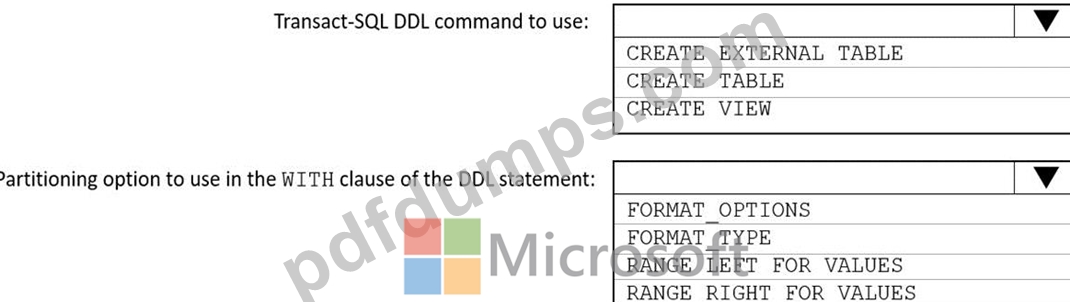
Answer:
Explanation: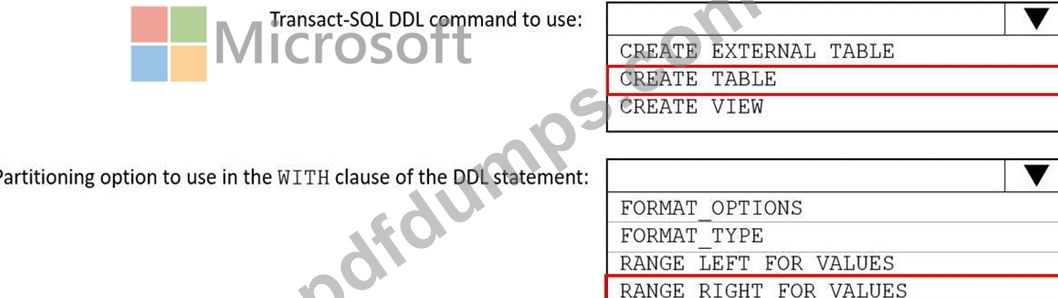
Reference:
https://docs.microsoft.com/en-us/sql/t-sql/statements/create-table-azure-sql-data-warehouse
NEW QUESTION # 202
You have an Azure Data Lake Storage account that contains one CSV file per hour for January 1, 2020, through January 31, 2023. The files are partitioned by using the following folder structure.
csv/system1/2026/{month)/{filename).csv
You need to query the files by using an Azure Synapse Analytics serverless SQL pool The solution must return the row count of each file created during the last three months of 2022.
How should you complete the query? To answer, select the appropriate options in the answer area.
NOTE: Each correct selection is worth one point.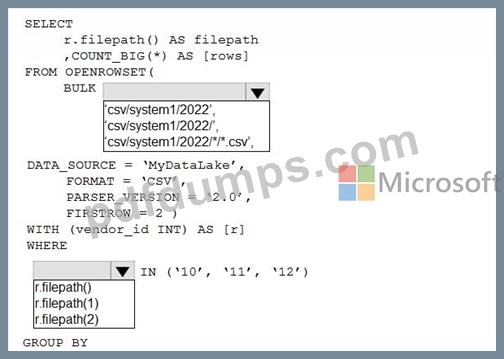
Answer:
Explanation: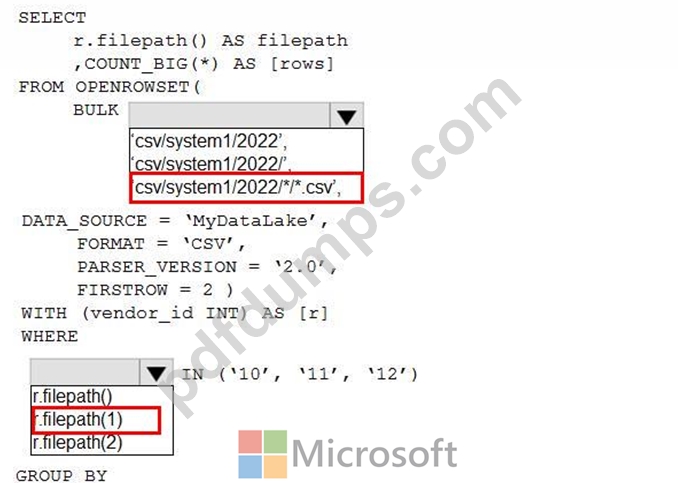
NEW QUESTION # 203
You develop data engineering solutions for a company.
A project requires the deployment of data to Azure Data Lake Storage.
You need to implement role-based access control (RBAC) so that project members can manage the Azure Data Lake Storage resources.
Which three actions should you perform? Each correct answer presents part of the solution.
NOTE: Each correct selection is worth one point.
- A. Configure end-user authentication for the Azure Data Lake Storage account.
- B. Configure access control lists (ACL) for the Azure Data Lake Storage account.
- C. Configure service-to-service authentication for the Azure Data Lake Storage account.
- D. Create security groups in Azure Active Directory (Azure AD) and add project members.
- E. Assign Azure AD security groups to Azure Data Lake Storage.
Answer: B,D,E
Explanation:
References:
https://docs.microsoft.com/en-us/azure/data-lake-store/data-lake-store-secure-data
NEW QUESTION # 204
You have an Azure Synapse Analytics dedicated SQL pool named SQL1 that contains a hash-distributed fact table named Table1.
You need to recreate Table1 and add a new distribution column. The solution must maximize the availability of data.
Which four actions should you perform in sequence? To answer, move the appropriate actions from the list of actions to the answer area and arrange them in the correct order.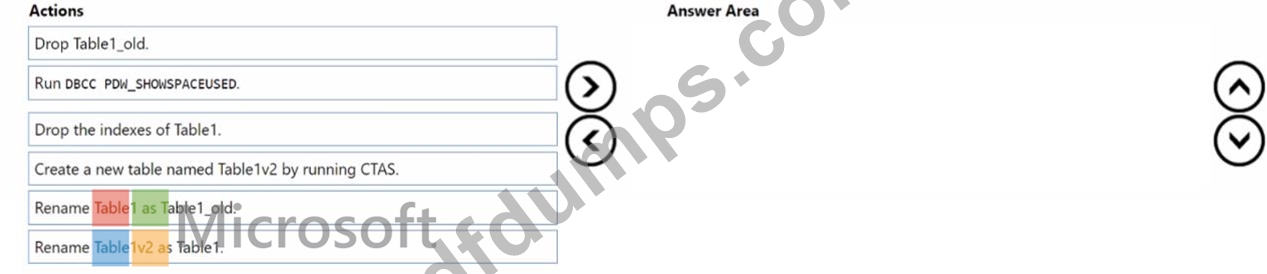
Answer:
Explanation: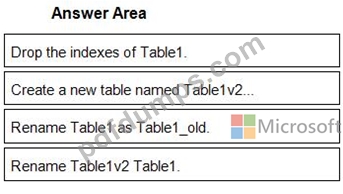
1 - Drop the indexes of Table1.
2 - Create a new table named Table1v2...
3 - Rename Table1 as Table1_old.
4 - Rename Table1v2 Table1.
NEW QUESTION # 205
You have an Azure subscription that contains the following resources:
An Azure Active Directory (Azure AD) tenant that contains a security group named Group1 An Azure Synapse Analytics SQL pool named Pool1 You need to control the access of Group1 to specific columns and rows in a table in Pool1.
Which Transact-SQL commands should you use? To answer, select the appropriate options in the answer area.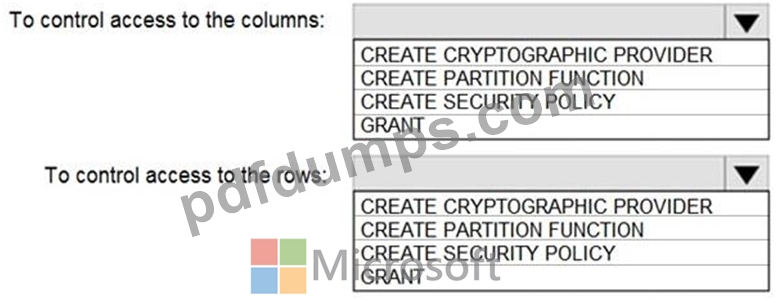
Answer:
Explanation: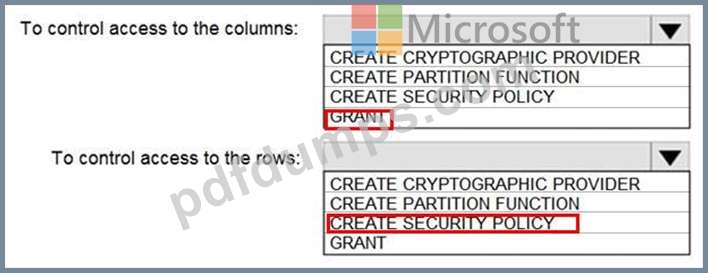
Reference:
https://docs.microsoft.com/en-us/azure/synapse-analytics/sql-data-warehouse/column-level-security
NEW QUESTION # 206
......
The DP-203 exam is designed for data engineers, architects, and developers who want to demonstrate their expertise in Azure data technologies. It is intended for professionals who are responsible for designing and implementing data solutions on Azure, and who have experience working with Azure data services. Candidates who pass the DP-203 exam will be able to demonstrate their ability to create scalable and secure data solutions that meet the needs of their organization.
DP-203 Questions Prepare with Learning Information: https://actualtorrent.pdfdumps.com/DP-203-valid-exam.html