


JN0-281 Exam Info and Free Practice Test All-in-One Exam Guide Mar-2026
Pass Juniper JN0-281 Actual Free Exam Q&As Updated Dump Mar 16, 2026
NEW QUESTION # 14
Exhibit: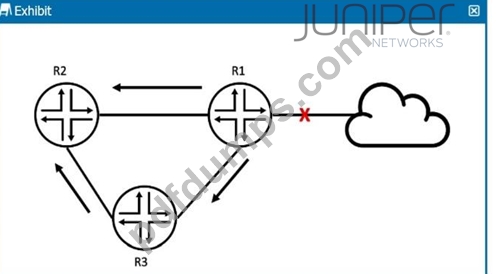
R2 received an OSPF update from R1, and it received the same update from R3.
Referring to the exhibit, what will R2 do?
- A. R2 ignores the update from R1.
- B. R2 acknowledges R3 and discards it.
- C. R2 ignores the update from R3.
- D. R2 does nothing with R3's update.
Answer: C
Explanation:
In the exhibit, R2 receives the same OSPF update from both R1 and R3. OSPF has mechanisms to prevent unnecessary processing of duplicate LSAs (Link-State Advertisements).
Step-by-Step Breakdown:
OSPF LSA Processing:
OSPF uses LSAs to exchange link-state information between routers. When a router receives an LSA, it checks if it already has a copy of the LSA in its Link-State Database (LSDB).
Duplicate LSAs:
If R2 has already received and processed the update from R1, it will ignore the update from R3 because it already has the same LSA in its database. OSPF uses the concept of flooding, but it does not reprocess LSAs that it already knows about.
R2 Behavior:
R2 will keep the update from R1 (the first one it received) and will ignore the same LSA from R3, as it is already in the LSDB.
Juniper Reference:
OSPF LSA Processing: Junos adheres to OSPF standards, ensuring that duplicate LSAs are not processed multiple times to avoid unnecessary recalculations.
NEW QUESTION # 15
What are two consequences of having all network devices in a single collision domain? (Choose two.)
- A. The chance of packet collision is increased.
- B. The amount of network resource consumption does not change.
- C. The chance of packet collision is decreased.
- D. The amount of network resource consumption is increased.
Answer: A,D
Explanation:
A collision domain is a network segment where data packets can "collide" with one another when being sent on the same network medium.
Step-by-Step Breakdown:
Increased Collision Probability:
If all devices are in a single collision domain, the likelihood of packet collisions increases as more devices attempt to send packets simultaneously, leading to network inefficiencies.
Increased Resource Consumption:
More collisions result in increased network resource consumption as devices need to retransmit packets, causing higher utilization of bandwidth and slowing down network performance.
Juniper Reference:
Collision Domains: Proper network segmentation using switches reduces collision domains, thereby improving network performance and reducing packet collisions.
NEW QUESTION # 16
What are two characteristics of a typical EBGP underlay fabric? (Choose two.)
- A. Each device in an EBGP fabric will be configured in its own unique private AS.
- B. Each device in an EBGP fabric will be configured to be part of the same private AS.
- C. An EBGP fabric relies on an IGP to advertise loopback IPs.
- D. An EBGP fabric does not require an IGP to advertise loopback IPs.
Answer: A,D
NEW QUESTION # 17
VLANs help in reducing which of the following? (Choose two)
- A. Collision domains
- B. Encryption requirements
- C. Routing complexity
- D. Broadcast domains
Answer: A,D
NEW QUESTION # 18
Which statement is correct about a three-stage IP fabric underlay?
- A. Every server that connects to a three-stage IP fabric must be multihomed.
- B. Every spine device can communicate directly with other spine devices.
- C. Every ingress interface into the fabric is only two hops away from the egress interface.
- D. Every leaf device can communicate directly with other leaf devices.
Answer: C
Explanation:
In a three-stage IP fabric (also known as a Clos fabric), traffic between any two points (ingress to egress) in the fabric is only two hops away.
Step-by-Step Breakdown:
Three-Stage IP Fabric:
Leaf Layer: Leaf switches connect directly to servers and edge devices.
Spine Layer: Spine switches provide connectivity between leaf switches but do not connect to each other directly.
Two-Hop Communication:
In this architecture, every leaf switch is connected to every spine switch. Therefore, when a packet enters the fabric via an ingress leaf switch, it is forwarded to a spine switch, which then directs the packet to the correct egress leaf switch. This path always involves exactly two hops:
Ingress leaf → Spine → Egress leaf.
Benefits:
This consistent two-hop path ensures predictable latency and makes the network highly scalable while maintaining low complexity.
Juniper Reference:
IP Fabric Architecture: This two-hop property of Clos fabrics is a hallmark of spine-leaf designs, as supported by Juniper's QFX and EX switches in data centers.
NEW QUESTION # 19
In OSPF, which command is commonly used to monitor neighbor relationships?
- A. show ospf database
- B. show ospf interfaces
- C. show ip route ospf
- D. show ip ospf neighbors
Answer: D
NEW QUESTION # 20
What is Integrated Routing and Bridging (IRB) primarily used for in a Junos device?
- A. For aggregating multiple interfaces.
- B. For implementing security policies.
- C. To separate VLAN traffic.
- D. To provide inter-VLAN routing.
Answer: D
NEW QUESTION # 21
Referring to the exhibit, what needs to be done to make this a valid IP fabric?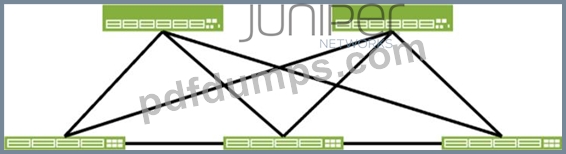
- A. Add a connection between the spine nodes
- B. Remove one of the redundant links between a leaf node and a spine node
- C. Remove the connection between the leaf nodes
- D. Add two connections between the spine nodes
Answer: C
NEW QUESTION # 22
You are troubleshooting a downed BGP session.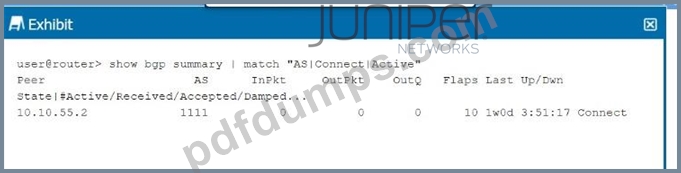
Referring to the exhibit, what is the cause of the problem?
- A. The local peer has sent an Open message but not received one from the remote peer.
- B. The local peer has sent an Update message but not received one from the remote peer.
- C. The TCP session between the peers has not been established.
- D. The UDP session between the peers has not been established.
Answer: C
Explanation:
The BGP session in the exhibit shows the state as Connect, which indicates that the TCP session between the BGP peers has not been fully established.
Step-by-Step Breakdown:
BGP State "Connect":
The Connect state is the second stage in the BGP finite state machine (FSM). At this stage, BGP is trying to establish a TCP session with the peer, but the session has not yet been successfully established.
A successful TCP three-way handshake (SYN, SYN-ACK, ACK) is required before BGP can progress to the OpenSent state, where the peers exchange BGP Open messages.
Possible Causes:
A firewall blocking TCP port 179.
Incorrect IP addresses or network connectivity issues between the BGP peers.
Juniper Reference:
BGP Troubleshooting: In Junos, if a BGP session is stuck in the Connect state, the issue is likely due to a failure in establishing the underlying TCP connection.
NEW QUESTION # 23
Which statement is correct about the BGP AS path when advertising routes?
- A. The local AS number is added to the beginning of the AS path.
- B. The order of the AS path is only significant in IBGP.
- C. The order of the AS path is not significant.
- D. The local AS number is added to the end of the AS path.
Answer: A
Explanation:
The BGP AS (Autonomous System) path attribute is crucial in path selection and loop prevention.
Each BGP router appends its local AS number to the beginning of the AS path when it advertises a route to an external BGP (eBGP) peer.
Step-by-Step Breakdown:
AS Path Attribute:
The AS path is a sequence of AS numbers that a route has traversed to reach a destination. Each AS adds its number to the front of the path, allowing BGP to track the route's history.
Why the Local AS is Added at the Beginning:
When advertising a route to an eBGP neighbor, a BGP router adds its own AS number to the beginning of the AS path. This ensures that the AS path reflects the route's journey accurately from the origin to the destination, and prevents loops in BGP. If the route returns to the same AS, the router will detect its AS number in the path and reject the route, preventing routing loops. Order of the AS Path:
The order is significant because BGP uses it to select the best path. A shorter AS path is preferred, as it indicates fewer hops between the source and destination. Juniper Reference: AS Path Attribute: Junos devices append the local AS at the start of the AS path before advertising the route to an external peer.
NEW QUESTION # 24
In OSPF, what is the function of the Link-State Database (LSDB)?
- A. To keep the topology structure of the network.
- B. To log changes in network topology.
- C. To store OSPF routing tables.
- D. To maintain a list of OSPF neighbors.
Answer: A
NEW QUESTION # 25
Which statement is correct about IBGP?
- A. It requires a logical full mesh.
- B. It ensures that the local and remote peers use different AS numbers.
- C. It requires a physical full mesh.
- D. It ensures that duplicate AS numbers are not present in the AS path.
Answer: A
Explanation:
In IBGP (Internal Border Gateway Protocol), all routers within the same AS (Autonomous System) must have a logical full-mesh topology. This means that every IBGP router must be able to communicate with every other IBGP router directly or indirectly to ensure proper route propagation.
Step-by-Step Breakdown:
Logical Full Mesh:
In an IBGP setup, routers do not re-advertise routes learned from one IBGP peer to another IBGP peer. This rule is in place to prevent routing loops within the AS.
To ensure full route propagation, a logical full mesh is required, meaning every IBGP router must peer with every other IBGP router in the AS. This can be done either directly or via route reflection or confederation.
Physical Full Mesh Not Required:
The physical topology does not need to be a full mesh, but the BGP peering relationships must form a logical full mesh. Techniques like route reflectors or BGP confederations can reduce the need for manual full-mesh peering.
Juniper
Reference: IBGP Configuration: IBGP logical full mesh requirements can be simplified using route reflectors to avoid the complexity of manually configuring many IBGP peers.
NEW QUESTION # 26
Which statement is correct about the BGP AS path when advertising routes?
- A. The local AS number is added to the beginning of the AS path.
- B. The order of the AS path is only significant in IBGP.
- C. The order of the AS path is not significant.
- D. The local AS number is added to the end of the AS path.
Answer: A
Explanation:
The BGP AS (Autonomous System) path attribute is crucial in path selection and loop prevention. Each BGP router appends its local AS number to the beginning of the AS path when it advertises a route to an external BGP (eBGP) peer.
Step-by-Step Breakdown:
AS Path Attribute:
The AS path is a sequence of AS numbers that a route has traversed to reach a destination. Each AS adds its number to the front of the path, allowing BGP to track the route's history.
Why the Local AS is Added at the Beginning:
When advertising a route to an eBGP neighbor, a BGP router adds its own AS number to the beginning of the AS path. This ensures that the AS path reflects the route's journey accurately from the origin to the destination, and prevents loops in BGP. If the route returns to the same AS, the router will detect its AS number in the path and reject the route, preventing routing loops.
Order of the AS Path:
The order is significant because BGP uses it to select the best path. A shorter AS path is preferred, as it indicates fewer hops between the source and destination.
Juniper Reference:
AS Path Attribute: Junos devices append the local AS at the start of the AS path before advertising the route to an external peer.
NEW QUESTION # 27
What does filter-based forwarding in networking typically allow?
- A. Forwarding decisions based on MAC addresses
- B. Load balancing across multiple CPUs
- C. Aggregation of multiple routes into a single entry
- D. Routing decisions based on extended criteria like packet headers
Answer: D
NEW QUESTION # 28
Referring to the exhibit, how many stages are in this IP fabric?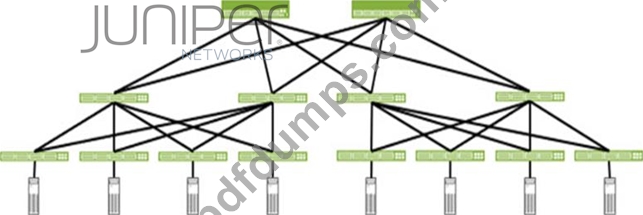
- A. 0
- B. 1
- C. 2
- D. 3
Answer: A
NEW QUESTION # 29
Generated routes in a network are mainly used to:
- A. Reduce the overall size of the routing table.
- B. Manually configure specific network routes.
- C. Summarize external routes into the network.
- D. Automatically create a route when a specified condition is met.
Answer: D
NEW QUESTION # 30
What is the primary purpose of MAC address filtering on a switch?
- A. To limit the rate of incoming packets.
- B. To prevent unauthorized devices from accessing the network.
- C. To distribute traffic evenly across multiple links.
- D. To control the flow of encrypted data.
Answer: B
NEW QUESTION # 31
What is the primary purpose of using aggregate routes in a network?
- A. To filter unwanted traffic
- B. To statically define a route to a specific destination
- C. To dynamically adjust to network changes
- D. To summarize and reduce the number of routes in the routing table
Answer: D
NEW QUESTION # 32
Which two statements are correct about aggregated Ethernet bundles? (Choose two.)
- A. You must purchase a services license for the chassis to support aggregate Ethernet interfaces.
- B. You must enable the chassis to support aggregated Ethernet interfaces.
- C. You must specify which interfaces are members of a specific aggregated Ethernet bundle.
- D. You must enable LACP when configuring aggregated Ethernet bundles.
Answer: B,C
NEW QUESTION # 33
What protocol and port does BGP use for control plane communication?
- A. protocol TCP, port 159
- B. protocol UDP, port 159
- C. protocol UDP, port 179
- D. protocol TCP, port 179
Answer: D
NEW QUESTION # 34
......
Online Questions - Valid Practice JN0-281 Exam Dumps Test Questions: https://actualtorrent.pdfdumps.com/JN0-281-valid-exam.html