


Free FCP_FGT_AD-7.6 Exam Braindumps certification guide Q&A
FCP_FGT_AD-7.6 Certification Overview Latest FCP_FGT_AD-7.6 PDF Dumps
Fortinet FCP_FGT_AD-7.6 Exam Syllabus Topics:
| Topic | Details |
|---|---|
| Topic 1 |
|
| Topic 2 |
|
| Topic 3 |
|
| Topic 4 |
|
| Topic 5 |
|
NEW QUESTION # 16
Which two statements about equal-cost multi-path (ECMP) configuration on FortiGate are true? (Choose two.)
- A. If SD-WAN is enabled, you control the load balancing algorithm with the parameter load-balance-mode.
- B. If SD-WAN is disabled, you configure the load balancing algorithm in config system settings.
- C. If SD-WAN is disabled, you can configure the parameter v4-ecmp-mode to volume-based.
- D. If SD-WAN is enabled, you can configure routes with unequal distance and priority values to be part of ECMP.
Answer: A,C
Explanation:
When SD-WAN is disabled, FortiGate supports volume-based ECMP mode via the v4-ecmp-mode parameter.
When SD-WAN is enabled, the load balancing algorithm is controlled by the load-balance-mode parameter within the SD-WAN configuration.
NEW QUESTION # 17
Refer to the exhibits.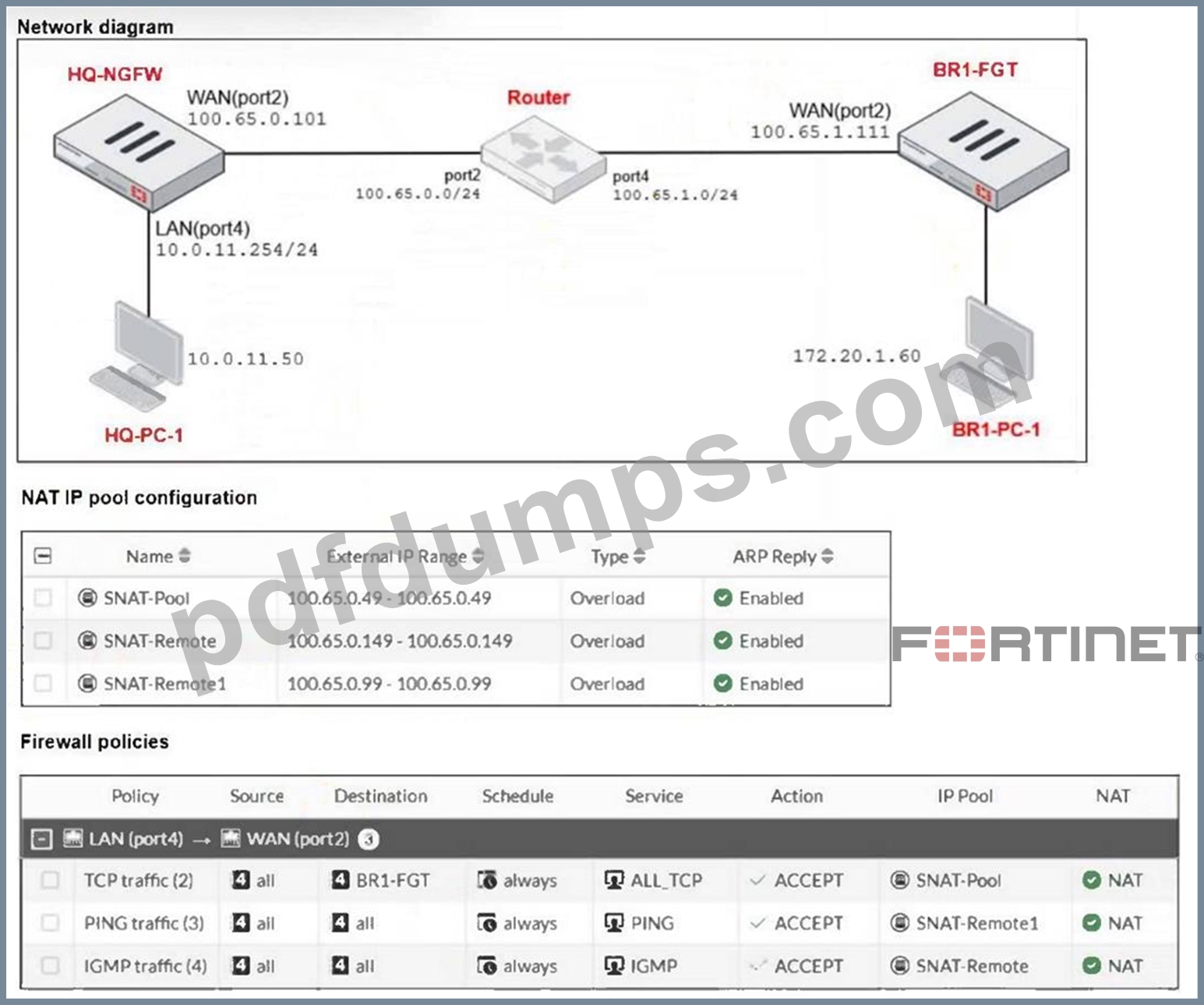
The exhibits show a diagram of a FortiGate device connected to the network, as well as the IP pool configuration and firewall policy objects.
The WAN (port2) interface has the IP address 100.65.0.101/24.
The LAN (port4) interface has the IP address 10.0.11.254/24.
Which IP address will be used to source NAT (SNAT) the traffic, if the user on HQ-PC-1 (10.0.11.50) pings the IP address of BR-FGT (100.65.1.111)
- A. 100.65.0.149
- B. 100.65.0.49
- C. 100.65.0.101
- D. 100.65.0.99
Answer: D
Explanation:
The ping traffic policy uses the IP pool named SNAT-Remote1, which has the external IP range 100.65.0.99. Therefore, traffic matching this policy (ping from HQ-PC-1 to BR1-FGT) will use 100.65.0.99 for source NAT.
NEW QUESTION # 18
You have configured the FortiGate device for FSSO. A user is successful in log-in to windows, but their access to the internet is denied.
What should the administrator check first?
- A. The FortiGate FSSO active users list for user's IP address.
- B. Whether the user is assigned to the correct AD group.
- C. The FortiGate firewall policy settings for SSL decryption.
- D. The windows event viewer for failed login attempts.
Answer: A
Explanation:
Checking the active users list verifies if FortiGate correctly associates the user with their IP address, ensuring proper policy enforcement for internet access.
NEW QUESTION # 19
Which two statements describe characteristics of automation stitches? (Choose two.)
- A. Triggers can involve external connectors.
- B. An automation stitch can have multiple triggers.
- C. Actions involve only devices included in the Security Fabric.
- D. Multiple actions can run in parallel.
Answer: A,D
Explanation:
Automation stitches can execute multiple actions concurrently (in parallel).
Triggers for automation stitches can come from external connectors beyond just Fortinet devices.
NEW QUESTION # 20
You have configured the below commands on a FortiGate.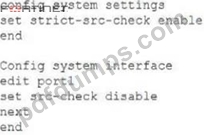
What would be the impact of this configuration on FortiGate?
- A. Port1 will be enabled with flexible RPF, and all other interfaces will be enabled for strict RPF
- B. FortiGate will enable strict RPF on all its interfaces and port1 will be exempted from RPF checks.
- C. FortiGate will enable strict RPF on ail its interfaces and port1 will be enable for asymmetric routing.
- D. The global configuration will take precedence and FortiGate will enable strict RPF on all interfaces.
Answer: B
Explanation:
The global setting enables strict source checking (RPF) on all interfaces by default. The per-interface setting disables the source check on port1, exempting it from strict RPF enforcement.
NEW QUESTION # 21
Refer to the exhibit.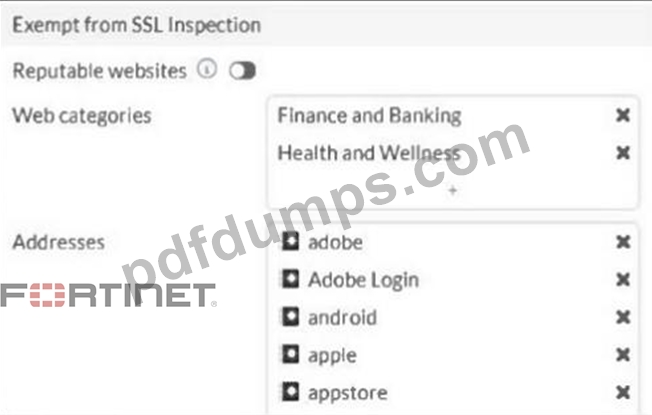
The predefined deep-inspection and custom-deep-inspection profiles exclude some web categories from SSL inspection, as shown in the exhibit.
For which two reasons are these web categories exempted? (Choose two.)
- A. The FortiGate temporary certificate denies the browser's access to websites that use HTTP Strict Transport Security.
- B. The legal regulation aims to prioritize user privacy and protect sensitive information for these websites.
- C. These websites are in an allowlist of reputable domain names maintained by FortiGuard.
- D. The resources utilization is optimized because these websites are in the trusted domain list on FortiGate.
Answer: A,B
Explanation:
FortiGate's temporary SSL certificate may cause access denial to sites using HTTP Strict Transport Security (HSTS), so such sites are exempted from deep SSL inspection.
Legal regulations require exemption of certain categories to protect user privacy and sensitive information, so these web categories are excluded from SSL inspection.
NEW QUESTION # 22
Which statement correctly describes NetAPI polling mode for the FSSO collector agent?
- A. The NetSessionEnum function is used to track user logouts.
- B. The collector agent must search Windows application event logs.
- C. The collector agent uses a Windows API to query DCs for user logins.
- D. NetAPI polling can increase bandwidth usage in large networks.
Answer: D
Explanation:
NetAPI polling mode involves frequent queries to domain controllers, which can cause increased bandwidth usage, especially in large networks with many login events.
NEW QUESTION # 23
When configuring firewall policies which of the following is true regarding the policy ID?
- A. A policy ID cannot be edited once a policy is created.
- B. It is mandatory to provide a policy ID while creating a firewall policy regardless of GUI or CLI.
- C. A firewall policy ID identifies the order of policy execution in firewall policies.
- D. You can create a policy in CLI with policy ID 0.
Answer: A
Explanation:
Once a firewall policy is created, its policy ID is fixed and cannot be changed; this ID uniquely identifies the policy within the FortiGate configuration.
NEW QUESTION # 24
A new administrator is configuring FSSO authentication on FortiGate using DC Agent Mode.
Which step is NOT part of the expected process?
- A. FortiGate determines user identity based on the IP address in the FSSO list.
- B. The user logs into the windows domain.
- C. The collector agent forwards login event data to FortiGate.
- D. The DC agent sends login event data directly to FortiGate.
Answer: C
Explanation:
In DC Agent Mode, the DC agent sends login event data directly to FortiGate without involving a collector agent.
NEW QUESTION # 25
Refer to the exhibit, which shows a partial configuration from the remote authentication server.
Why does the FortiGate administrator need this configuration?
- A. To authenticate Any FortiGate user groups.
- B. To set up a RADIUS server Secret.
- C. To authenticate only the Training user group.
- D. To authenticate and match the Training OU on the RADIUS server.
Answer: C
Explanation:
The Fortinet-Group-Name attribute is used to restrict authentication to users who belong specifically to the "Training" user group on the RADIUS server.
NEW QUESTION # 26
Which three statements about SD-WAN performance SLAs are true? (Choose three.)
- A. They rely on session loss and jitter.
- B. They are applied in a SD-WAN rule lowest cost strategy.
- C. They monitor the state of the FortiGate device.
- D. They can be measured actively or passively.
- E. All the SLAtargets can be configured.
Answer: A,D,E
Explanation:
SD-WAN SLAs monitor metrics like packet loss and jitter to evaluate link performance.
SLA measurements can be performed using active probing or passive monitoring.
Administrators can configure all SLA target parameters to define performance criteria.
NEW QUESTION # 27
A network administrator is reviewing firewall policies in both Interface Pair View and By Sequence View. The policies appear in a different order in each view.
Why is the policy order different in these two views?
- A. Policies in Interface Pair View are prioritized by security levels, while By Sequence View strictly follows the administrator's manual ordering.
- B. Interface Pair View sorts policies based on matching interfaces, while By Sequence View shows the actual processing order of rules.
- C. By Sequence View groups policies based on rule priority, while Interface Pair View always follows the order of traffic logs.
- D. The firewall dynamically reorders policies in Interface Pair View based on recent traffic patterns, but By Sequence View remains static.
Answer: B
Explanation:
Interface Pair View organizes policies grouped by source and destination interfaces, whereas By Sequence View displays policies in the exact order they are processed by the firewall.
NEW QUESTION # 28
What is the primary FortiGate election process when the HA override setting is enabled?
- A. Connected monitored ports > System uptime > Priority > FortiGate serial number
- B. Connected monitored ports > Priority > System uptime > FortiGate serial number
- C. Connected monitored ports > Priority > HA uptime > FortiGate serial number
- D. Connected monitored ports > HA uptime > Priority > FortiGate serial number
Answer: C
Explanation:
When HA override is enabled, FortiGate uses the following election order: number of connected monitored ports, then device priority, followed by HA uptime, and finally FortiGate serial number as a tiebreaker.
NEW QUESTION # 29
Refer to the exhibits.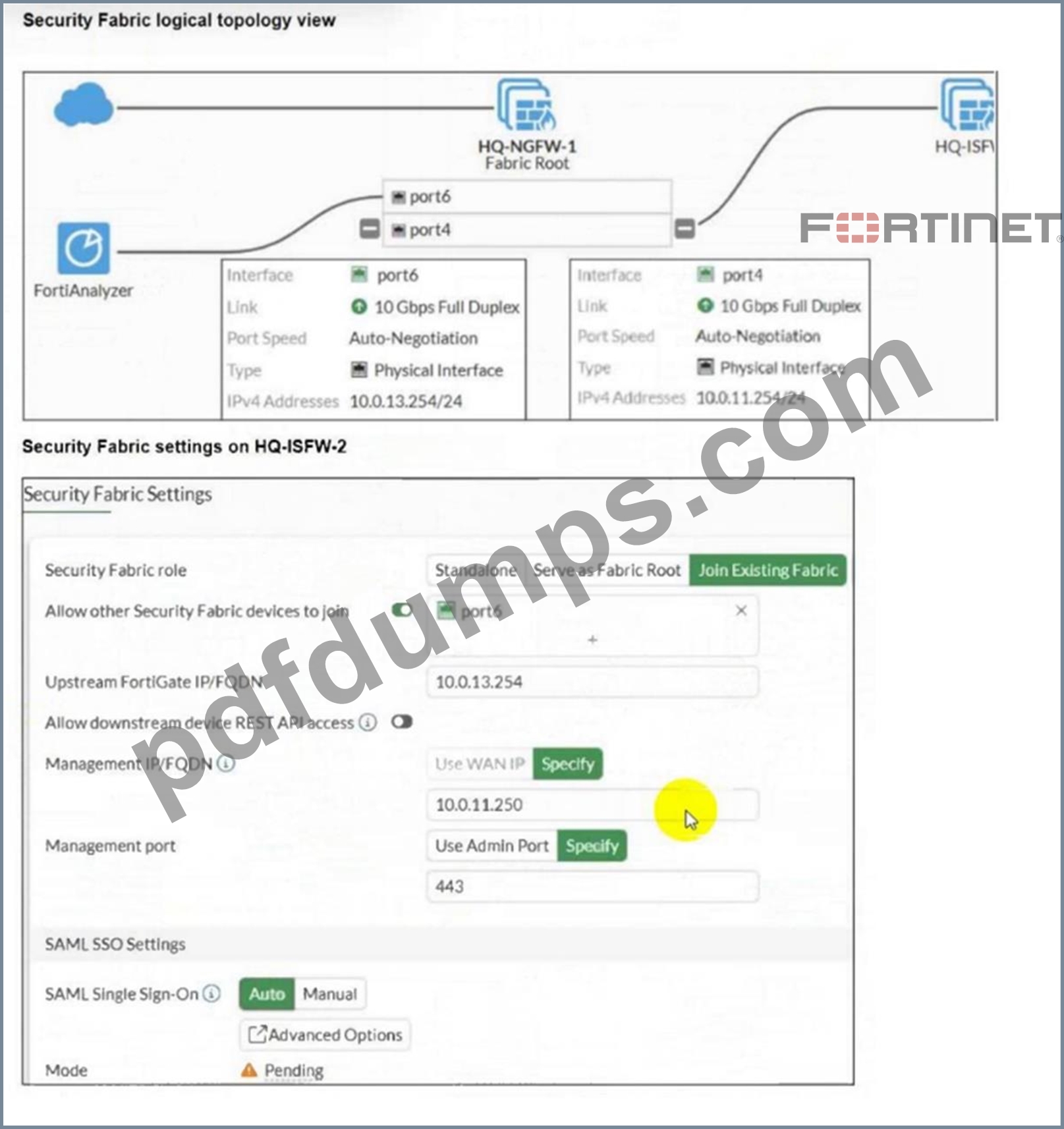
An administrator wants to add HQ-ISFW-2 in the Security Fabric. HQ-ISFW-2 is in the same subnet as HQ-ISFW. After configuring the Security Fabric settings on HQ-ISFW-2, the status stays Pending.
What can be the two possible reasons? (Choose two.)
- A. SAML Single Sign-On must be set to Manual.
- B. HQ-ISFW-2 must be authorized on HQ-ISFW.
- C. Management IP must be set to 10.0.13.254.
- D. Upstream FortiGate IP must be set to 10.0.11.254.
Answer: B,D
Explanation:
The Upstream FortiGate IP should match the IP address of the Fabric Root interface, which is 10.0.11.254, not 10.0.13.254.
The new device (HQ-ISFW-2) must be authorized on the Fabric Root (HQ-ISFW) before it can join the Security Fabric, otherwise the status remains pending.
NEW QUESTION # 30
A network administrator enabled antivirus and selected an SSL inspection profile on a firewall policy.
When downloading an EICAR test file through HTTP, FortiGate detects the virus and blocks the file. When downloading the same file through HTTPS, FortiGate does not detect the virus and does not block the file, allowing it to be downloaded.
The administrator confirms that the traffic matches the configured firewall policy.
What are two reasons for the failed virus detection by FortiGate? (Choose two.)
- A. The El CAR test file exceeds the protocol options oversize limit.
- B. The browser does not trust the FortiGate self-signed CA certificate.
- C. The selected SSL inspection profile has certificate inspection enabled.
- D. The website is exempted from SSL inspection.
Answer: B,D
NEW QUESTION # 31
Refer to the exhibits.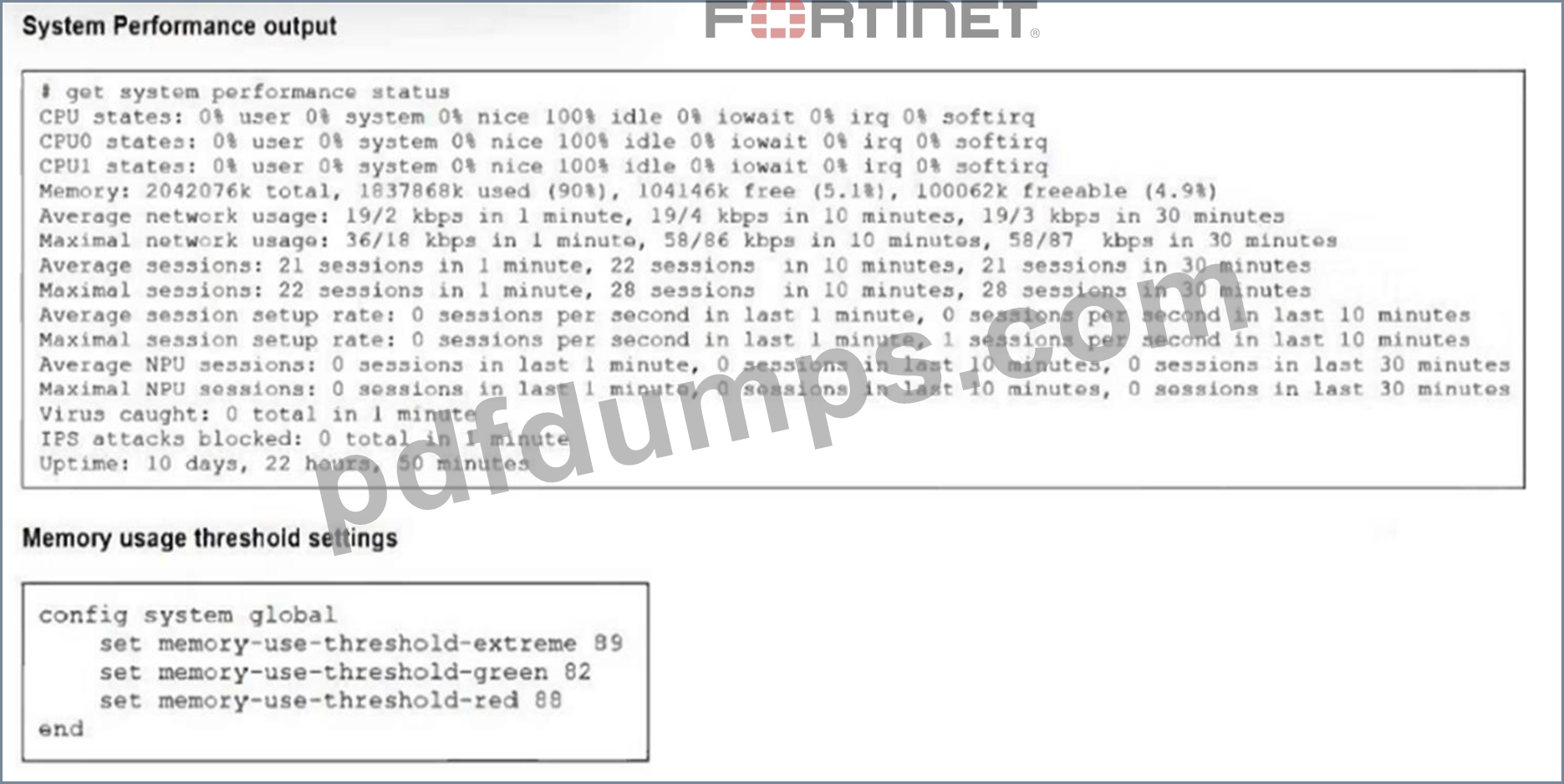
The exhibits show the system performance output and default configuration of high memory usage thresholds on a FortiGate device.
Based on the system performance output, what are the two possible outcomes? (Choose two.)
- A. Administrators can change the configuration.
- B. Administrators can access FortiGate only through the console port.
- C. FortiGate has entered conserve mode.
- D. FortiGate drops new sessions.
Answer: A,D
Explanation:
Since memory usage is at 90%, exceeding the red threshold (88%), FortiGate enters a state where configuration changes are still allowed.
In this state, FortiGate drops new sessions to preserve resources and maintain stability.
NEW QUESTION # 32
Refer to the exhibit.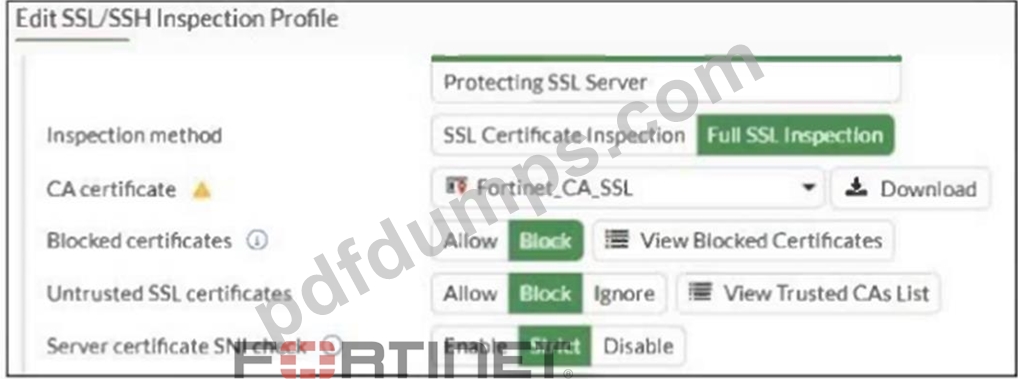
What would be the impact of these settings on the Server certificate SNI check configuration on FortiGate?
- A. FortiGate will close the connection if the SNI does not match the CN and SAN fields
- B. FortiGate will accept the connection with a warning if the SNI does not match the CN or SAN fields.
- C. FortiGate will close the connection if the SNI does not match the CN or SAN fields.
- D. FortiGate will accept and use the CN in the server certificate for URL filtering if the SNI does not match the CN or SAN fields.
Answer: A
Explanation:
With the Server certificate SNI check set to Strict, FortiGate enforces that the SNI must match either the Common Name (CN) or Subject Alternative Name (SAN) in the server certificate; otherwise, it closes the connection.
NEW QUESTION # 33
Refer to the exhibit.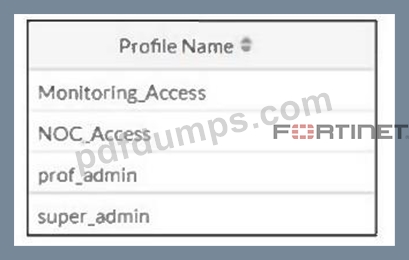
The NOC team connects to the FortiGate GUI with the NOC_Access admin profile. They request that their GUI sessions do not disconnect too early during inactivity.
What must the administrator configure to answer this specific request from the NOC team?
- A. Move NOC_Access to the top of the list to ensure all profile settings take effect.
- B. Increase the offline value of the Override Idle Timeout parameter in the NOC_Access admin profile.
- C. Ensure that all NOC_Access users are assigned the super_admin role to guarantee access
- D. Increase the admintimeout value under config system accprofile NOC_Access.
Answer: D
Explanation:
The admintimeout setting in the admin access profile controls the inactivity timeout for GUI sessions. Increasing this value will extend the session duration before automatic disconnection.
NEW QUESTION # 34
......
The Best Fortinet FCP_FGT_AD-7.6 Study Guides and Dumps of 2025: https://actualtorrent.pdfdumps.com/FCP_FGT_AD-7.6-valid-exam.html