


[Dec 06, 2025] Powerful CTFL_Syll_4.0 PDF Dumps for CTFL_Syll_4.0 Questions
Authentic CTFL_Syll_4.0 Dumps - Free PDF Questions to Pass
NEW QUESTION # 67
Consider the following table, which contains information about test cases from the test management system: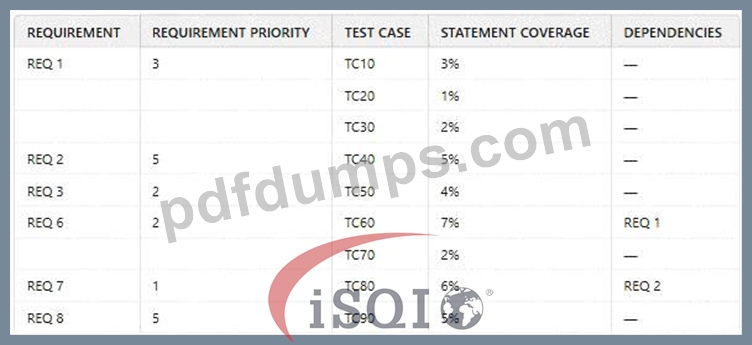
Which ONE of the following optionsorganizes the test cases based on the statement coverage strategy, while considering practical constraints?
- A. {TC 80; TC 70; TC 50; TC 60; TC 20; TC 30; TC 10; TC 40; TC 90}
- B. {TC 20; TC 30; TC 10; TC 40; TC 50; TC 70; TC 60; TC 80; TC 90}
- C. {TC 60; TC 80; TC 40; TC 90; TC 50; TC 10; TC 70; TC 30; TC 20}
- D. {TC 10; TC 30; TC 20; TC 60; TC 40; TC 80; TC 90; TC 50; TC 70}
Answer: C
Explanation:
Statement coverage strategyprioritizestest cases with higher statement coverage first, whileresolving dependenciesbefore execution.
* TC60 (7%)has thehighest coveragebutdepends on REQ 1, so it should be executedafter its dependency is covered.
* TC80 (6%)depends onREQ 2, so it should be prioritizedafter TC40 (REQ 2).
* TC40 (5%)andTC90 (5%)should be executed early.
* Lower coverage test cases (TC10, TC70, TC30, TC20) should come last.
Thus, the correct order is{TC 60; TC 80; TC 40; TC 90; TC 50; TC 10; TC 70; TC 30; TC 20} (D).
NEW QUESTION # 68
Which ONE of the following statements would you expect to be the MOST DIRECT advantage of the whole- team approach?
- A. Avoiding requirements misunderstandings that may not have been detected until dynamic testing when they are more expensive to fix.
- B. Capitalizing on the combined skills of business representatives, testers, and developers working together to contribute to project success.
- C. Reducing the involvement of business representatives because of enhanced communication and collaboration between testers and developers.
- D. Having an automated build and test process, at least once a day, that detects integration errors early and quickly.
Answer: B
Explanation:
The whole-team approach promotes collaboration among stakeholders (business representatives, developers, and testers) to ensure better quality and project success (A). This approach allows for early identification of issues, enhances shared responsibility, and improves software quality. Option C is a valid but indirect benefit, while options B and D do not directly describe the core advantage of the whole-team approach.
NEW QUESTION # 69
Which ONE of the following options explains a benefit of independent testing the BEST?
- A. The testers can be isolated from the development team and thus avoid acquiring the same bias as the developers.
- B. Developers may lose a sense of responsibility for the quality of the product they develop.
- C. Independent testers are likely to recognize different types of failures compared to developers.
- D. Independent testers may lack information regarding the test object.
Answer: C
Explanation:
Independent testers provide a fresh perspective and are more likely to identify failures that developers might overlook due to their familiarity with the software (C). Independent testing helps avoid cognitive biases, improves defect detection, and enhances the overall quality assurance process. While A and D touch on related concepts, they do not directly define the benefit as well as C does. Option B highlights a potential challenge rather than a benefit.
NEW QUESTION # 70
Which of the following is a typical potential risk of using test automation tools?
- A. Reduced feedback times regarding software quality compared to manual testing
- B. Underestimation of effort required to maintain test scripts
- C. Reduced test execution times compared to manual testing
- D. Reduced repeatability and consistency of tests compared to manual testing
Answer: B
Explanation:
One of the typical potential risks associated with using test automation tools is the underestimation of the effort required to maintain test scripts. While test automation can reduce test execution times and provide more consistent and repeatable tests compared to manual testing, maintaining test scripts can be labor-intensive and often requires significant effort. Changes in the application under test can lead to frequent updates in the test scripts to keep them functional and relevant.
References:
* ISTQB CTFL Syllabus V4.0, Section 6.2 on the benefits and risks of test automation tools
* The syllabus outlines that while automation can improve efficiency, it also introduces maintenance challenges.
NEW QUESTION # 71
Confirmation testing is performed after:
- A. a failed test, and aims to run that test again to confirm that the same behavior still occurs and thus appears to be reproducible
- B. a defect is fixed, and if such testing is successful then the regression tests that are relevant for such fix can be executed
- C. the execution of an automated regression test suite to confirm the absence of false positives in the test results
- D. a defect is fixed and after other tests do not find any side-effect introduced in the software as a result of such fix
Answer: B
Explanation:
Confirmation testing is performed after a defect is fixed, and if such testing is successful then the regression tests that are relevant for such fix can be executed. Confirmation testing, also known as re-testing, is the process of verifying that a defect has been resolved by running the test case that originally detected the defect.
Confirmation testing is usually done before regression testing, which is the process of verifying that no new defects have been introduced in the software as a result of changes or fixes. Therefore, option D is the correct answer.
References: ISTQB Certified Tester Foundation Level Syllabus v4.01, Section 2.4.1, page 28; ISTQB Glossary v4.02, page 15.
NEW QUESTION # 72
Consider the following user story about the authentication functionality of an e-commerce website:
"As a logged-in user, I want to change my current password with a new one, so that I can make my account safer".
The following are some of the acceptance criteria defined for the user story:
[a] After the logged-in user has successfully changed his password, an email confirming the change must be sent to him
[b] To successfully change the password, the logged-in user must enter the current password, enter a new valid password, and finally confirm by pressing the 'Change Password' button
[c] To be valid, the new password entered by the logged-in user is not only required to meet the criteria related to the length and type of characters, but must also be different form the last 5 passwords of that user
[d] A dedicated error message must be presented to the logged-in user when he enters a wrong current password
[e] A dedicated error message must be presented to the logged-in user when he enters the correct current password, but enters an invalid password Based only on the given information, which of the following ATDD tests is most likely to be written first?
- A. The logged-in user enters the correct current password, enters an invalid password, and finally views the dedicated error
- B. The logged-in user submits a purchase order containing ten items, selects to pay with a Visa credit card, enters credit card information of a valid card, presses the 'Confirm' button, and finally views the dedicated message confirming that the purchase has been successful
- C. The logged-in user enters a wrong current password and views the dedicated error message
- D. The logged-in user enters the correct current password, enters a valid new password (different from the last 5 passwords), presses the Change Password' button, and finally receives the e-mail confirming that the password has been successfully changed
Answer: D
Explanation:
ATDD stands for Acceptance Test-Driven Development, which is a collaborative approach to software development and testing, in which the acceptance criteria of a user story are defined and automated as executable tests before the implementation of the software system. ATDD tests are usually written in a Given-When-Then format, which describes the preconditions, the actions, and the expected outcomes of a test scenario. ATDD tests are intended to verify that the software system meets the expectations and the needs of the users and the stakeholders, as well as to provide feedback and guidance for the developers and the testers.
Based on the given information, the ATDD test that is most likely to be written first is the one that corresponds to option B, which is:
Given the logged-in user is on the Change Password page When the user enters the correct current password, enters a valid new password (different from the last 5 passwords), and presses the Change Password button Then the user receives an email confirming that the password has been successfully changed This ATDD test is most likely to be written first, because it covers the main functionality and the happy path of the user story, as well as the most important acceptance criterion [a]. It also verifies that the user can change the password with a valid new password that meets the criteria related to the length, the type of characters, and the history of the passwords, as specified in the acceptance criterion [c]. The other options are not likely to be written first, because they either cover less critical or less frequent scenarios, such as entering a wrong current password [d] or an invalid new password [e], or they are not related to the user story or the acceptance criteria at all, such as submitting a purchase order [d]. References: ISTQB Certified Tester Foundation Level (CTFL) v4.0 sources and documents:
* ISTQB Certified Tester Foundation Level Syllabus v4.0, Chapter 1.3.1, Testing in Software Development Lifecycles1
* ISTQB Glossary of Testing Terms v4.0, Acceptance Test-Driven Development, User Story, Acceptance Criterion, Given-When-Then2
NEW QUESTION # 73
A software company decides to invest in reviews of various types. The thought process they have is that each artifact needs to be reviewed using only one of the review methods depending on the criticality of the artifact.
- A. The thought process is correct. It wastes time to review same artifact using efferent review methods
- B. The thought process is incorrect. Same artifact can be reviewed using different review methods
- C. The thought process is incorrect. The whole company should adopt same standard for review of all artifacts.
- D. The thought process is correct. The whole company should decide or the review method based on their CMM level.
Answer: B
Explanation:
The thought process of the software company is incorrect, because it assumes that each artifact can be reviewed using only one review method, and that the review method depends solely on the criticality of the artifact. This is a simplistic and rigid approach that does not consider the benefits and limitations of different review methods, the context and purpose of the review, and the feedback and improvement opportunities that can be gained from multiple reviews. According to the CTFL 4.0 Syllabus, the selection of review methods should be based on several factors, such as the type and level of detail of the artifact, the availability and competence of the reviewers, the time and budget constraints, the expected defects and risks, and the desired outcomes and quality criteria. Moreover, the same artifact can be reviewed using different review methods at different stages of the development lifecycle, to ensure that the artifact meets the changing requirements, standards, and expectations of the stakeholders. For example, a requirement specification can be reviewed using an informal review method, such as a walkthrough, to get an initial feedback from the users and developers, and then using a formal review method, such as an inspection, to verify the completeness, correctness, and consistency of the specification. Therefore, the software company should adopt a more flexible and context-sensitive approach to selecting and applying review methods for different artifacts, rather than following a fixed and arbitrary rule. References = CTFL 4.0 Syllabus, Section 3.2.1, page 31-32; Section
3.2.2, page 33-34; Section 3.2.3, page 35-36.
NEW QUESTION # 74
Which ONE of the following options is NOT a test objective?
- A. Validating whether the test object is complete and works as expected by the stakeholders
- B. Triggering failures and finding defects
- C. Finding errors
- D. Verifying whether specified requirements have been fulfilled
Answer: C
Explanation:
The primary objectives of testing, as outlined in the ISTQB CTFL v4.0 syllabus, include verifying whether specified requirements are met (A), detecting failures and defects (B), and validating that the test object functions as expected (D). However, "finding errors" (C) is not a direct objective. Errors result from human mistakes, but testing primarily identifies defects, which are flaws in the system that cause failures. Testing aims to reveal defects rather than directly identify errors in the code.
NEW QUESTION # 75
The following rules determine the annual bonus to be paid to a salesman of a company based on the total annual amount of the sales made (referred to as TAS).
If the TAS is between 50k€ and 80k€, the bonus is 10%. If the TAS exceeds 80k€ by a value not greater than
40k€, the bonus is 15%. Finally, if the TAS
exceeds the maximum threshold which entitles to a 15% bonus, the bonus is 22%.
Consider applying equivalence partitioning to the TAS (Note: 1k€ = 1000 euros).
Which one of the following answers contain only test cases that belong to the same equivalence partition?
- A. TC1 = 79k€; TC2= 80k€; TC3=81k€; TC4=82k€
- B. TC1 = 90k€; TC2= 110k€; TC3=125k€: TC4=140k€
- C. TC1 = 81 k€; TC2= 97k€; TC3=111k€; TC4=118k€
- D. TC1 = 40k€; TC2= 46k€; TC3=51k€; TC4=53k€
Answer: C
Explanation:
This answer is correct because equivalence partitioning is a test design technique that divides the input domain of a system or component into partitions of equivalent data, such that each partition is expected to produce the same output or behavior. Equivalence partitioning aims to reduce the number of test cases by selecting one representative value from each partition. In this case, the input domain of the TAS can be divided into four partitions based on the bonus rules: less than 50k€, between 50k€ and 80k€, between 80k€ and 120k€, and more than 120k€. The test cases in the answer belong to the same partition, which is between 80k€ and 120k€, and they are expected to produce the same output, which is a bonus of 15%. References: ISTQB Glossary of Testing Terms v4.0, ISTQB Foundation Level Syllabus v4.0, Section 2.3.2.1
NEW QUESTION # 76
Which ONE of the following tools would be MOST SUITABLE for facilitating thecreation of test cases, test data, and test procedures?
- A. Test execution and coverage toolsfacilitate the automated execution of tests and the measurement of test coverage.
- B. DevOps tools, as they support the automated build process and CI/CD.
- C. Static testing toolsas they assist the tester in conducting reviews and static analysis.
- D. Test design and implementation toolsare specifically designed for creating test cases, test data, and test procedures.
Answer: D
Explanation:
The correct tool forcreating test cases, test data, and test proceduresis atest design and implementation tool (A).
* (B) is incorrectas static testing tools focus oncode analysis, not test case creation.
* (C) is incorrectbecause DevOps tools manageautomation pipelines, not test design.
* (D) is incorrectbecause test execution tools focus onrunning tests rather than designing them.
Test design tools helpoptimize test coverage, reduce redundancy, and improve efficiency.
Reference:ISTQB CTFL v4.0 Syllabus, Section 6.1 - Test Design Tools
NEW QUESTION # 77
The following 4 equivalence classes are given:
Which of the following alternatives includes correct test values for x. based on equivalence partitioning?
- A. -99; 99:101; 1001
- B. -1000; -100; 100; 1000
- C. -100; 100:1000; 1001
- D. -500; 0; 100; 1000
Answer: B
Explanation:
* The question is about selecting the correct test values for x based on equivalence partitioning.
Equivalence partitioning is a software test design technique that divides the input data of a software unit into partitions of equivalent data from which test cases can be derived. In this case, the given equivalence classes are:
* (x \leq -100)
* (-100 < x < 100)
* (100 \leq x < 1000)
* (x \geq 1000)
Option D provides a value from each of these partitions:
* For (x \leq -100), it gives -1000.
* For (-100 < x < 100), it gives -100 and 100.
* For (100 \leq x < 1000), it gives 500.
* For (x \geq 1000), it gives 1500.
So, option D covers all four given equivalence classes with appropriate values.
References: ISTQB Certified Tester Foundation Level (CTFL) v4.0 documents available at ISTQB and ASTQB.
* 1: ISTQB Foundation Level Syllabus 2018, Version 4.0, p. 38
* 2: ISTQB Foundation Level Syllabus 2018, Version 4.0, p. 39
* : ISTQB Foundation Level Syllabus 2018, Version 4.0, p. 40
NEW QUESTION # 78
You are working on creating test cases for a user story -
As a customer, I want to be able to book an ISTQB exam for a particular date, so that I can find choose my time slot and pay the correct amount, including discounts, if any.
The acceptance criteria for this :
1.The dates shown should be from the current date to 2 years in future
2.Initially there should be 10 timeslots available for each day, 1 hour each, starting at 8 AM GMT
3.Maximum 5 persons should be able to select a time slot after which that time slot should become unavailable
4.First timeslot should have a 10% discount.
Which of the following is the BEST example of a test case for this user story?
- A. Logon to the site. Book an exam for the current date. Expected result: timeslots should be shown.Change the time to any other date prior to the selected date. Expected result: New slot should become visible.
- B. Logon to the site. Book 5 exams for the current date. Expected result: Exams should be booked. Book
6th timeslot for the same date. Expected result: The exam should be booked but no discount should be given. - C. Logon to the site and book an exam for the 8 AM (GMT) timeslot. Expected result: You should get
10% discounted price. Change the time to any other timeslot. Expected result: Discount should be removed - D. Logon to the site. Expected result: Default 8 AM (GMT) timeslot should be selected. Change the time to any other timeslot. Expected result: New slot should be booked
Answer: C
Explanation:
The best example of a test case for this user story should cover the acceptance criteria comprehensively.
Option A addresses the critical aspects of the acceptance criteria:
* Verifying the discount for the first timeslot (8 AM GMT) - ensuring it provides a 10% discount.
* Verifying that changing the time slot removes the discount - ensuring the discount logic is correctly applied.
This test case effectively validates the functionality related to both the discount and the ability to change time slots, which are key parts of the user story's requirements.
NEW QUESTION # 79
Consider the following simplified version of a state transition diagram that specifies the behavior of a video poker game: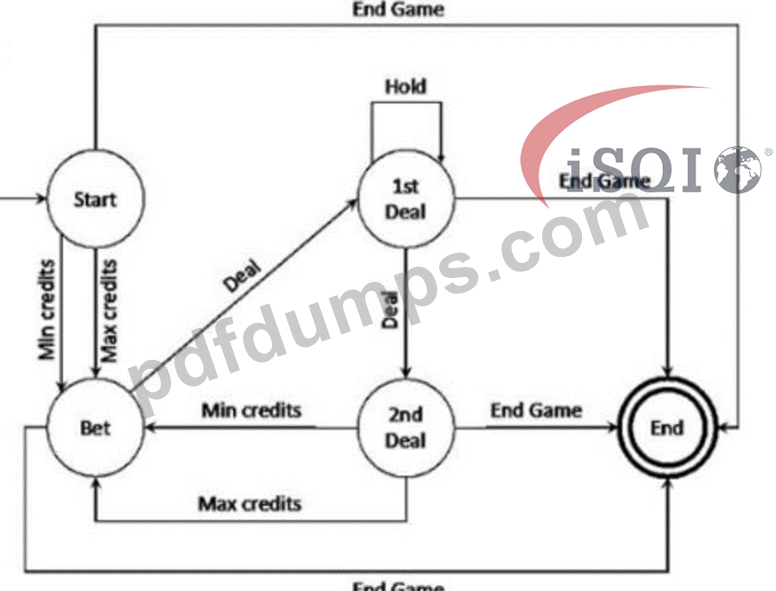
What Is the minimum number of test cases needed to cover every unique sequence of up to 3 states/2 transitions starting In the "Start" state and ending In the "End" state?
- A. 0
- B. 1
- C. 2
- D. 3
Answer: A
Explanation:
The minimum number of test cases needed to cover every unique sequence of up to 3 states/2 transitions starting in the "Start" state and ending in the "End" state is 4. This is because there are 4 unique sequences of up to 3 states/2 transitions starting in the "Start" state and ending in the "End" state:
* Start -> Bet -> End
* Start -> Deal -> End
* Start -> 1st Deal -> End
* Start -> 2nd Deal -> End References: ISTQB Certified Tester Foundation Level (CTFL) v4.0 sources and documents.
NEW QUESTION # 80
Which ONE of the following options identifies the perspectives through which acollective authorship processgenerates a shared vision of user stories?
- A. Product owner, development, and testing
- B. Business, architecture, and testing
- C. Business, development, and testing
- D. Business, development, and acceptance testing
Answer: C
Explanation:
Business, development, and testing (C)are the three key perspectives inagile user story refinement:
* Business (Product Owner, Stakeholders)- Ensures the story aligns with user needs and business goals.
* Development (Developers)- Provides insights on feasibility and technical constraints.
* Testing (Testers, QA)- Ensures testability, acceptance criteria, and risk identification.
* (A) is incorrectbecause the product owner is part of business stakeholders.
* (B) is incorrectbecause architecture is part of development, but not the primary driver of user stories.
* (D) is incorrectbecauseacceptance testing is a process, not a stakeholder group.
Across-functional team collaborationensureswell-defined, testable, and feasibleuser stories.
NEW QUESTION # 81
Which ONE of the following activities TYPICALLY belongs to the planning phase of the review process?
- A. Each reviewer conducts an individual review to identify anomalies, recommendations, and questions.
- B. The purpose and scope of the review are defined, as well as the work product to be reviewed and the exit criteria.
- C. A separate defect report is created for each identified defect so that corrective actions can be tracked.
- D. The reviewers analyze and discuss the anomalies found during the review in a joint meeting.
Answer: B
Explanation:
Theplanning phase of the review process(C) includes defining thereview's purpose, scope, and exit criteriato ensure alignment.Option Ais part of the defect management phase,Bhappens during individual preparation, andDtakes place in the review meeting.
NEW QUESTION # 82
You are a tester working on a critical project. Based on the risk analysis you need to decide on the order of test execution. Which of the following lists the correct sequence of test execution? Priority 1 is the highest and Priority 3 is the lowest priority.
Test CasePriorityDependencies
Test A3-
Test B1TestD
TestC2Test A
Test D3*
- A. C-B-A-D
- B. D-C- B-A
- C. D-B-A-C
- D. D-A-B-C
Answer: C
Explanation:
When deciding on the order of test execution based on priorities and dependencies, the correct sequence should consider both the priority levels and any dependencies between test cases. Here's the analysis:
* Test B has the highest priority (1) and depends on Test D.
* Test D should be executed before Test B.
* Test C has a medium priority (2) and depends on Test A.
* Test A can be executed at any time since it has no dependencies.
Considering these dependencies and priorities, Test D should be executed first, followed by Test B. After that, Test A and finally Test C. Therefore, the correct sequence is D-B-A-C.
NEW QUESTION # 83
The following 4 equivalence classes are given: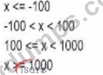
Which of the following alternatives includes correct test values for x. based on equivalence partitioning?
- A. -99; 99:101; 1001
- B. -1000; -100; 100; 1000
- C. -100; 100:1000; 1001
- D. -500; 0; 100; 1000
Answer: B
Explanation:
* The question is about selecting the correct test values for x based on equivalence partitioning.
Equivalence partitioning is a software test design technique that divides the input data of a software unit into partitions of equivalent data from which test cases can be derived. In this case, the given equivalence classes are:
* (x \leq -100)
* (-100 < x < 100)
* (100 \leq x < 1000)
* (x \geq 1000)
Option D provides a value from each of these partitions:
* For (x \leq -100), it gives -1000.
* For (-100 < x < 100), it gives -100 and 100.
* For (100 \leq x < 1000), it gives 500.
* For (x \geq 1000), it gives 1500.
So, option D covers all four given equivalence classes with appropriate values.
References: ISTQB Certified Tester Foundation Level (CTFL) v4.0 documents available at ISTQB and ASTQB.
1: ISTQB Foundation Level Syllabus 2018, Version 4.0, p. 38
2: ISTQB Foundation Level Syllabus 2018, Version 4.0, p. 39
3: ISTQB Foundation Level Syllabus 2018, Version 4.0, p. 40
NEW QUESTION # 84
......
Guaranteed Accomplishment with Newest Dec-2025 FREE: https://actualtorrent.pdfdumps.com/CTFL_Syll_4.0-valid-exam.html