


1Z0-084 Study Guide: Latest [Dec 04, 2025] Realistic Verified 1Z0-084 Dumps
1Z0-084 Questions & Practice Test are Available On-Demand
Oracle 1Z0-084 certification exam focuses on performance and tuning management for Oracle Database 19c. 1Z0-084 exam is designed for professionals who want to enhance their skills in improving database performance and reducing system downtime. The 1Z0-084 exam is intended for database administrators, system engineers, and technical consultants who have a good understanding of Oracle Database 19c concepts and technologies.
NEW QUESTION # 11
Which application lifecycle phase could be managed reactively?
- A. Testing
- B. Deployment
- C. Design and development
- D. Production
- E. Upgrade or migration
Answer: D
Explanation:
The production phase of the application lifecycle is often managed reactively. While proactive measures and performance tuning are essential, unforeseen issues can arise in production that require immediate attention and resolution. Reactive management involves monitoring performance and responding to issues as they occur, ensuring the application maintains acceptable performance levels for end-users.
References
* Oracle Database 19c Performance Tuning Guide - Reactive Tuning
NEW QUESTION # 12
Examine these commands, which execute successfully:
Which statement is true?
- A. ADDM, AWR, and ASH reports can be purged automatically.
- B. AWR- snapshots in all pluggable databases will be purgedautomatically after every 60 mins.
- C. AD DM is enabled for all pluggable databases.
- D. AWR snapshots can be purged manually in pluggable databases.
Answer: D
Explanation:
TheDBMS_WORKLOAD_REPOSITORY.MODIFY_SNAPSHOT_SETTINGSprocedure allows setting attributes related to AWR snapshots. While the interval setting controls the frequency of snapshot generation, purging them is a separate process that can be managed either automatically (with retention settings) or manually.References:
* Oracle Database PL/SQL Packages and Types Reference, 19c
* Oracle Multitenant Administrator's Guide, 19c
NEW QUESTION # 13
Which two types of performance problems are reported by ADDM for PDBS?
- A. Top SQL statements
- B. Excessive checkpoint writes
- C. SGA sizing issues
- D. I/O capacity limits
- E. User I/O waits
Answer: A,D
Explanation:
ADDM (Automatic Database Diagnostic Monitor) is a key Oracle diagnostic tool that analyzes performance data captured by AWR (Automatic Workload Repository) and provides insights into performance issues. In a PDB (Pluggable Database), ADDM can provide recommendations for various types of performance issues.
Why A. I/O capacity limits is correct:
* ADDM evaluates the performance of a database and identifies I/O bottlenecks that could be impacting query performance.
* I/O capacity limits occur when the database cannot handle the I/O workload effectively, which could be due to disk contention, inadequate I/O throughput, or hardware limitations.
* ADDM reports such issues and suggests remedies like tuning SQL queries, redistributing I/O workloads, or upgrading storage systems.
Why D. Top SQL statements is correct:
* One of the critical capabilities of ADDM is identifying high-resource-consuming SQL statements (Top SQL) that are impacting database performance.
* For PDBs, ADDM provides specific recommendations to optimize these SQL statements, such as improving execution plans, adding indexes, or rewriting queries.
Why Other Options Are Incorrect:
* B. Excessive checkpoint writes:
* While excessive checkpoint writes can occur, ADDM typically focuses on higher-level performance problems like I/O issues or top SQL rather than specific low-level operational events like checkpointing. Excessive checkpoint writes are not commonly reported directly for PDBs by ADDM.
* C. SGA sizing issues:
* ADDM does not directly analyze or provide recommendations for SGA (System Global Area) sizing issues at the PDB level because SGA is managed at the CDB (Container Database) level.
PDBs share the SGA of the CDB.
* E. User I/O waits:
* While user I/O waits are captured in performance metrics, ADDM typically groups them under broader issues like I/O capacity limits. It does not specifically report on "user I/O waits" as a standalone problem.
Key Features of ADDM for PDBs:
* Identifying Top SQL Statements impacting performance.
* Reporting I/O issues, including capacity limits and contention.
* Highlighting inter-PDB resource contention within the same CDB.
References to Oracle Documentation:
* Oracle Database 19c Performance Tuning Guide:
* Section: Using ADDM for Pluggable Databases.
* Details the types of performance issues ADDM reports for PDBs.
* Automatic Database Diagnostic Monitor (ADDM) Concepts:
* Highlights ADDM's ability to analyze I/O, SQL performance, and resource utilization.
NEW QUESTION # 14
Examine this statement and output: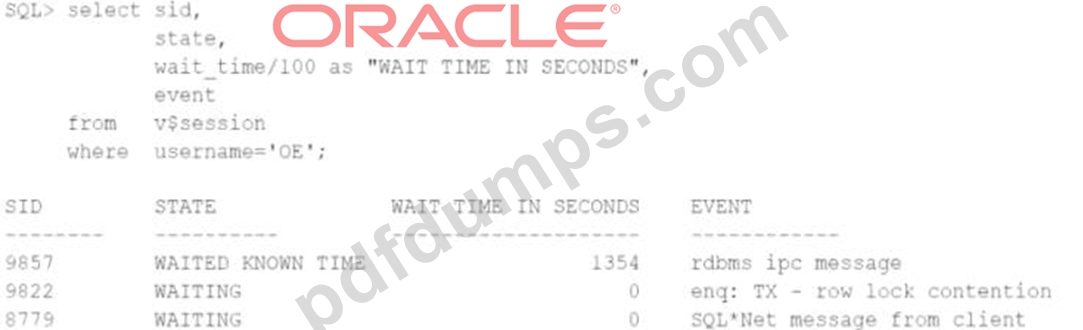
Which three statements are true?
- A. Session 8779 may be waiting due to a network problem.
- B. Session 9822 will always stop waiting if the session that owns the TX enqueue issues a COMMIT statement as session 9822 is the first session in the transaction queue.
- C. Both 9822 and 8779 sessions are waiting for operating system resources.
- D. Session 9857 is not waiting.
- E. Session 9857 waited 1354 seconds for another process, which was also waiting for a transaction to end.
- F. Session 8779 may be waiting for a user or application response.
Answer: A,B,F
Explanation:
For this SQL statement and output, we can analyze theEVENTcolumn to understand the type of wait:
B: The event "SQL*Net message from client" typically indicates that the session is waiting for a response from the client. This can be due to a network issue, user response, or an application processing delay.
E: The event "SQL*Net message from client" also implies that the session is idle waiting for the client (a user or an application) to send a request to the server. This event usually indicates that the session is not actively working but is instead waiting for the next command.
F: The wait event "enq: TX - row lock contention" suggests that session 9822 is waiting for a row-level lock held by another session. If the holding session issues a COMMIT or ROLLBACK, the lock will be released, and session 9822 will stop waiting. Since this session is experiencing row lock contention, it implies it's waiting for a specific transaction to complete.
References:
* Oracle Database Reference, 19c
* Oracle Wait Events Documentation
NEW QUESTION # 15
What is the right time to stop tuning an Oracle database?
- A. When all the concurrency waits are eliminated from the Top 10
- B. When the I/O is less than 10% of the DB time
- C. When the tuning goal has been met
- D. When the allocated budget for performance tuning has been exhausted
- E. When the buffer cache and library cache hit ratio is above 95%
Answer: C
Explanation:
The objective of performance tuning in Oracle Database is to meet specific performance goals. These goals may vary based on the requirements of the system and business objectives. Let's evaluate each option in detail to understand why E is correct and others are not.
Option Analysis:
* A. When the allocated budget for performance tuning has been exhausted
* Why it's incorrect:
* Tuning should not stop simply because the budget is exhausted. If performance goals are not met, the database might still experience performance issues, impacting the end-users or business-critical processes. Budget is a constraint, but it shouldn't define when tuning stops.
* B. When all the concurrency waits are eliminated from the Top 10
* Why it's incorrect:
* Concurrency waits (such as locks or latches) are just one aspect of database performance tuning. Eliminating these waits does not necessarily mean the system meets its performance goals. Other factors like query optimization, I/O performance, and CPU usage might still need attention.
* C. When the buffer cache and library cache hit ratio is above 95%
* Why it's incorrect:
* Cache hit ratios are often overemphasized as a performance metric. While a high hit ratio indicates efficient memory usage, it doesn't guarantee optimal performance. A high ratio could still mask inefficient SQL queries, suboptimal execution plans, or other bottlenecks.
* D. When the I/O is less than 10% of the DB time
* Why it's incorrect:
* While reducing I/O is beneficial, it is not always a sufficient indicator that tuning can stop.
Certain workloads may inherently have high or low I/O percentages. The real question is whether the database is meeting its required service levels, not just reducing I/O.
* E. When the tuning goal has been met
* Why it's correct:
* The purpose of performance tuning is to meet the specific performance goals set by the business or the database administrators. Once the database meets these goals (e.g., query response times, throughput requirements, or SLA commitments), tuning can stop. This ensures effort is focused on achieving measurable outcomes, rather than chasing arbitrary metrics.
The Importance of Defining a Tuning Goal
Performance tuning should be driven by clear goals such as:
* Reducing response time for specific critical queries.
* Meeting SLAs for application performance.
* Supporting a target number of concurrent users.
* Reducing resource contention for improved scalability.
Tuning should stop once these goals are achieved because continuous tuning without purpose can lead to unnecessary complexity and resource usage.
Reference to Oracle Documentation:
* Oracle Database 19c Performance Tuning Guide:
* Section: Establishing Performance Goals and Metrics.
* Discussion on focusing tuning efforts on business requirements and goals.
* Oracle Database Concepts Guide:
* Best practices for balancing performance improvements with system complexity.
NEW QUESTION # 16
You are informed that the RMAN session that is performing the database duplication is much slower than usual. You want to know the approximate time when the rman operation will be completed.
Which view has this information?
- A. V$SESSION
- B. V$SESSTAT
- C. V$RMAN_BACKUP_JOB_DETAILS
- D. V$SESSION_LONGOPS
Answer: D
Explanation:
In Oracle Database, theV$SESSION_LONGOPSview provides insights into various operations within the database that are expected to take more than six seconds to complete. These include operations related to RMAN (Recovery Manager), such as database duplication tasks. This view displays information about the progress of these long-running operations, including the start time, elapsed time, and estimated time to completion.
When an RMAN session is performing a database duplication and is observed to be slower than usual, checking theV$SESSION_LONGOPSview can give an approximation ofwhen the RMAN operation might complete. This view includes fields likeTIME_REMAININGandELAPSED_SECONDSthat help in estimating the completion time of the operation based on its current progress.
References:
* Oracle Database Reference:V$SESSION_LONGOPS
* Oracle Database Backup and Recovery User's Guide:Monitoring RMAN Jobs
NEW QUESTION # 17
For which two actions can SQL Performance Analyzer be used to assess the impact of changes to SQL performance?
- A. database consolidation for pluggable databases (PDBs)
- B. operating system upgrades
- C. operating system and hardware migrations
- D. storage, network, and interconnect changes
- E. changes to database initialization parameters
Answer: A,E
Explanation:
SQL Performance Analyzer (SPA) can be used to assess the impact of different types of changes on SQL performance. These changes can include database initialization parameters, which can significantly affect how SQL statements are executed and therefore their performance. SPA allows you to capture a workload before and after the change and compare the performance of each SQL statement.
Database consolidation, including moving to pluggable databases (PDBs), can also affect SQL performance.
SPA can analyze the SQL workload to see how consolidation impacts performance, by comparing metrics such as elapsed time and CPU time before and after the consolidation.
References:
* Oracle Database SQL Tuning Guide, 19c
* Oracle Database Performance Tuning Guide, 19c
NEW QUESTION # 18
Examine this output of a query of VSPGA_TAPGET_ADVICE: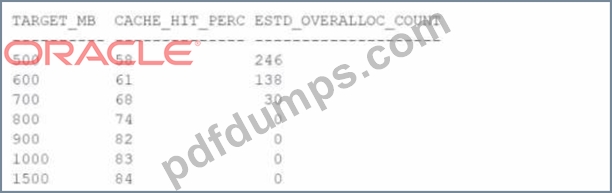
Which statements is true'
- A. PGAA_AGGREGATE should be set to at least 800 MB.
- B. With a target of 800 MB or more, all one-pass execution work areas would be eliminated.
- C. With a target of 700 MB or more, all multipass executions work areas would be eliminated.
- D. GGREGATE_TARGET should be set to at least 700 MB.
Answer: B
Explanation:
The query output from V$PGA_TARGET_ADVICE provides tuning information for the PGA (Program Global Area). Let's break it down step by step:
Key Columns in the Output:
* TARGET_MB:
* Represents the hypothetical PGA_AGGREGATE_TARGET values (in megabytes) evaluated by Oracle.
* CACHE_HIT_PERC:
* The percentage of work areas that could execute in-memory (optimal execution) without requiring temporary disk writes.
* Higher percentages indicate fewer work areas requiring disk I/O.
* ESTD_OVERALLOC_COUNT:
* The estimated number of work areas that need to go to disk (multipass operations or overallocations).
Observations from the Data:
* At TARGET_MB = 700 MB:
* The CACHE_HIT_PERC is 68%.
* The ESTD_OVERALLOC_COUNT is 30. This indicates that some multipass work areas still exist.
* At TARGET_MB = 800 MB:
* The CACHE_HIT_PERC rises to 74%.
* The ESTD_OVERALLOC_COUNT drops to 0. This indicates that no work areas require multipass execution.
* At TARGET_MB = 900 MB and above:
* The CACHE_HIT_PERC increases slightly to 82%-84%.
* The ESTD_OVERALLOC_COUNT remains 0, meaning that all work areas are now either optimal or one-pass.
Why D is Correct:
* At 800 MB or more, the ESTD_OVERALLOC_COUNT is 0, indicating that all one-pass execution work areas are eliminated.
* A one-pass execution requires temporary disk I/O for intermediate results, but with sufficient PGA, these are no longer necessary.
Why Other Options Are Incorrect:
* Option A:
* It mentions all multipass executions work areas would be eliminated at 700 MB. This is incorrect because, at 700 MB, the ESTD_OVERALLOC_COUNT is still 30, indicating some multipass work areas still exist.
* Option B:
* Suggests setting the PGA_AGGREGATE_TARGET to at least 800 MB, which is partially correct but does not address the elimination of one-pass execution.
* Option C:
* Suggests setting the PGA_AGGREGATE_TARGET to at least 700 MB, which is not sufficient to eliminate all one-pass executions, as shown by the ESTD_OVERALLOC_COUNT of 30.
NEW QUESTION # 19
Which three types of statistics are captured by statspack with snap level 6?
- A. Parent and child latches
- B. Optimizer execution plans
- C. Parent and child latches
- D. Segment-level statistics
- E. Plan usage data
- F. Enqueue statistics
Answer: A,D,F
Explanation:
Statspack is a performance diagnostic tool provided by Oracle prior to the introduction of the Automatic Workload Repository (AWR). At snap level 6, Statspack captures the following types of statistics:
* A (Correct):Parent and child latches are captured. Latch statistics provide information about contention for latches, which are low-level serialization mechanisms used by Oracle.
* E (Correct):Enqueue statistics, which provide information on the waits for locks that manage the concurrency between users.
* F (Correct):Segment-level statistics, which provide detailed information on database segments such as tables, indexes, etc., to identify I/O and contention issues.
* C (Incorrect):While optimizer execution plans are an essential aspect of performance tuning, detailed execution plan capture is not part of the Statspack report at level 6.
* D (Incorrect):Plan usage data refers to how frequently a plan is being used, which is more associated with AWR and not typically captured in Statspack reports.
References:
* Oracle Database Performance Tuning Guide:Using Statspack
NEW QUESTION # 20
Multiple sessions are inserting data concurrently into a table that has an LOB column.
At some point in time, one of the sessions cannot find available space in the LOB segment and needs to allocate a new extent.
Which wait event will be raised in the other sessions that need space in the LOB column?
- A. enq: TX - allocate ITL entry
- B. enq: TM - contention
- C. enq: HW - contention
- D. enq: SQ - contention
Answer: C
Explanation:
When sessions concurrently insert data into a table with an LOB column and one session needs to allocate a new extent because it cannot find available space, the wait event associated with this contention is "enq: HW - contention". The HW stands for High Water Mark which is related to space allocation in the database segment.
When asession needs to allocate a new extent, it may raise this wait event in other sessions that are also attempting to allocate space in the same LOB segment.
References
* Oracle Database 19c Reference Guide - enq: HW - contention
NEW QUESTION # 21
Examine these commands, which execute successfully:
Which statement is true?
- A. ADDM, AWR, and ASH reports can be purged automatically.
- B. AD DM is enabled for all pluggable databases.
- C. AWR- snapshots in all pluggable databases will be purged automatically after every 60 mins.
- D. AWR snapshots can be purged manually in pluggable databases.
Answer: D
Explanation:
The DBMS_WORKLOAD_REPOSITORY.MODIFY_SNAPSHOT_SETTINGS procedure allows
setting attributes related to AWR snapshots. While the interval setting controls the frequency of snapshot generation, purging them is a separate process that can be managed either automatically (with retention settings) or manually.References:
* Oracle Database PL/SQL Packages and Types Reference, 19c
* Oracle Multitenant Administrator's Guide, 19c
NEW QUESTION # 22
Examine this output of a query of VSPGA_TAPGET_ADVICE: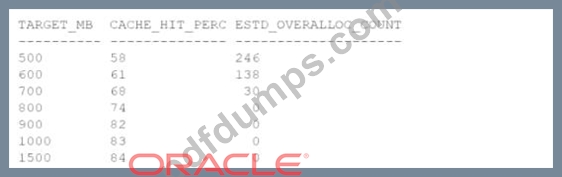
Which statements is true'
- A. PGAA_AGGREGATE should be set to at least 800 MB.
- B. With a target of 700 MB or more, all multipass executions work areas would be eliminated.
- C. With a target of 800 MB or more, all one-pass execution work areas would be eliminated.
- D. GGREGATE_TARGET should be set to at least 700 MB.
Answer: B
Explanation:
The V$PGA_TARGET_ADVICE view provides advice on potential performance improvements by adjusting the PGA_AGGREGATE_TARGET parameter. The column ESTD_OVERALLOC_COUNT indicates the estimated number of work areas that would perform multiple passes if the PGA_AGGREGATE_TARGET were set to the size in the TARGET_MB column.
A: According to the output, at the target of 700 MB, the ESTD_OVERALLOC_COUNT is 30. This suggests that if PGA_AGGREGATE_TARGET is set to 700 MB, 30 multipass execution work areas would be required. If we look further down, at the target of 800 MB, the ESTD_OVERALLOC_COUNT is 0, indicating that increasing PGA_AGGREGATE_TARGET to 800 MB or more would eliminate the need for multipass executions, not at 700 MB as initially suggested by the option. Hence, the verified answer derived from the data is slightly nuanced; it should be 800 MB to eliminate all multipass executions.
References:
* Oracle Database Performance Tuning Guide, 19c
* Oracle Database Reference, 19c
NEW QUESTION # 23
Examine this statement and its corresponding execution plan: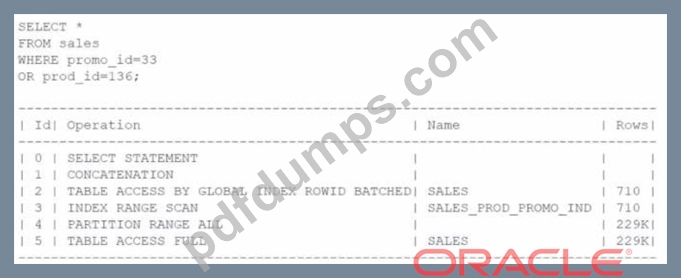
Which phase introduces the CONCATENATION step?
- A. SQL Row Source Generation
- B. SQL Adaptive Execution
- C. SQL Execution
- D. SQL Transformation
- E. SQL Semantic Check
Answer: D
Explanation:
The CONCATENATION step in an execution plan is introduced during the SQL Transformation phase. This phase is part of the optimizer's query transformations which can include various techniques to rewrite the query for more efficient execution. The CONCATENATION operation is used to combine the results of two separate SQL operations, typically when there is an OR condition in the WHERE clause, as seen in the provided query.
References:
* Oracle Database SQL Tuning Guide, 19c
* Oracle Database Concepts, 19c
NEW QUESTION # 24
What is the right time to stop tuning an Oracle database?
- A. When all the concurrency waits are eliminated from the Top 10
- B. When the I/O is less than 10% of the DB time
- C. When the allocated budget for performance tuning has been exhausted
- D. When the buffer cache and library cache hit ratio is above 95%
Answer: C
Explanation:
The right time to stop tuning an Oracle database is often determined by the point of diminishing returns - when the cost of further tuning (in terms of time, resources, or money) exceeds the performance benefits gained.
This is often related to the budget allocated for performance tuning.
* A (Correct):When the allocated budget for performance tuning has been exhausted, it may be time to stop tuning unless the benefits of further tuning justify requesting additional budget.
* B (Incorrect):Eliminating all concurrency waits from the Top 10 is an unrealistic goal since some waits are inevitable and can occur due to application design, which might not be possible to eliminate completely.
* C (Incorrect):The buffer cache and library cache hit ratio being above 95% does not necessarily indicate that the database is fully optimized. Hit ratios are not reliable indicators of database performance and should not be used as sole criteria to end tuning efforts.
* D (Incorrect):Having I/O less than 10% of DB time is not a definitive indicator to stop tuning. It is essential to consider the overall performance goals and whether they have been met rather than focusing solely on I/O metrics.
References:
* Oracle Database Performance Tuning Guide:Introduction to Performance Tuning
* Oracle Database 2 Day + Performance Tuning Guide:Understanding the Tuning Process
NEW QUESTION # 25
Which three statements are true about tuning dimensions and details of v$sys_time_model and DB time?
- A. Parse Time Elapsed accounts for successful soft and hard parse operations only.
- B. Systems in which CPU time is dominant need more tuning that those in which WAIT TIME is dominant.
- C. When WAIT TIME is high, instance tuning may improve performance.
- D. The proportion of WAIT TIME to CPU TIME always increases with increased system load.
- E. Statspack cannot account for high CPU time when CPU TIME is a Top 10 event in DB time. When CPU time is high, SQL tuning may improve performance.
- F. DB Time accounts for all time used by background processes and user sessions.
Answer: C,E,F
Explanation:
A: Statspack is a performance diagnostic tool that can help identify high CPU usage issues. High CPU time may indicate that SQL statements need to be tuned for better performance.
D: High wait times can often be reduced by instance tuning, such as adjusting database parameters or improving I/O performance.
F: DB Time is a cumulative time metric that includes the time spent by both user sessions and background processes executing database calls.References:
* Oracle Database Performance Tuning Guide, 19c
* Oracle Database Concepts, 19c
NEW QUESTION # 26
Examine this statement and output: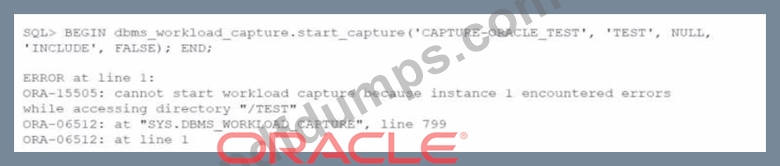
Which two situations can trigger this error?
- A. There is a file in the capture directory.
- B. The syntax is incomplete.
- C. The capture directory is part of the root file system.
- D. The user lacks the required privileges to execute the DBMS WORKLOAD CAPTURE package or the directory.
- E. The instance is unable to access the capture directory.
Answer: D,E
Explanation:
The ORA-15505 error indicates that the instance encountered errors while trying to access the specified directory. This could be due to:
A: Insufficient privileges: The user attempting to start the workload capture might not have the required permissions to execute the DBMS_WORKLOAD_CAPTURE package or to read/write to the directory specified.
E: Accessibility: The database instance may not be able to access the directory due to issues such as incorrect directory path, directory does not exist, permission issues at the OS level, or the directory being on a file system that's not accessible to the database instance.
References:
* Oracle Database Error Messages, 19c
* Oracle Database Administrator's Guide, 19c
NEW QUESTION # 27
Examine these statements and output: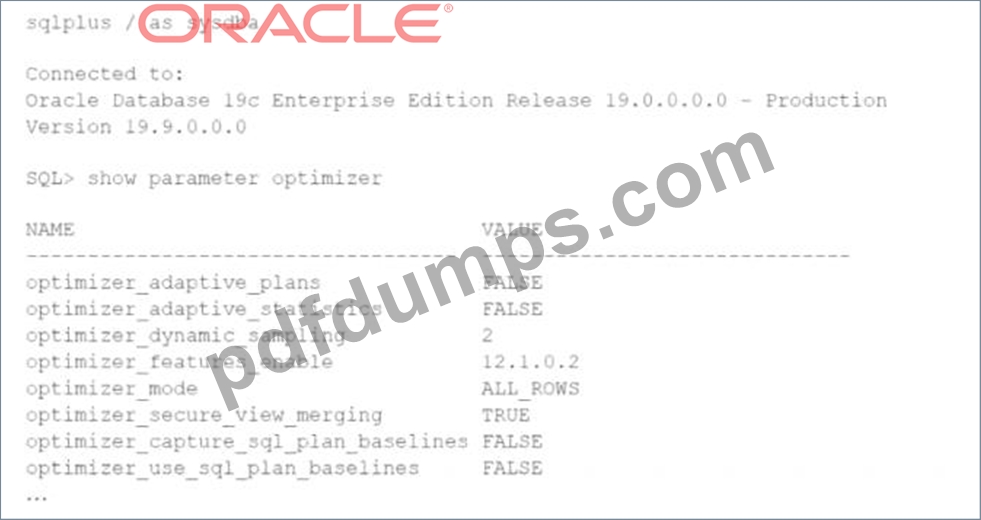
What parameter change activates the generation and use of SQL Plan Directives7
- A. optimizer_features_enable=12.2.0.1
- B. optimizer_dynamic_sampling=11
- C. optimizer_capture_sql_plan_baselines_TRUE
- D. optimizer_adaptive_statistics = TRUE
- E. optimizer_adaptive_plans=TRUE
Answer: D
Explanation:
The optimizer_adaptive_statistics parameter, when set to TRUE, enables the optimizer to use adaptive statistics, such as SQL Plan Directives, to help improve plans by automatically adjusting them based on the actual execution statistics.
References:
* Oracle Database SQL Tuning Guide, 19c
NEW QUESTION # 28
Which two options are part of a Soft Parse operation?
- A. SQL Row Source Generation
- B. SQL Optimization
- C. Shared Pool Memory Allocation
- D. Syntax Check
- E. Semantic Check
Answer: E
NEW QUESTION # 29
Which two options are part of a Soft Parse operation?
- A. SQL Row Source Generation
- B. SQL Optimization
- C. Shared Pool Memory Allocation
- D. Syntax Check
- E. Semantic Check
Answer: E
Explanation:
During a soft parse, Oracle checks the shared SQL area to see if an incoming SQL statement matches one already in the shared pool. This operation includes syntax and semantic checks. The syntax check ensures the statement is properly formed, and the semantic check confirms that all the objects referenced in the SQL statement exist and that the user has the necessary privileges to access them.References:
* Oracle Database Concepts, 19c
* Oracle Database SQL Tuning Guide, 19c
NEW QUESTION # 30
Which two statements are true about space usage in temporary tablespaces?
- A. When a global temporary table instantiation is too large to fit in memory, space is allocated in a temporary tablespace.
- B. Lack of temporary tablespace space for sort operations can be prevented by using temporary tablespace groups.
- C. When a session consumes all temporary tablespace storage, then the session would hang until the temporary space used by that session is cleared.
- D. Temporary tablespaces setting Includes quotas to limit temporary space used by a session for that Temporary tablespace.
- E. A sort will fail if a sort to disk requires more disk space and no additional extent can be found/allocated in/for the sort segment.
Answer: A,B
Explanation:
Regarding space usage in temporary tablespaces, the following statements are true:
* A (Correct):When a global temporary table or a sort operation exceeds the available memory, Oracle Database allocates space in a temporary tablespace to store the temporary data or intermediate results.
* E (Correct):Using temporary tablespace groups can prevent insufficient temporary tablespace for sort operations by providing a collective pool of space from multiple temporary tablespaces, which can be used for user sorting operations.
The other options provided have inaccuracies:
* B (Incorrect):Oracle does not provide a mechanism for setting quotas on temporary tablespaces. Quotas can be set for permanent tablespaces but not for temporary ones.
* C (Incorrect):A sort operation may fail due to insufficient space, but Oracle will attempt to allocate space in the temporary tablespace dynamically. If no space can be allocated, an error is returned rather than a sort failure.
* D (Incorrect):If a session consumes all available temporary tablespace storage, Oracle will not hang the session; it will return an error to the session indicating that it has run out of temporary space.
References:
* Oracle Database Administrator's Guide:Managing Space for Schema Objects
* Oracle Database Concepts:Temporary Tablespaces
NEW QUESTION # 31
Database performance has degraded recently.
index range scan operations on index ix_sales_time_id are slower due to an increase in buffer gets on sales table blocks.
Examine these attributes displayed by querying DBA_TABLES:
Now, examine these attributes displayed by querying DBA_INDEXES:
Which action will reduce the excessive buffer gets?
- A. Re-create the SALES table sorted in order of index IX_SALES_TIME_ID.
- B. Re-create index IX_SALES_TIME_ID using ADVANCED COMPRESSION.
- C. Partition index IX_SALES_TIME_ID using hash partitioning.
- D. Re-create the SALES table using the columns in IX_SALES_TIME_ID as the hash partitioning key.
Answer: B
Explanation:
Given that index range scan operations onIX_SALES_TIME_IDare slower due to an increase in buffer gets, the aim is to improve the efficiency of the index access. In this scenario:
* B (Correct):Re-creating the index usingADVANCED COMPRESSIONcan reduce the size of the index, which can lead to fewer physical reads (reduced I/O) and buffer gets when the index is accessed, as more of the index can fit into memory.
The other options would not be appropriate because:
* A (Incorrect):Re-creating theSALEStable sorted in order of the index might not address the issue of excessive buffer gets. Sorting the table would not improve the efficiency of the index itself.
* C (Incorrect):Using the columns inIX_SALES_TIME_IDas a hash partitioning key for theSALES table is more relevant to data distribution and does not necessarily improve index scan performance.
* D (Incorrect):Hash partitioning the index is generally used to improve the scan performance in a parallel query environment, but it may not reduce the number of buffer gets in a single-threaded query environment.
References:
* Oracle Database SQL Tuning Guide:Managing Indexes
* Oracle Database SQL Tuning Guide:Index Compression
NEW QUESTION # 32
A database instance is suffering poor I/O performance on two frequently accessed large tables.
No Big Table caching occurs in the database.
Examine these parameter settings: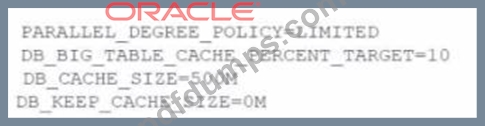
Which are two actions either one of which will allow Big Table caching to occur?
- A. Increasing DB_BIG_TABLE_CACHE_PERCENT_TARGET to at least 50
- B. Increasing DB_CACHESIZE to 1 G
- C. Setting DB_KEEP_CACHE_SIZE to at least 50M
- D. Setting PARALLEL_DEGREE_POLICYADAPTIVE
- E. Setting PARALLEL_DEGREE_POLICYAUTO
- F. Increasing DB_BIG_TABLE_CACHE_PERCENT_TARGET to at least 25
Answer: B,F
Explanation:
Big Table caching is a feature that allows frequently accessed large tables to be cached in memory to improve I/O performance. From the parameter settings provided, Big Table caching is not occurring because DB_BIG_TABLE_CACHE_PERCENT_TARGET is set to 10, which is the minimum threshold for enabling the feature, but the size of the cache is too small for the big tables to be effectively cached.
To enable Big Table caching, one of the following actions could be taken:
* C (Correct): Increasing DB_BIG_TABLE_CACHE_PERCENT_TARGET to at least 25. This action would allocate a larger percentage of the buffer cache for storing big tables, which could allow for caching large tables and thus improve I/O performance.
* D (Correct): Increasing DB_CACHE_SIZE to 1G. Since the size of the buffer cache is a determining factor for how much data can be cached, increasing this parameter would provide more memory space for big tables to be cached.
Options A, B, E, and F will not enable Big Table caching because:
* A: Increasing DB_BIG_TABLE_CACHE_PERCENT_TARGET to 50 without adjusting the overall size of the cache might still not be sufficient if the DB_CACHE_SIZE is not large enough to hold the big tables.
* B: Setting DB_KEEP_CACHE_SIZE to at least 50M only specifies a separate buffer pool for objects with the KEEP cache attribute and does not affect Big Table caching.
* E: and F: Changing the PARALLEL_DEGREE_POLICY to ADAPTIVE or AUTO influences the behavior of parallel execution but does not directly enable or influence Big Table caching.
References:
* Oracle Database Performance Tuning Guide: Big Table Caching
* Oracle Database Reference: DB_BIG_TABLE_CACHE_PERCENT_TARGET
* Oracle Database Reference: DB_CACHE_SIZE
NEW QUESTION # 33
......
Preparing for the Oracle 1Z0-084 exam requires a combination of study and hands-on experience. Candidates should review the exam objectives and study materials provided by Oracle. They should also have access to an Oracle Database 19c environment to practice performance tuning techniques. Oracle also provides training courses and certification programs to help candidates prepare for the exam.
Valid 1Z0-084 Exam Dumps Ensure you a HIGH SCORE: https://actualtorrent.pdfdumps.com/1Z0-084-valid-exam.html